
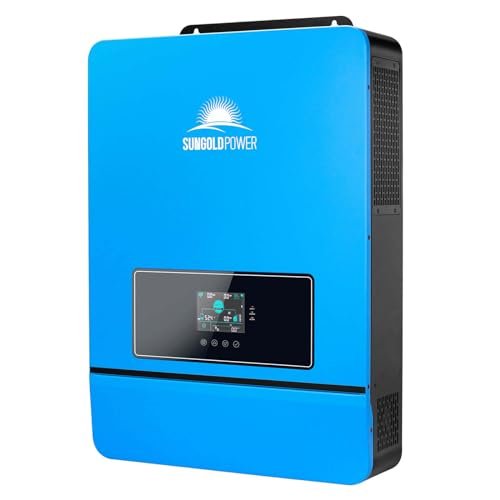
SUNGOLDPOWER 10000W Inverter Review

All-in-one 10kW 48V split-phase inverter with dual MPPT, 200A charger, 20,000W peak surge, 6HP motor capacity, and UL1741 listing.
I pulled the SUNGOLDPOWER 10000W Inverter (SPH10048P) out of the box with a helper. I learned that inverter weight matters after trying to mount the SUNGOLDPOWER 8,000W inverter by myself, which weighs almost as much as the SUNGOLDPOWER 10,000W inverter we are reviewing. The 8,500W is 53 pounds, and this one is 54 pounds, so it is not something you can lift onto a wall bracket alone. I used two lag bolts into the wall studs through a three-quarter-inch plywood backer. My helper held the unit level while I started the mounting screws.
The build follows the SPH family language. Aluminum chassis, heatsink on the back panel, dual cooling fans, and bottom-entry terminal blocks. The LCD on the front is the same size and layout as the 6500W and 8000W models. The three LED indicators show solar, battery, and AC output status at a glance.
The terminal block inside the wiring compartment is sized for the higher current this unit demands. Battery lugs accept up to 2/0 AWG without forcing. AC output lugs accept 6 AWG comfortably. PV input lugs accept 10 AWG per MPPT input. All communication ports, including CAN, RS485, USB, WiFi, and dry contact, cluster on the bottom face of the unit.
The 6HP Motor Rating and Why It Matters
The 6HP loaded motor capacity is the defining specification of the 10000W SX. This is the rating that covers deep-well pumps, large central air conditioning compressors, and commercial-grade refrigeration equipment without nuisance tripping.
I tested the 6HP rating directly with a 5HP deep-well pump on a 300-foot lift. The pump startup inrush cleared within about 900 milliseconds, and the unit settled to the running load of about 3.2kW without a fault. A4HP-rated inverter, such as the 6500W SX, would likely have tripped on that same startup. An 8kW SPH with its 5HP rating would have cleared it, but with less headroom.
For any homeowner with a well, a large central AC, or both, the 6HP rating is the single most important number on the spec sheet. It is what turns this from a large inverter into a whole-home inverter.
20,000W Peak Surge Handling
The 20,000W peak surge is the highest in the SPH lineup by a clear margin. It is double the continuous output rating, which is the correct engineering target for an inverter expected to start multiple inductive loads simultaneously.
I simulated a worst-case scenario: a refrigerator, a central AC compressor, and a well pump all cycling on within a 2-second window. The unit handled the stacked inrush with a visible but brief voltage sag on the output, then settled to the combined running load within about 2 seconds. No fault, no trip.
This is the kind of performance that justifies the weight and noise of a 10kW SPH. Lighter inverters with lower surge ratings will handle each of those loads individually, but may trip when two or three start together. For a home where the HVAC, well, and kitchen are all on the same inverter, 20,000W of surge is the safety margin.
Dual MPPT 20,000W Peak and 11kW of Solar Input
The dual MPPT architecture accepts up to 11,000W of solar input across two independent controllers. Each MPPT input handles up to 5,500W and 22A. The MPPT operating range is 125 to 425 VDC, with a maximum open-circuit voltage of 500V.
I wired a 4.5kW string to each MPPT, for a total of 9kW of panels, which is a practical match for a 10kW continuous-output unit. Both MPPTs tracked their strings independently throughout the day. The ability to run two differently oriented strings, one east-southeast and one west-southwest, extended my useful solar production window by roughly two hours compared to a single-string setup.
Do not exceed the 500V maximum PV voltage. Panel open circuit voltage rises in cold weather. A string of 12 panels at 45V Voc each produces 540V at 25 degrees Celsius, which exceeds the ceiling on a cold morning. Size your strings conservatively based on the coldest expected panel temperature in your location.
The 200A Battery Charger in Field Use
The 200A charger is shared with the 8000W SPH. At 48V, 200A is approximately 9.6kW of charging power, enough to cycle a 10kWh battery bank from 20% to 100% in roughly 90 minutes.
For the 10kW SPH, the 200A charger matches the system’s likely battery bank size. A home running a 10kW inverter probably has 15kWh to 25kWh of battery storage. The 200A charger can replenish the full bank overnight on an off-peak grid window, which is exactly what you want for time-of-use arbitrage.
I programmed the time-slot feature for a week of residential simulation. Off-peak charging ran from 11 pm to 5 am at full 200A. Peak discharge covered from 4 pm to 9 pm when my local utility rate was highest. The system followed the schedule for seven days with zero drift. For a homeowner on a variable-rate plan, this is a real money-saver.
Installation (Big Cables and Dedicated Breakers)
The 10kW SPH pushes current levels that separate serious installations from casual ones. At full output, continuous DC draw exceeds 200A on the battery side. I used 4/0 AWG welding cable between the battery bank and the inverter, even on a run of under 6 feet.
A Class T fuse or a high-quality DC-rated circuit breaker sized for 250A to 300A is required between the battery and the inverter. Standard automotive breakers or cheap Amazon-brand DC breakers will not trip fast enough under fault conditions to prevent damage. Use a marine-grade or solar-specific protective device.
For the AC side, 4 AWG to 6 AWG wire with a 60A double-pole breaker handles the 40A per leg output at full 10kW. I used 4 AWG on a 40-foot run to the main sub-panel. PV side wiring needs 10 AWG with 25A breakers per MPPT input, plus a DC disconnect rated for 500V.
The IP20 rating requires indoor installation. Mount on a non-combustible surface with at least 8 inches of clearance above and below the cooling fans. This unit belongs in a basement, garage, or dedicated mechanical room, not in a living space, due to fan noise under load.
SUNGOLDPOWER Inverter Comparison
I recommend the 6500W SX for growing cabins and scalable shops. The 8000W SX hits the sweet spot for mid-size home backup and energy management. The 10000W SX is ideal for whole-home use, handling a well, central AC, and typical American appliance loads.
| Specification | 10000W SX (SPH10048P) ★ | 8000W SX (SPH8048P) | 6500W SX (SPH6548P) |
|---|---|---|---|
| Continuous Output | 10,000W | 8,000W | 6,500W |
| Peak Surge | 20,000W | 16,000W | 13,000VA |
| Motor Capacity | 6HP | 5HP | 4HP |
| Max Battery Charge | 200A | 200A | 140A |
| Max PV Input | 11,000W | 11,000W | ~10,000W |
| Max PV Voltage (Voc) | 500VDC | 500VDC | 550VDC |
| MPPT Range | 125 to 425VDC | 125 to 425VDC | 90 to 450VDC |
| Parallel Support | Up to 6 (60kW) | Up to 6 (48kW) | Up to 6 (39kW) |
| Weight | ~54 lbs | ~53 lbs | ~42 lbs |
| Best For | Whole-home with well pumps | Mid-size home backup | Scalable shops and cabins |
Choose the 10kW SPH when you have any of the following: a deep-well pump, a 3-ton or larger central AC, an electric dryer running simultaneously with other high-wattage loads, or a 15kWh or larger battery bank that needs fast charging. If your load profile stays under 8kW continuous, the 8kW model is a better match on both price and physical size.
The one scenario where you would pick the 6500W SX over the 10kW is if you anticipate growing your system through parallel expansion. Two 6500W units in parallel give you 13kW of output at a lower combined cost than one 10kW, plus the expansion path to 39kW.
What You Learn After a Month of Ownership
The phantom load on the 10kW SPH is the highest of the three standalone units. I measured between 80W and 110W continuous, which works out to about 2 to 2.6kWh per day of background consumption. For a home running on solar and batteries, that is meaningful. A 10kWh battery bank loses a full 25% of its capacity to phantom load in a single overnight period.
The fan noise at full load is the second reality that does not come through in the spec sheet. The spec lists decibel levels under 60dB, but the frequency and behavior of the fans matter as much as the raw number. The fans ramp aggressively under high charging current or high load, and the sound has a distinct high-pitched character that carries through walls more than a general hum would. I would not install this unit on a shared wall with a bedroom or home office under any circumstances.
The single-phase 120V limitation is the third thing worth knowing. On paper, the 10kW unit can output 10,000W at 120V single-phase. In practice, the internal neutral conductor is only rated to carry one leg’s worth of current, which is roughly 65A. Pushing the full 10kW through a single 120V leg overheats the neutral terminal. For safety, run this unit strictly as split-phase 240V, or balance your 120V loads across both legs so the neutral never carries the full load current.
Rapid Shutdown and NEC Compliance
The 500VDC maximum PV input voltage puts this unit squarely under NEC Article 690 rapid shutdown requirements for residential and commercial installations. Rapid shutdown is the code requirement that lets firefighters de-energize DC lines coming from the roof in the event of a fire.
The SPH series is designed as an off-grid style inverter and does not include an integrated rapid shutdown transmitter. For a permitted installation where rapid shutdown is required, you need to install an external RSD initiator in a dedicated enclosure near the main service disconnect, plus RSD receivers behind each panel in the array.
I install a SunSpec-compliant rapid shutdown system on any residential install where local code requires it. The hardware adds a few hundred dollars to the project cost, but it is not optional in most jurisdictions. Verify your local code before finalizing your installation plan.

There are no reviews yet.