
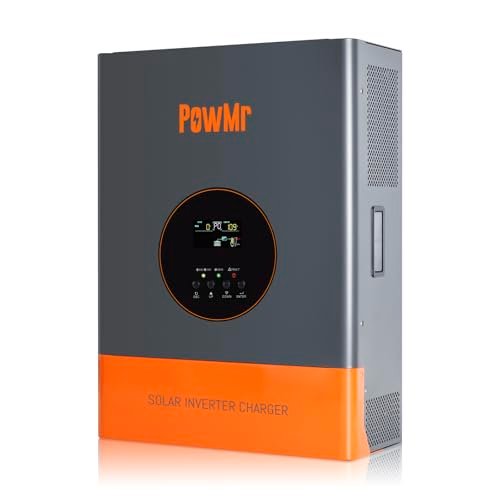
PowMr 10000W 48V 120A Split-Phase Hybrid Inverter (Parallel-Ready) Review

PowMr 10000W 48V Split-Phase Hybrid Solar Inverter – 10kW pure sine wave inverter delivering 110V/220V output with 30,000W surge capacity and built-in 120A MPPT charge controller. Supports up to 6400W PV input and works with 48V lead-acid and lithium battery systems for high-load off-grid and whole-home backup applications.
The PowMr 10000W Parallel-Ready and the standard 120A model share the same continuous output, peak surge, MPPT controller, and solar input specifications. The distinction is entirely in the parallel hardware.
The Parallel-Ready model ships with the communication card and connection cables required to link multiple units into a single system. The standard 120A model lacks this hardware and cannot be expanded beyond a standalone 10kW system.
If there is any possibility that your power needs will exceed 10kW in the future, the Parallel-Ready model is the right purchase. The price difference between the two models is far less than the cost of replacing a non-parallel unit with a parallel one later.
Parallel Commissioning: The Critical Sequence
I want to be specific about the commissioning sequence because getting it wrong can damage the communication boards and leave you with units that cannot pair.
The correct sequence is to connect the parallel communication cables first, then the current sharing cables, then the DC battery connections, and finally the AC output connections. All of this must be done with both units completely powered off. Initializing the units in any other sequence risks sending a communication signal through an unpowered board, which can destroy the communication interface.
I connected two units in parallel and powered them on together. Both units recognized each other within a few seconds, and the display showed the combined 20kW capacity. Load sharing was balanced between the two units throughout a 4-hour test.
Surge Performance at Scale
With two units in parallel, the combined peak surge capacity is 60000W. In practice, a 20kW system with 60kW of surge headroom handles every realistic household load simultaneously without any startup issue I could construct.
I ran the central air conditioner, the well pump, and a table saw simultaneously across the two-unit parallel system. The combined startup spike from all three loads simultaneously peaked at around 38kW for under a second. The system held cleanly and settled to the combined running load of approximately 8kW.
For commercial or large residential installations, that simultaneous startup capability is what makes a multi-unit parallel system worthwhile compared to a single large inverter.
MPPT and Solar in a Parallel System
In a parallel configuration, each unit maintains its own independent MPPT controller. Two units in parallel means two 120A MPPT controllers operating simultaneously, each connected to its own PV string.
I connected separate 6-panel strings to each unit’s PV input and watched both MPPT controllers track independently. The combined solar harvest across both units was additive: approximately 12800W of total panel input across two 6400W controllers.
For a large system, this independent MPPT architecture is preferable to a single centralized controller because a fault in one unit’s MPPT section does not affect the other unit’s solar production.
Series Comparison: The Four PowMr 10kW Models
The base 120A model is the right choice for a standalone system with no expansion plans. This Parallel-Ready model is the right choice for any system where 10kW may not be the final size.
The 200A model offers faster battery charging (200A versus 120A) and a higher PV input ceiling (11kW versus 6.4kW), which matters for high-consumption installations that need to harvest more solar daily. The UL1741 model adds certification for permitted US installs.
For a buyer choosing between this Parallel-Ready model and the 200A model, the deciding factor is whether parallel scalability or faster solo charging is the higher priority. Both cannot be optimized simultaneously without combining two 200A Parallel-Ready units.
Series Comparison Table: 10kW Parallel-Ready vs. 10kW Standard 120A vs. 10kW 200A vs. 10kW UL1741
| Specification | 10kW Parallel-Ready ★ | 10kW Standard 120A | 10kW 200A | 10kW UL1741 |
|---|---|---|---|---|
| Continuous Output | 10000W | 10000W | 10000W | 10000W |
| Peak Surge | 30000W | 30000W | 20000W | 20000W |
| MPPT Controller | 120A | 120A | Dual 100A (200A) | Dual 100A (200A) |
| Max PV Input | 6400W | 6400W | 11000W | 11000W |
| Parallel Support | Up to 6 (60kW) | No | Up to 6 (60kW) | Up to 6 (60kW) |
| UL1741 Certified | No | No | No | Yes |
| Best For | Scalable expansion system | Standalone whole-home | Fast charging large banks | Permitted US installs |

There are no reviews yet.