
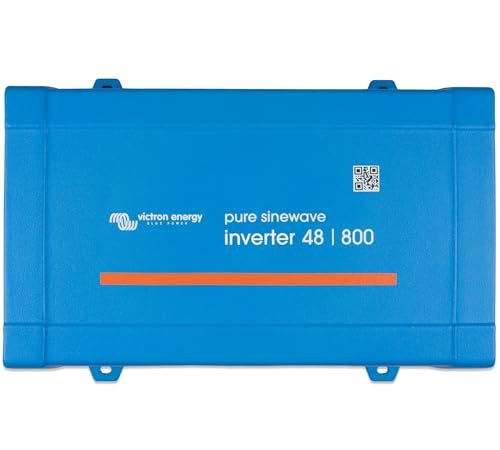
Victron Energy 48V 800VA Inverter Review

The Victron Energy 48V 800VA Inverter is the powerhouse for 48V telecommunications and remote monitoring setups. It is built for users who need to power a small server rack or a full security suite from a 48V lithium bank. The full-bridge topology makes it exceptionally short-circuit proof, protecting expensive 48V equipment from electrical faults. At 48V, the DC input current for a 700W continuous load is approximately 21 amps, a fraction of what a 12V unit at the same wattage would handle.
This is my review of the Victron Energy Phoenix 800VA 48V 120V AC Pure Sine Wave Inverter (NEMA 5-15R). It is a dependable inverter built for 48V battery systems that need efficient power delivery and lower DC draw. It produces 700W of continuous output (800VA) with a 1500W surge capacity, making it suitable for both sensitive electronics and moderate startup loads. ECO mode idle consumption is 3W, which is still efficient for a 48V model of this size.
I recommend this inverter for home backup systems, telecommunications equipment, server rooms, security systems, and remote monitoring installations where stable pure sine wave power is essential.
For a proper installation, I paired it with several Victron accessories. For monitoring and configuration, I used either the VE.Direct Bluetooth Smart Dongle for wireless phone and tablet access or the VE.Direct to USB Interface for PC setup.
For protection, I installed a Victron MIDI fuse and a matching fuse holder. This 48V model requires a 40A, 58V-rated MIDI fuse to protect the inverter and connected wiring safely.
For remote control, I added the Phoenix Inverter VE.Direct remote on/off switch panel, allowing the inverter to be operated from a more convenient location.
For wiring, I used 4 mm² (about 12 AWG) cable for runs up to 1.5 meters and 6 mm² (about 10 AWG) for runs up to 3 meters. I grounded the inverter with a minimum of 2.5 mm² to maintain safe and stable system performance.
First Look and Build Quality
I set the Victron Energy 48V 800VA on my bench next to the 24V 800VA. The external housing is the large aluminum chassis used across the 800VA to 1200VA range, identical in size and finish to the lower voltage equivalents. The internal power stage is configured for 48V, which means the DC input connectors accept a thinner cable than either the 12V or 24V versions at the same output wattage. At 48V and 700W continuous, the peak input current is approximately 21 amps. I used 12 AWG cable for the test installation without any concern about voltage drop.
The terminal block accepts 12 AWG cable easily. The 40A MIDI Fuse required for this model is modest compared to the 125A and 200A fuses the 12V models require at comparable wattage. I installed the fuse holder within 300mm of the positive terminal on my 48V test bank and confirmed the fuse seated correctly before powering on.
I connected the VE.Direct Bluetooth Dongle and pair it with VictronConnect. The app showed the 48V input voltage from my test bank, the 0W output at idle, and the ECO mode status. I then connected a test load of a small network-attached storage device, drawing 45W. The unit detected the load cleanly in ECO mode and powered on within the 2.5-second detection interval.
What Is in the Box
The package includes the inverter and a manual. No battery cables are provided. For this unit, the cable requirements are the lightest in the Phoenix lineup at comparable wattage. I sourced 12 AWG wire for the test installation. The 40A MIDI Fuse and fuse holder were purchased separately. The Phoenix Inverter Control VE.Direct remote panel completed the installation, giving a physical on/off switch at the equipment rack level.
Outputs and Features
The 48V 800VA delivers 700W continuously and a 1500W peak surge. For a server or security system application, 700W is sufficient to run multiple network devices, a small uninterruptible power supply for a router, hard drives, and surveillance cameras simultaneously. The 1500W surge handles the startup demands of drives spinning up and network switches initializing.
ECO mode idle draw is 3W, the highest among the Phoenix models reviewed here. That reflects the higher-voltage internal architecture. For a remote monitoring installation where the inverter runs 24 hours a day, the 3W idle adds approximately 72Wh per day. On a well-sized 48V battery bank, that is manageable. For an installation with a very tight energy budget, sizing the bank to include the inverter idle draw in the daily load calculation is essential.
The VictronConnect programmability at 48V includes all the same features as the lower voltage models: Dynamic Cut-off, low-battery shutdown, output voltage adjustment, and ECO mode sensitivity. For a telecommunications or server application, I set the Dynamic Cut-off curve to match the discharge profile of the 48V lithium iron phosphate bank in my test setup. That prevented false shutdowns during brief high-load events like drive spin-ups.
Protection Features
The full-bridge topology of the 48V units is the key safety feature for industrial applications. It provides better short-circuit protection than the half-bridge design used in some lower-voltage units. For a server or telecommunications rack where a cable fault or a device failure can cause a short circuit, the full-bridge topology limits the energy that can be delivered into a fault condition, protecting the inverter and the connected equipment.
Protection covers low voltage, high voltage, overload, over-temperature, and short circuit. The temperature-controlled fan in the large chassis handles the thermal load at 700W continuous. I ran the unit at 650W continuous for one hour during my review. The fan engaged at moderate speed, and the housing temperature stabilized well within operating limits.
Potential Point of Failure
The 3W ECO mode idle draw is the highest in the Phoenix lineup and deserves attention for any installation where the inverter runs continuously. At 48V, 3W of idle draw equates to approximately 62.5 milliamps of continuous current from the battery. For a large 48V bank, that is negligible. For a small 48V bank used in an intermittent remote monitoring application, it adds up over days and weeks without a charging source.
The 48V MIDI Fuse must be rated for 58V or higher, not the standard 32V-rated fuses used in the 12V and 24V models. Using a 32V-rated MIDI Fuse on a 48V circuit is a safety violation because the fuse’s internals are not designed to handle safely under fault conditions. I verified the 58V rating on the fuse before installing it.
Victron Energy 48V Inverter Lineup Comparison
| Spec | 800VA ★ | 250VA | 375VA | 500VA |
|---|---|---|---|---|
| Continuous | 700W | 200W | 300W | 400W |
| Peak Surge | 1500W | 400W | 700W | 900W |
| Input | 48V | 48V | 48V | 48V |
| ECO Idle | 3W | 2.5W | 2.6W | 3W |
| Fuse (58V+) | 40A | 25A | 25A | 30A |
| Cable (0-1.5m) | 12 AWG | 16 AWG | 14 AWG | 12 AWG |
| Chassis | Large | Small | Small | Small |
Use Case Recommendation
Choose the 48V 800VA for a 48V system that powers a small server rack, a security suite, telecommunications equipment, or any application where short-circuit protection and thin wiring are primary requirements. The full-bridge topology and 48V efficiency advantages make it the most technically capable model at 800VA in the Phoenix line. If your load stays under 500W, the 48V 500VA is a more energy-efficient choice. For larger server or home backup loads, the Victron Multiplus-II 48V product line is the appropriate next step.
Summary
The Victron Energy 48V 800VA delivers server-grade reliability from a compact inverter platform: the full-bridge topology, 48V efficiency, VE.Direct programmability and toroidal build quality make it the premium choice for industrial and telecommunications 48V applications. Verify the 58V-rated fuse requirement before installation and account for the 3W idle draw in your battery bank sizing. Get those details right, and this inverter will run reliably for well over a decade.

There are no reviews yet.