
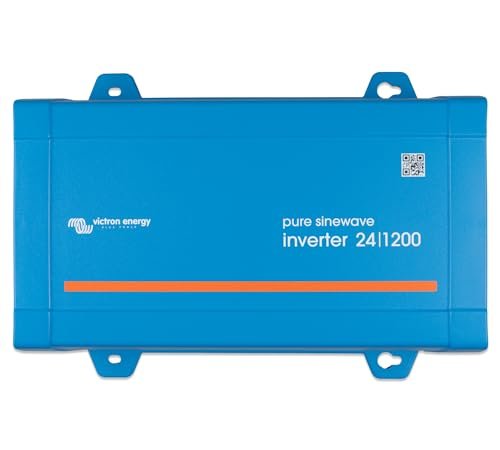
Victron Energy 24V 1200VA Inverter Review

The Victron Energy 24V 1200VA Inverter is the heavy lifter of the 24V compact Phoenix range. It is built for larger off-grid solar setups and commercial work trucks that use 24V battery banks to reduce wiring costs. The 2200W peak surge handles sustained heavy loads and high-draw appliances better than the 12V counterpart at the same wattage, because the 24V platform runs at roughly half the current for the same output. That lower current means less heat in the cables and more stable performance in demanding environments.
This is my review of the Victron Energy Phoenix 1200VA 24V 120V AC Pure Sine Wave Inverter (NEMA 5-15R), a robust and reliable solution for 24V battery systems in mobile, off-grid, and small home setups. It provides 1000W continuous output (1200VA) with a peak surge of 2200W, making it capable of running household appliances, office equipment, and workshop tools. With an ECO mode idle draw of only 1W, it’s highly efficient for extended use in RVs, boats, cabins, or home backup scenarios.
For my installation, I paired the inverter with the recommended Victron accessories to ensure a safe and fully functional setup. For monitoring and configuration, I used the VE.Direct Bluetooth Smart Dongle for mobile access, with the option of the VE.Direct-to-USB Interface for PC-based tuning. On the protection side, I installed a 100A Victron MIDI fuse with a proper MIDI fuse holder (32V rated), which is critical for system safety. I also added the Phoenix VE.Direct remote on/off panel for convenient control.
Cabling was sized according to run length: 10 mm² (approx. 8 AWG) for runs up to 1.5 meters, and 16 mm² (approx. 6 AWG) for runs up to 3 meters. Grounding was done with a minimum of 6 mm² to ensure system stability and safety. This setup reflects my approach to real-world installations: prioritising proper protection, correct cabling, and reliable control to maximise the inverter’s performance and longevity.
First Look and Build Quality
I placed the Victron Energy 24V 1200VA on my workbench next to the 12V version. The external housing is identical: the same large aluminium chassis, the same front-panel VE. Direct port, the same NEMA 5-15R outlet, and the same temperature-controlled fan. The difference is inside. The 24V model operates at half the DC voltage of the 12V version at the same output wattage, resulting in less thermal stress on internal components and greater stability under sustained loads in high-ambient-temperature environments.
I checked the terminal block. The M8 bolt-style terminals are the same heavy-duty design as the 12V 1200VA. At 24V and 1000W continuous, peak current draw is approximately 60 amps, which is half of what the 12V version handles. That means the 100A MIDI Fuse required for this model is smaller than the 200A fuse the 12V needs, and the cable gauge is more manageable at 8 AWG versus 4 AWG.
The temperature-controlled fan engaged during my sustained load testing and operated at a noticeably lower speed than during equivalent tests on the 12V model. Lower current at the same output power means the power stage generates less heat, and the fan works less hard to maintain operating temperature. In a hot vehicle or off-grid enclosure, that thermal advantage matters over time.
What Is in the Box
The package includes the inverter and a manual. No battery cables are provided. For a 24V 1200VA unit, I sourced 8 AWG cable for runs of up to 1.5 meters. For runs between 1.5 and 3 meters, 6 AWG is the correct choice. The 100A MIDI Fuse and holder must be purchased separately and installed close to the Phoenix Inverter Control VE’s positive battery terminal. A direct remote panel is a recommended addition for any permanent installation in a vehicle or solar shed.
Outputs and Features
The 24V 1200VA delivers 1000W of continuous output and a 2200W peak surge. The surge rating is slightly lower than the 12V 1200VA at 2400W, which reflects the different internal design at 24V. In practice, the 2200W surge is sufficient for a compressor fridge startup, a coffee maker, or a small power tool. Appliances that require a harder start than a standard compressor, such as a well pump or an air conditioner, may need a 24V 2000VA or larger unit.
The VE.Direct port connects to the VictronConnect app via the Bluetooth dongle. I programmed the low-battery shutdown threshold for the specific lithium bank in my test setup and set the Dynamic Cut-off to prevent false trips during startup sags. The output voltage and ECO mode sensitivity are also adjustable. These programmable features are the same across the entire Phoenix line and represent a significant advantage over any non-Victron competitor.
Efficiency for the 24V 1200VA is approximately 92 per cent, slightly higher than the 12V model at 91 per cent. That one-per-cent difference reflects the lower resistive losses in the DC input side at 24V compared to 12V. Over a system running 8 to 10 hours daily, that efficiency difference adds up to a meaningful reduction in battery drain.
Protection Features
The 24V 1200VA includes the same protection suite as all Phoenix models: low-voltage, high-voltage, overload, over-temperature, and short-circuit protection. The SinusMax technology delivers the 2200W surge through the toroidal transformer without stressing the main power stage. The toroidal design provides better surge handling than high-frequency architectures, which is why Victron’s surge ratings translate reliably to real-world performance rather than being marketing numbers that trip the overload protection in practice.
The operating temperature range is wider on the 24V model than on an equivalent 12V unit because the lower current at 24V reduces internal heating under sustained load. For a commercial work truck or an off-grid solar installation in a region with high ambient temperatures, the 24V platform is the more durable choice.
Potential Point of Failure
The battery bank configuration is the most common installation error on a 24V system. A 24V bank built from two 12V batteries in series must be balanced correctly. Mismatched batteries in a series 24V configuration degrade faster and can cause uneven charging, leading to one battery being chronically over-discharged. I recommend using matched batteries from the same production batch for any 24V series bank.
The front-panel configuration buttons feel slightly softer than the rest of the assembly. I set my frequency and voltage preferences at commissioning and labelled the buttons to prevent accidental changes during operation. In a vehicle environment where vibration is a constant, that step is worth the 30 seconds it takes.
Victron Energy 24V Inverter Lineup Comparison
| Spec | 1200VA ★ | 250VA | 375VA | 500VA | 800VA |
|---|---|---|---|---|---|
| Continuous | 1000W | 200W | 300W | 400W | 700W |
| Peak Surge | 2200W | 400W | 700W | 900W | 1500W |
| Input | 24V | 24V | 24V | 24V | 24V |
| ECO Idle | 1W | 1.3W | 1.4W | 1.5W | 1.5W |
| Fuse | 100A | 30A | 40A | 60A | 80A |
| Cable (0-1.5m) | 8 AWG | 14 AWG | 12 AWG | 10 AWG | 10 AWG |
| Chassis | Large | Small | Small | Small | Large |
Use Case Recommendation
Choose the 24V 1200VA if you are running a 24V battery bank and need to power high-draw appliances, including a coffee maker, a small microwave, or a power tool. It is the right choice for commercial work trucks, larger solar installations, and any system where the 12V wiring overhead is impractical. If your loads stay under 800W, the 24V 800VA is a more efficient and less expensive option. If you need 6000W of surge for an air conditioner or a well pump, step up to the 24V 2000VA or the Victron Multiplus line.
Summary
The Victron Energy 24V 1200VA is a capable, efficient inverter for serious off-grid and commercial 24V applications: the 2200W surge, toroidal construction, VE.Direct programmability and improved thermal performance over the 12V counterpart make it a strong investment for any installer who can build on 24V. The battery bank configuration and cable sizing are the two installation variables that require the most attention. Get those right, and this inverter will run reliably for well over a decade.

There are no reviews yet.