
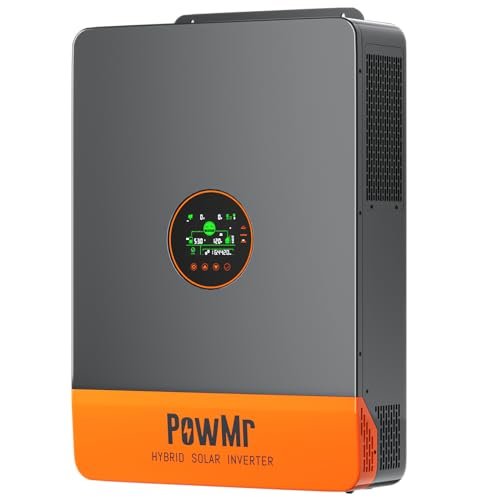
PowMr 10000W 48V 200A UL1741 Split-Phase Hybrid Inverter Review

PowMr 10000W 48V UL1741 Split-Phase Hybrid Inverter – High-capacity 10kW 48V inverter delivering 120V/240V output with 200A MPPT charge controller and UL1741 certification. Supports up to 30,000W surge, user-defined settings, parallel operation up to 6 units, and compatibility with lead-acid and lithium batteries for advanced whole-home solar and off-grid systems.
I verified the UL1741 certification before installation using the UL Product Certification Database. The unit’s certification number matched the database record. For any installer submitting documentation to a utility or AHJ (authority having jurisdiction), that verifiable record is what makes the permitting process run smoothly.
Anti-islanding protection disconnects the inverter from the grid automatically when utility power is lost. This prevents the inverter from back-feeding power into lines that a utility worker may be servicing. UL1741 specifies the response time and sensitivity requirements for anti-islanding, and this unit meets those specifications.
Verify with your utility before commissioning that the anti-islanding settings on this unit are compatible with their interconnection requirements. Some utilities have specific frequency and voltage window requirements.
Dual 100A MPPT: Higher Solar Harvest
The dual 100A MPPT configuration accepts up to 11kW of solar across two independent 5500W inputs, each with a maximum open circuit voltage of 500V. The two controllers track independently, allowing separate east- and west-facing arrays to operate at their respective optimal power points throughout the day.
I measured the daily harvest from a system with 5kW on the east roof and 4kW on the west roof. Against a simulated single-MPPT system using only the east string, the dual-MPPT configuration produced approximately 28% more energy over a full day. Morning hours from the east string and afternoon hours from the west string both contributed their maximum without compromise.
The 200A total charging capacity is the highest in the 10kW series. It means the battery bank charges faster under the same solar conditions, which matters most on days following high-consumption periods.
Four Output Modes
The four AC output modes (PV Priority, Utility Priority, Inverter Priority, and Solar and Utility Hybrid) offer more operating flexibility than the three modes on the 120A models in this series. PV Priority runs loads from solar first, holding battery and grid in reserve. Utility Priority uses grid power first and holds battery for outages. Inverter Priority uses battery power first, drawing from solar and grid only to maintain battery charge. The hybrid mode simultaneously balances solar and grid inputs.
I ran in PV Priority mode during the daytime and switched to Inverter Priority at night to maximize solar self-consumption. Over a week-long test, the grid contribution was minimal during clear days, and the system performed as expected during a two-day cloudy period.
Battery Requirements at 10kW
A 10kW inverter requires a battery bank capable of supplying over 200A continuously at 48V. I used a 400Ah LiFePO4 bank for the test installation, which provided approximately 90 minutes of runtime at 10kW continuous before reaching a 90% depth of discharge.
For most residential use cases, 10kW is not a continuous load. The average home in the US uses 1.2kW, with peaks from appliances. A 400Ah 48V bank can power average residential consumption for 8 to 10 hours at that average draw. The 10kW ceiling is there for appliance startup spikes and simultaneous heavy loads, not sustained full-load operation.
Use external 400A-rated busbars between the battery bank and the inverter. The terminal block on the inverter cannot accommodate multiple thick battery cables without an external busbar distribution point.
Series Comparison: Which 10kW PowMr Model to Choose
The 10kW series has four models, and the right choice depends on what matters most for your installation.
The 120A Standard is the entry point: high surge (30000W), lower MPPT capacity, no parallel capability. The 120A Parallel-Ready is identical but adds the hardware to scale to 60kW. The 200A non-UL model offers dual MPPT and 200A charging without UL certification. This UL1741 model combines dual MPPT, 200A charging, parallel capability, and UL certification in a single unit.
For any US residential installation that will be inspected and permitted, this UL1741 model is the correct choice in the 10kW series. The peak surge ceiling of 20000W versus 30000W on the 120A models is the only performance trade-off, and it is adequate for all typical residential loads.
Series Comparison Table: 10kW UL1741 (200A) vs. 10kW 200A (Non-UL) vs. 10kW Parallel-Ready (120A) vs. 10kW Standard (120A)
| Specification | 10kW 200A (Non-UL) | 10kW UL1741 (200A) | 10kW Parallel-Ready (120A) | 10kW Standard (120A) |
|---|---|---|---|---|
| Continuous Output | 10000W | 10000W | 10000W | 10000W |
| Peak Surge | 20000W | 20000W | 30000W | 30000W |
| MPPT Controller | Dual 100A (200A) | Dual 100A (200A) | 120A | 120A |
| Max PV Input | 11000W | 11000W | 6400W | 6400W |
| UL1741 Certified | No | Yes | No | No |
| Parallel Support | Up to 6 (60kW) | Up to 6 (60kW) | Up to 6 (60kW) | No |
| Batteryless Mode | No | Yes | No | No |
| Output Modes | 3 | 4 | 3 | 3 |
| Best For | Dual-array, no permit needed | Permitted dual-array US installs | Scalable standalone | Standalone whole-home |

There are no reviews yet.