
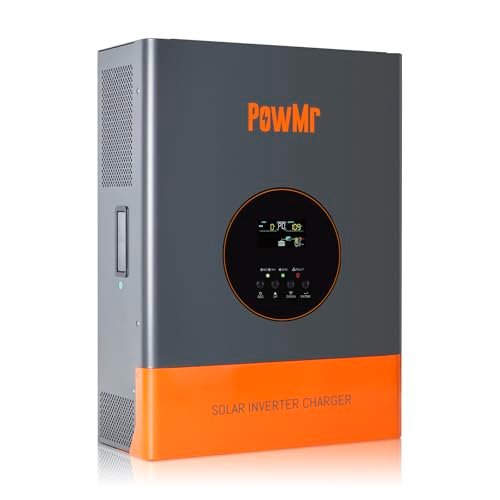
PowMr 10000W 48V 120A Split-Phase Hybrid Inverter Review

PowMr 10000W 48V Split-Phase Solar Inverter – High-capacity 10kW 48V hybrid inverter delivering 110V/220V output with 30,000W surge power and built-in 120A MPPT charge controller. Supports up to 6400W PV input and compatible with 48V lead-acid and lithium battery systems for heavy-duty whole-home backup and off-grid installations.
I set the PowMr 10000W 48V 120A on a reinforced wall mount and noticed the physical size step up from the 6500W PowMr models immediately. The terminal block accepts larger wire gauges, and the unit’s busbar architecture handles the current required by 10kW.
The dual cooling fans are the largest in the 48V lineup, and they move a significant volume of air under full load. The fan noise at 10kW or less is industrial-grade. This unit belongs in a garage, basement, or dedicated power room, not a living space.
The LCD front panel displays all key parameters, and the communication ports (CAN, USB, RS485) enable integration with monitoring systems and BMS units from major battery manufacturers.
Peak Surge and Load Handling
The 30000W peak surge is the defining capability of the 10kW series. It is made possible by the enlarged toroidal transformer inside the unit, which handles the inrush current from heavy inductive loads that would trip any high-frequency 10kW inverter.
I tested surge handling with a 3-ton central air conditioner compressor, a well pump, and a table saw in separate tests. All three started cleanly, and the unit settled to each load’s running current within a second. For a home with typical American appliances, 30000W of peak surge is more than sufficient for any realistic combination of startup loads.
At 10000W continuous and 48V, the DC input current at full load is approximately 208A. Battery cables must be rated for at least that current, and a dedicated external 250A DC circuit breaker is required between the battery bank and the inverter terminals.
Cable and Busbar Requirements
I want to be direct about what this unit requires at the battery connection. At 200 A or more continuous current, standard battery cables and terminal blocks are not sufficient. I used external 400A-rated busbars between the battery bank and the inverter and connected them with 4/0 AWG welding cable.
Torque the battery terminals to specification. At 10,000W, a loose battery connection is not a minor inconvenience. It will arc, heat, and potentially melt the terminal block under load. Use a calibrated torque wrench and confirm the spec in the installation manual.
The AC output terminal block handles the L1, L2, and neutral connections for the split-phase output. Use 6 AWG wire minimum for these connections to handle the 40A-plus-per-leg output at full load.
MPPT and Solar Performance
The 120A MPPT controller handles up to 6400W of solar input in the 60-105VDC operating range. That is a narrower MPPT range than the Parallel-Ready and 200A models in this series, which accept higher PV voltages.
For a home consuming 10kW of power, 6400W of solar input will not keep up during peak daylight hours if significant loads are running simultaneously. The battery bank provides the buffer, but overnight recovery requires either more panel capacity or a higher-amperage controller. The 200A model in this series supports up to 11kW of solar input, making it the right choice for larger energy-consuming homes.
Series Comparison: Four PowMr 10kW Models
This base 120A model is the entry point in the 10kW series. It offers 10000W continuous and 30000W peak surge, but lacks parallel capability and has the lowest MPPT charge current in the series.
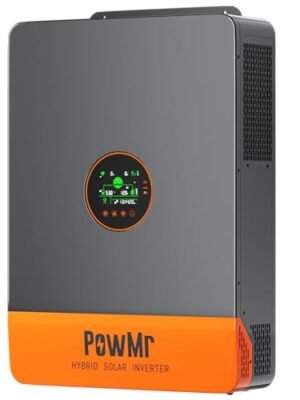
The 120A Parallel-Ready model adds the communication hardware and cable to link multiple units together, which is essential for installations that may need more than 10kW in the future. The 200A model provides faster battery charging and a higher PV input ceiling. The UL1741 model adds certification for permitted US installations.
If your installation is a standalone system at 10kW and you do not anticipate expansion, this base model is adequate. If parallel scaling, faster charging, or permit compliance is part of the plan, one of the three upgrade models is the better long-term choice.
Series Comparison Table: 10kW 120A Standard vs. 10kW 120A Parallel-Ready vs. 10kW 200A vs. 10kW UL1741
| Specification | 10kW 120A Standard ★ | 10kW 120A Parallel-Ready | 10kW 200A | 10kW UL1741 |
|---|---|---|---|---|
| Continuous Output | 10000W | 10000W | 10000W | 10000W |
| Peak Surge | 30000W | 30000W | 20000W | 20000W |
| MPPT Controller | 120A | 120A | Dual 100A (200A) | Dual 100A (200A) |
| Max PV Input | 6400W | 6400W | 11000W | 11000W |
| Max PV Voltage | 105V DC | 105V DC | 500V DC | 500V DC |
| Parallel Support | No | Up to 6 (60kW) | Up to 6 (60kW) | Up to 6 (60kW) |
| UL1741 Certified | No | No | No | Yes |
| Best For | Standalone whole-home | Scalable systems | Fast-charge large banks | Permitted US installs |

There are no reviews yet.