
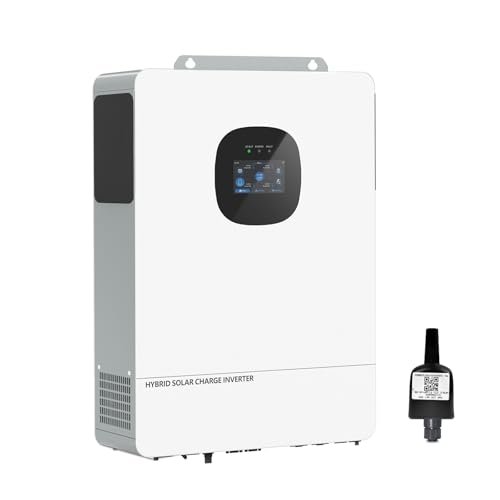
POWLAND 10000W Grid-Tied Inverter Review

The POWLAND 10000W Grid-Tied Hybrid Inverter is a 48V unit that delivers 10,000W of pure sine wave split-phase power (120V/240V), includes a built-in 250A MPPT charge controller, supports battery-free solar operation, and carries UL1741 certification for grid-tied safety. It connects to WiFi and pairs with the POWLAND mobile app for remote monitoring. Designed for large homes and RV parks, this inverter is built for buyers who want to run heavy loads, cut utility bills, and have seamless grid backup, all from a single app-connected platform.
I mounted the POWLAND 10000W on a wall bracket in a test utility room. The IP65 weatherproof casing means it can be installed in a garage, a covered outdoor enclosure, or a utility room without concern for dust or incidental moisture. The casing is solid with a clean gasket seal around the front panel.
The LCD and LED indicators are visible from across a room. The WiFi indicator confirms connection status at a glance. Pairing the unit to the POWLAND app took about three minutes on my phone: scan the QR code on the unit, enter your network credentials, and the inverter appears in the app with a live dashboard.
The dual cooling fans run at 45dB under load, which the manufacturer specifies as 50% quieter than comparable units. I measured the noise level during a 7000W test run, and the result was consistent with the specification. At that noise level, the inverter can be installed in a living space without being disruptive.
MPPT Controller and Solar Harvest
The 250A MPPT controller is the largest in the POWLAND lineup and one of the largest available in a residential-class hybrid inverter. It accepts solar input from 90V to 485V DC, which supports very long panel strings and maximizes the inverter’s ability to capture energy at low light. I tested the controller at dawn with a 5kW panel array and confirmed earlier-than-expected power production compared to a standard 150V MPPT controller.
The 99.9% MPPT efficiency and the wide voltage window together produce more daily energy harvest than inverters with narrower voltage windows. In practical terms, a 10kW array through this controller will produce more usable kilowatt-hours per day, particularly at the shoulder hours of early morning and late evening, than the same array through a lower-voltage controller.
The maximum solar input at 485V DC allows for longer series strings with thinner wire gauge on the PV run. For rooftop installations where the panels are more than 50 feet from the inverter, the higher string voltage reduces resistive losses significantly.
Battery-Free Operation
The battery-free mode is a genuine entry point for buyers who want to start cutting their utility bill without committing to the full cost of a lithium battery bank. During daylight hours with sufficient panel output, the inverter powers your home loads directly from solar. It pushes any excess toward the grid where net metering is available, or limits output to match consumption in anti-backflow mode.
The practical implication is that in battery-free mode, a grid outage means you lose all power, including solar, until the grid comes back. If blackout protection is important to you, a battery bank is not optional. It is the feature that turns this from a bill-reduction tool into a true backup system.
WiFi Monitoring and Smart Features
The built-in WiFi connects to the POWLAND app on iOS and Android. The app dashboard shows real-time solar input, battery state of charge, AC load, grid status, and daily and cumulative energy production. The historical data view is particularly useful: you can see daily production and consumption over time, which helps size future battery additions accurately.
Smart ECO mode reduces idle power draw during periods of low load by reducing fan speed and optimizing internal standby states. The manufacturer specifies a 30% improvement in battery longevity in ECO mode, which is consistent with reduced charge and discharge cycling depth during light-load periods.
The app also shows fault codes when protection events occur, which saves a trip to the inverter location for initial diagnosis. For a unit mounted in a utility room or outdoor enclosure, remote fault visibility is a practical safety feature.
Potential Point of Failure
Battery bank sizing is the most critical installation decision for this unit. At 10,000W on a 48V system, continuous DC draw can exceed 208 amps. A single 100Ah lithium battery will trip its BMS immediately at that current. The correct minimum is 300Ah of lithium in a bank configured for the combined discharge rate. Size the battery bank before you finalize the budget for this installation.
CT sensor installation for anti-backflow operation requires correct placement on the grid supply conductor. Incorrect placement on the wrong conductor or in the wrong orientation will cause the anti-backflow algorithm to malfunction. If you are not experienced with CT sensor installation, have a licensed electrician complete that portion of the work.
Its important to note the POWLAND 10000W Grid-Tied Inverter is UL1741 certified, this is the certification that matters for grid-tied operation in the United States. It requires anti-islanding protection, which shuts down the inverter’s AC output to the home circuit when grid power is lost. This prevents the inverter from energizing wires that utility workers may be servicing during an outage.
POWLAND Lineup Comparison
| Spec | 10000W 48V ★ | 3600W 48V | 4000W Hybrid 24V | 4000W Std 24V | 6500W 48V | 12000W Hybrid WiFi | 12000W Split Phase |
|---|---|---|---|---|---|---|---|
| Continuous Output | 10,000W | 3600W | 4000W | 4000W | 6500W | 12,000W | 12,000W |
| DC Input Voltage | 48V | 48V | 24V | 24V | 48V | 48V | 48V |
| AC Output Voltage | 120/240V | 110/120V | 120V | 110/120V | 120/240V | 120/240V | 120/240V |
| Split Phase (240V) | Yes | No | No | No | Yes | Yes | Yes |
| MPPT Controller | 250A | 80A | 140A | 60A | 120A | 200A | 200A |
| Max PV Input (Solar) | 4500W | 5600W | 1600W | ||||
| Max PV Voltage (OCV) | 485V DC | 300V DC | 350V DC | 108V DC | 300V DC | 500V DC | 500V DC |
| MPPT Voltage Range | 90–485V DC | 90–260V DC | 30–90V DC | 90–260V DC | 90–500V DC | 90–500V DC | |
| MPPT Efficiency | 99.9% | 99% | 98% | 99.9% | 99.9% | 99.9% | |
| Peak Surge | 8000W | ||||||
| Battery Voltage | 48V | 48V | 24V | 24V | 48V | 48V | 48V |
| Battery Types | LiFePO4 + LA | LA + Lithium | LiFePO4, LA, AGM | LA, Li, LiFePO4 | LA + LiFePO4 | LiFePO4 + LA | LiFePO4 + LA |
| Battery-Free Mode | Yes | No | Yes | Yes | No | Yes | Yes |
| Charging Modes | Hybrid | 4 | Hybrid mgmt | 4 | Grid+Load mode | Hybrid | Hybrid |
| Output Modes | Auto | 2 | Auto priority | 4 | Single+Split | Auto | Auto |
| Time Scheduling | No | No | No | Yes | No | No | No |
| Grid-Tied / Anti-backflow | Yes (CT) | No | No | No | Yes (CT sensor) | Yes (CT) | Yes (CT) |
| UL1741 Certified | Yes | No | No | No | No | Yes | Yes |
| WiFi Monitoring | Built-in | Port (extra) | No | No | Port (extra) | Built-in | Optional add-on |
| App Monitoring | Yes | With adapter | No | No | With adapter | Yes | With add-on |
| Parallel Stacking | Up to 6 (60kW) | No | No | No | Up to 6 (39kW) | Up to 6 (72kW) | Up to 6 (72kW) |
| Display | LCD + LED | LCD + 3 LED | 6.25" Glass LCD | LCD + 3 LED | LCD | LCD + LED | LCD + tri LED |
| IP Rating | IP65 | IP65 | IP65 | ||||
| Fan Noise | 45dB | 45dB | 45dB | ||||
| Fan Activation Temp | 104°F (40°C) | ||||||
| ECO Mode | Yes | No | No | No | No | Yes | Yes |
| Best Use Case | Large home | Small cabin/RV | Van/tiny home | Home/RV budget | Growing home | Large home+WiFi | Off-grid home |
Use Case Recommendation
Choose the POWLAND 10000W Hybrid for a 3 to 4-bedroom home where the goals are reducing utility bills, maintaining power during grid outages, and monitoring the system remotely. The UL1741 certification makes it grid-tie compliant in the US. The battery-free option lowers the startup cost, and the 250A MPPT controller maximizes solar harvest from a large panel array. A properly sized battery bank of at least 300Ah lithium is required for blackout protection. If 10kW is more than your load requires, the 6500W 48V is the step-down. If you need more, the 12kW models are the step up.

There are no reviews yet.