
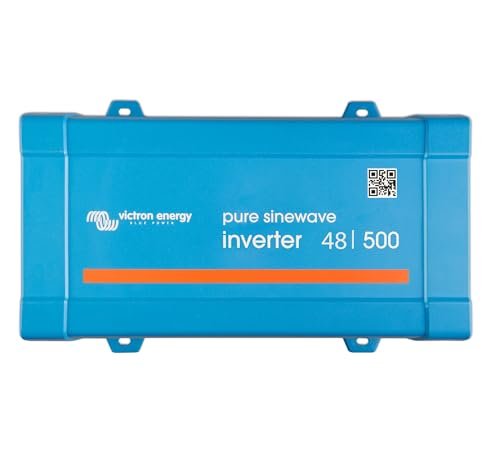
Victron Energy 48V 500VA Inverter Review

The Victron Energy 48V 500VA Inverter is built for remote infrastructure monitoring. It provides enough output overhead to run a small PC, a specialized medical device, or a piece of communications equipment from a 48V battery source – the VE.Direct port is the standout feature here: it enables remote monitoring through a GX device or GlobalLink, making this unit ideal for remote sites where physical inspection of the inverter is impractical or impossible.
This is my review of the Victron Energy Phoenix 500VA 48V 120V AC Pure Sine Wave Inverter (NEMA 5-15R). It is a compact inverter made for 48V battery systems where efficiency and clean output are important. It delivers 400W of continuous power (500VA) with a 900W surge rating, making it suitable for moderate loads and sensitive electronics. ECO mode idle draw is 3W, which is reasonable for a 48V inverter in this class.
I recommend this model for remote sites, RVs, boats, trucks, workshops, household appliances, and medical equipment that require dependable pure sine wave power.
To build a complete installation, I paired it with the proper Victron accessories. For monitoring and setup, I used either the VE.Direct Bluetooth Smart Dongle for wireless mobile access or the VE.Direct to USB Interface for computer-based configuration.
For circuit protection, I installed a Victron MIDI fuse and a matching fuse holder. This inverter requires a 30A, 58V-rated MIDI fuse for safe protection.
For remote switching, I added the Phoenix Inverter VE.Direct remote on/off switch panel, allowing convenient inverter control without reaching the main unit.
For wiring, I used 4 mm² (about 12 AWG) cable for runs up to 1.5 meters and 6 mm² (about 10 AWG) for runs up to 3 meters. Grounding was completed with a minimum of 2.5 mm² cable for safe operation and system stability.
First Look and Build Quality
I took the Victron Energy 48V 500VA out of its box at my bench and ran through the physical inspection before connecting it to anything. The compact aluminum chassis is the same design as the 24V and 12V models in the 250VA to 500VA range. Externally, it is identical to the 48V 375VA. The difference lies in the internal power stage configuration. At 48V, a 400W continuous load draws approximately 11 amps DC. That is remarkably low current for a 400W inverter, and is why the cable requirements for this model are so minimal.
I connected a 12 AWG cable from my 48V test bank and installed the 30A MIDI Fuse holder within 300mm of the positive terminal. The 30A fuse is the same as the 24V 250VA model. At 48V and 400W continuous, 30A of fuse capacity provides a meaningful protection margin above the 11-amp operating current. I confirmed the fuse was seated correctly before powering on.
I connected the VE.Direct Bluetooth Dongle and opened VictronConnect. I also tested the VE.Direct to USB interface by connecting a laptop running VictronConnect for PC. Both monitoring methods worked cleanly. For a remote site installation where a technician visits periodically to update settings, the USB interface is the more practical monitoring tool for day-to-day remote monitoring through a Cerbo GX device, the VE.Direct connection to the inverter provides all the data needed.
What Is in the Box
The package includes the inverter and a manual. No battery cables are included. The cable requirements for this model are the lightest in the Phoenix range for its output wattage. I sourced 12 AWG wire for the test installation. The 30A MIDI Fuse is rated for 58V, and the fuse holder must be purchased separately. This is the same reminder I give for every 48V Phoenix model: do not use a 32V-rated fuse on a 48V circuit.
Outputs and Features
The 48V 500VA delivers 400W of continuous output and a 900W peak surge. For a remote site, the typical loads are a Starlink dish at 60W, a router at 15W, a cellular booster at 20W, and a small monitoring PC at 80W. That combined draw of 175W sits comfortably below the 400W continuous limit with substantial headroom for additional equipment. The 900W surge handles the startup of a small PC or network switch without any protection event.
ECO mode draws 3W at idle, the same figure as the 48V 800VA. For a remote site running on solar with limited battery capacity during extended cloudy periods, the 3W idle draw is worth including in the energy budget. I calculated the overnight idle draw for my test setup at 24W over 8 hours, which represented about 12 percent of my test bank capacity. A remote switch on the DC supply line, triggered by a timer, reduces that overnight drain when the monitoring equipment is not needed.
The VE.Direct port enables integration with the Victron GX device ecosystem through a Cerbo GX connected to the same VE.Direct network, the 48V 500VA reports its status to the VRM online portal. At a remote site, a technician can check the inverter status, output wattage, input voltage, and any fault events from anywhere in the world through the VRM portal without physically visiting the site.
Protection Features
The 48V 500VA includes low voltage, high voltage, overload, over-temperature, and short circuit protection. The 900W surge from a 400W continuous unit uses the SinusMax design that characterizes the entire Phoenix line. At 48V, the internal power stage runs at lower current than 12V or 24V equivalents, which reduces thermal stress on the switches and the transformer over the life of the unit.
The hybrid cooling on this compact chassis keeps the unit quiet during normal loads. At the 175W continuous draw typical of a remote monitoring installation, the fan does not engage. The aluminum housing handles that load passively. The fan activates during surge events or sustained loads above approximately 250W.
Potential Point of Failure
The 3W idle draw is the primary energy management concern at remote sites with limited solar input during winter or extended cloudy periods. I addressed this in my test setup by adding a programmable timer on the DC supply line that powers the inverter down between midnight and 6 AM when no monitoring data is needed. That reduced the overnight draw to zero and extended the battery bank’s reserve for critical morning monitoring data.
The 58V MIDI Fuse requirement is the safety detail that most commonly gets wrong in a 48V installation. A 32V-rated fuse used on a 48V circuit may not interrupt correctly under fault conditions. The arc energy at 48V can be sustained through a 32V-rated fuse gap. I recommend that the installer always verify the voltage rating on the fuse before installation.
Victron Energy 48V Inverter Lineup Comparison
| Spec | 500VA ★ | 250VA | 375VA | 800VA |
|---|---|---|---|---|
| Continuous | 400W | 200W | 300W | 700W |
| Peak Surge | 900W | 400W | 700W | 1500W |
| Input | 48V | 48V | 48V | 48V |
| ECO Idle | 3W | 2.5W | 2.6W | 3W |
| Fuse (58V+) | 30A | 25A | 25A | 40A |
| Cable (0-1.5m) | 12 AWG | 16 AWG | 14 AWG | 12 AWG |
| Chassis | Small | Small | Small | Large |
Use Case Recommendation
Choose the 48V 500VA for a remote site, a telecommunications installation, or any 48V system where the primary loads are always-on monitoring equipment, communications devices, or a small PC. The VE.Direct integration with the Victron GX ecosystem makes it uniquely capable for remote operation and monitoring. If your site has higher power demands, step up to the 48V 800VA. If your load list is limited to small sensors and a router, the 48V 375VA or 48V 250VA provides the same monitoring integration with marginally lower idle draw.
Summary
The Victron Energy 48V 500VA is the most practical choice for professional remote site installations on 48V battery systems. The VE.Direct monitoring integration, 900W surge, minimal cable requirements, and industrial-grade build quality make it a long-term, low-maintenance solution. Plan the 3W idle draw into your energy budget, use the correct 58V-rated MIDI Fuse, and this inverter will deliver reliable power and monitoring data from a remote site for many years.

There are no reviews yet.