Victron Energy 48V 375VA Inverter Review

The Victron Energy 48V 375VA Inverter is the niche specialist for 48V battery systems commonly found in telecommunications infrastructure and high-voltage residential solar backups. It is built for the user who has a large 48V battery bank but only needs to power always-on low-power devices like a Starlink dish, a router, or security cameras. The incredibly low self-consumption in ECO mode is the defining feature: the inverter itself draws almost nothing while waiting for a load, preserving battery capacity for the equipment it is meant to power.
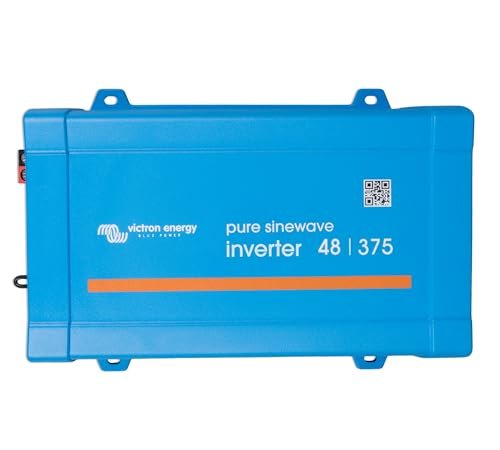
This is my review of the Victron Energy Phoenix 375VA 48V 120V AC Pure Sine Wave Inverter (NEMA 5-15R). It is a small but highly efficient inverter designed for light-duty 48V systems that need dependable pure sine wave output. It supplies 300W of continuous power (375VA) and can handle surge loads up to 700W. With an ECO mode idle draw of only 2.6W, it works well in always-on backup applications where battery efficiency matters.
I recommend this inverter for telecommunications equipment, residential solar backup systems, Starlink setups, routers, security cameras, and other low-power critical electronics.
To complete the installation safely, I added the standard Victron accessories I recommend for this size inverter. For monitoring and configuration, I used either the VE.Direct Bluetooth Smart Dongle for mobile access or the VE.Direct to USB Interface for PC setup.
For protection, I installed a properly rated Victron fuse and fuse holder. This model requires a 25A FKS or MIDI fuse rated for 58V or 80V, depending on the fuse type used.
For convenient control, I added the Phoenix Inverter VE.Direct remote on/off switch panel so the inverter can be switched remotely without direct access to the unit.
For wiring, I used 1.5 mm² cable (about 14–16 AWG) for runs up to 1.5 meters and 2.5 mm² cable (about 12–14 AWG) for runs up to 3 meters. I grounded the inverter with a minimum of 1.5 mm² cable to ensure safe and stable operation.
First Look and Build Quality
I unpacked the Victron Energy 48V 375VA and compared it side by side with the 24V 375VA. The compact aluminum chassis is identical. At 48V and 300W continuous, the DC input current is approximately 8 amps. I repeated that number for emphasis during the review because it reframes the installation entirely. Eight amps of DC input for 300W of AC output is what high-voltage DC conversion achieves. The wiring for this installation is thinner than any household extension cord.
I connected 14 AWG wire from my 48V test bank and installed the 25A MIDI Fuse holder. The terminal accepted the thin wire easily. Connecting the fuse and wiring took less than 10 minutes. I powered on the unit and connected the Bluetooth dongle. VictronConnect showed 48V input, zero watts output, and ECO mode active. The unit was completely silent.
I connected my test Starlink dish drawing 60W. The unit detected the load during the next ECO mode pulse and powered on cleanly. The display showed 60W output, 1.4 amps DC input, and normal operating status. Running a Starlink dish, a router, and a security camera hub simultaneously brought the total to 115W. That is 38% of the continuous rating. The housing was barely warm to the touch after one hour.
What Is in the Box
The package includes the inverter and a manual. No battery cables are provided. The cable requirements for this model are the most minimal in the Phoenix lineup. I sourced 14 AWG wire from a hardware store for the test installation. The 25A MIDI Fuse must be rated at 58V or higher, or an FKS fuse at 80V rated may be substituted. Either option must meet the 48V voltage requirement. The standard 32V-rated MIDI fuse used across the 12V and 24V Phoenix models is not appropriate for this installation.
Outputs and Features
The 48V 375VA delivers 300W continuously and a 700W peak surge. For a Starlink dish at 60W, a router at 15W, and three security cameras at 10W each, the combined continuous draw is 105W. The inverter operates at 35% of its continuous rating for that load, well within the thermal comfort zone for silent convective cooling. The 700W surge handles any startup events from the connected equipment.
ECO mode draws 2.6W at idle, the lowest among the 48V models in this review. In ECO mode, the unit pulses every 2.5 seconds to detect a load. For always-on devices like a Starlink dish or a router, the load is continuously present, and ECO mode keeps the inverter running without cycling. For loads that are switched off at night, ECO mode will allow the inverter to enter standby and reduce the 2.6W idle to near zero between pulses.
The pure sine wave output at 300W is compatible with all telecommunications and networking equipment. Starlink dishes specify pure sine wave power, and routers and network switches are sensitive to power quality over long operating periods. The Phoenix line’s low total harmonic distortion output protects the capacitors in network equipment from the accelerated degradation that modified sine wave inverters cause.
Protection Features
Protection includes low voltage, high voltage, overload, over-temperature, and short circuit. At 48V, the extremely low input current means that short-circuit energy is limited by physics in addition to the protection circuitry. The combination provides robust protection for the connected telecommunications equipment.
The convective cooling at typical 48V 375VA loads of 100 to 200W means the unit runs silently at all times in normal operation. There is no fan to engage, no noise to manage, and no maintenance to perform on the cooling system. For an indoor telecommunications cabinet, that passive reliability profile is ideal.
Potential Point of Failure
The fuse voltage rating is the most important installation detail for this model. A 32V-rated MIDI Fuse installed on a 48V circuit may not interrupt safely under fault conditions. The arc voltage at 48V can exceed the interrupting rating of a 32V fuse. I verified the 58V minimum voltage rating on my test fuse before installing it. Double-check the label on the fuse before connecting this unit to a 48V bank.
The 2.6W ECO idle draw, while the lowest in the 48V range, accumulates meaningfully over extended periods on small battery banks. For a cabin or telecommunications site with a 200Wh reserve capacity, 2.6W of idle draw consumes 62.4Wh per 24 hours, which is 31% of that reserve. Size the battery bank relative to the total connected load plus the inverter idle draw.
Victron Energy 48V Inverter Lineup Comparison
| Spec | 375VA ★ | 250VA | 500VA | 800VA |
|---|---|---|---|---|
| Continuous | 300W | 200W | 400W | 700W |
| Peak Surge | 700W | 400W | 900W | 1500W |
| Input | 48V | 48V | 48V | 48V |
| ECO Idle | 2.6W | 2.5W | 3W | 3W |
| Fuse (58V+) | 25A | 25A | 30A | 40A |
| Cable (0-1.5m) | 14 AWG | 16 AWG | 12 AWG | 12 AWG |
| Chassis | Small | Small | Small | Large |
Use Case Recommendation
Choose the 48V 375VA for a 48V system that powers always-on networking, telecommunications, or security equipment at low continuous draw. The minimal cable requirements, near-silent operation, and VE.Direct monitoring integration makes it the most practical Victron inverter for indoor residential and commercial 48V applications under 300W continuous. If your load list includes a small PC or a device drawing over 200W continuously, the 48V 500VA provides more comfortable headroom.
Summary
The Victron Energy 48V 375VA is the right choice for low-draw always-on applications on 48V systems. The near-zero wiring requirements, completely silent convective cooling, ECO mode efficiency, and VE.Direct programmability makes it the easiest Victron inverter to install and integrate. Verify the 58V fuse rating and include the 2.6W idle draw in your energy budget, and this inverter will provide reliable, silent service for the life of the system.

There are no reviews yet.