
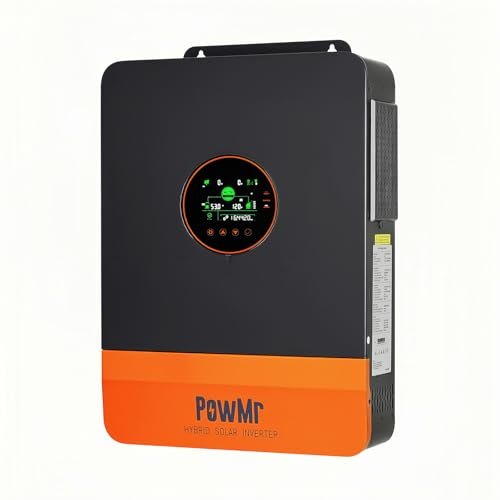
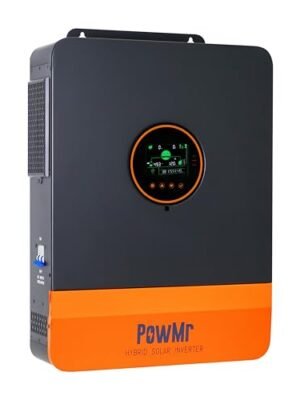
PowMr 6500W 48V 140A UL1741 Batteryless Split-Phase Inverter Review

6500W 48V Split Phase Solar Inverter – UL1741-certified off-grid 48V hybrid inverter with 140A MPPT charge controller, up to 10kW PV input (550V max), and support for parallel expansion up to 6 units. Compatible with lead-acid, lithium batteries, and batteryless operation for flexible whole-home solar systems.
UL1741 is the North American safety standard for inverters used in grid-connected and off-grid solar installations. Many US jurisdictions require UL1741 certification before an inspector will approve a solar installation. Some insurance policies for solar systems also require it.
I verified the unit’s certification status before installation. The UL mark was present on the unit itself and traceable in UL’s online database. That verification step is worth doing before installation, as some third-party, fake, or generic inverter listings claim compliance even though they don’t have the actual certification.
The UL1741 certification also includes anti-islanding protection, which prevents the inverter from feeding power back into the grid during a utility outage. Most US utilities require this protection as a condition of interconnection and protect utility workers who may be working on downed lines.
Batteryless Mode in Practice
I ran the batteryless mode without a battery connected on a day with consistent solar production of around 2000-2500W. The household loads were supplied by solar production throughout the afternoon with no interruptions. When the grid was available, and production dropped below load demand, the bypass relay engaged smoothly.
The minimum PV startup voltage of 150 VDC means you need a string of at least 4 standard panels in series before the inverter engages. I used five 390W panels in series, with a string voltage of around 220V at standard test conditions, which kept me well within the MPPT operating range all day.
For a homeowner who wants to start harvesting solar energy before committing to a battery bank, batteryless mode is the right entry point. The inverter is fully functional as a grid-tied solar system from day one, and a battery can be added later without requiring any hardware replacement.
Dual MPPT Performance
The dual 70A MPPT controllers track two independent panel strings, allowing east and west arrays, or any two strings with different orientations or shading patterns, to be harvested at full efficiency simultaneously.
I connected a southeast and a northwest string to the two MPPT inputs. The southeast string led production from 7 am to 1 pm. The northwest string contributed from 11 am onward and dominated from 2 pm until sunset. At no point during the day was either string being forced to a compromise power point.
The 550V maximum PV input allows strings of up to 13 or 14 standard 400W panels in series, reducing string current and permitting smaller PV wire gauges on long runs from rooftop to inverter.
Installation and Code Compliance
The installation process for the UL1741 model follows the same physical steps as the standard 6500W Hybrid. Wall mounting, terminal connections, and panel string wiring are identical. The difference appears in the commissioning and inspection phase.
For a permitted installation, the UL1741 certification is what the inspector checks before sign-off. Some jurisdictions also require a licensed electrician for the grid connection portion of the installation. Verify your local requirements before starting.
The 550V DC PV input still requires a dedicated DC disconnect between the panel strings and the inverter, even on the UL1741 model. Do not substitute an AC breaker on the DC circuit.
Series Comparison: UL1741 vs. Standard 6500W
The standard 6500W Hybrid and this UL1741 model share the same hardware: dual 140A MPPT, 6500W continuous, 13000W surge, and 550V PV input. The differences are certification, batteryless mode, and price.
The UL1741 model adds certification and batteryless mode. The standard 6500W model typically costs less and is appropriate for off-grid installations where utility interconnection and permits are not required.
For any US homeowner planning a grid-tied installation that will be inspected, the UL1741 model is the correct choice, and the price premium is justified by the compliance it provides.
Series Comparison Table: 6500W UL1741 Batteryless vs. 6500W Standard Hybrid vs. 5200W Hybrid
| Specification | 6500W UL1741 Batteryless ★ | 6500W Standard Hybrid | 5200W Hybrid |
|---|---|---|---|
| Continuous Output | 6500W | 6500W | 5200W |
| Peak Surge | 13000W | 13000W | 10400VA |
| MPPT Controller | Dual 70A+70A (140A) | Dual 70A+70A (140A) | Single 100A |
| Max PV Input | 10000W | 10000W | 6000W |
| UL1741 Certified | Yes | No | No |
| Batteryless Mode | Yes | No | Yes |
| Anti-Islanding | Yes (required) | Not specified | Yes |
| Best For | Permitted US grid-tied installs | Off-grid dual-string arrays | Single-array entry split-phase |

There are no reviews yet.