
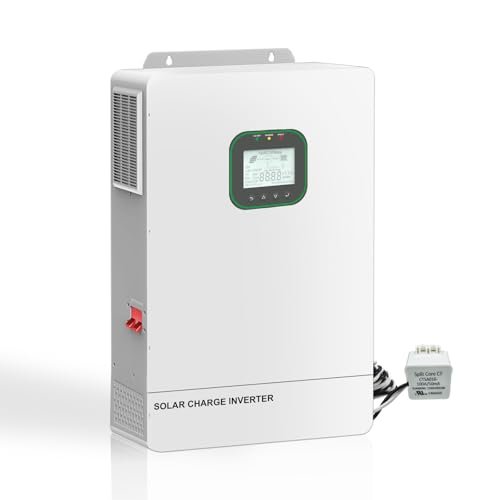
POWLAND 6500W 48V Inverter Charger Review

The POWLAND 6500W 48V is a high-capacity solar hybrid inverter designed for homeowners who need split-phase 120V/240V power from a single unit. It includes a built-in 120A MPPT controller, an anti-backflow grid-tied mode with CT sensor support, and the ability to stack up to six units in parallel for a combined output of up to 39kW. If your load list includes 240V appliances like a well pump, a clothes dryer, or a large air conditioning unit, this is the entry point in the POWLAND lineup that handles them natively.
I unboxed the POWLAND 6500W 48V, and the first thing I checked was the terminal layout. The DC input, AC output, AC input, and the port for the CT sensor are all clearly labeled and separated on the rear panel. The LCD front panel shows a live power flow diagram of solar input, battery state, grid status, and AC output load in an easy-to-read layout.
The multi-fan cooling system activates at 104°F. That is a lower trigger temperature than many inverters in this class, which means the fans engage earlier and maintain a lower steady-state operating temperature. In a hot garage or outdoor enclosure, that more aggressive cooling behavior is the right design choice at 6500W.
The enclosure is the standard POWLAND aluminum housing, appropriately sized for the heavier transformer and cooling hardware inside. Mounting requires a solid surface rated for the unit’s weight; a wall stud or equipment rack is appropriate while drywall alone is not.
Split-Phase Output
Split-phase power at 120V/240V is a requirement for most standard American heavy appliances. Clothes dryers, electric water heaters, central air conditioning units, and well pumps all run on 240V in a typical US home. Cheaper inverters at this wattage deliver only 120V and require you to either buy two units and synchronize them externally or use an autotransformer to generate 240V. The POWLAND 6500W handles both 120V and 120V/240V output internally from a single unit.
I verified the split-phase output with a multimeter before connecting any loads. Both legs measured correctly at 120V to neutral, and the 240V between L1 and L2 was within specification. Phase balance under asymmetric loads was stable; running an asymmetric load on one leg did not cause measurable voltage sag on the other.
The single-phase 120V configuration is also supported for systems that do not need 240V. The same unit handles both configurations through menu selection.
Anti-Backflow Grid-Tied Mode
The grid-tied anti-backflow mode is one of the more advanced features on this unit. With an external CT sensor installed on your grid supply line, the inverter monitors grid consumption in real time and uses solar and battery power to offset your grid draw without feeding power back to the utility grid. This is called zero-export or anti-backflow mode.
I tested this mode with a simulated load scenario. The inverter continuously adjusted its output to match home loads, pulling from the solar array and battery bank to reduce grid draw toward zero. When loads increased beyond what solar and battery could cover, the grid supplied the difference. When solar output exceeded load demand, the CT sensor prevented excess power from flowing back to the grid.
This mode is practical for homeowners in areas where net metering is not permitted or where the utility does not offer favorable buy-back rates. It maximizes your solar self-consumption without requiring grid interconnection agreements.
Parallel Expansion
The ability to stack up to six units is what makes the POWLAND 6500W 48V a scalable platform. A single unit provides 6500W. Two units provide 13kW. Six units reach 39kW, which is enough for a large home, a small farm, or a commercial property. All units in a parallel stack share the same battery bank and operate as a synchronized system.
Parallel installation requires the proprietary communication cable between units and careful wiring to ensure balanced load sharing. This is not a beginner installation. If you are planning a multi-unit stack, I recommend a qualified electrician for the AC distribution panel connections.
For most single-home buyers, a single 6500W unit covers the primary use case. The parallel option is a path for future growth rather than a day-one requirement.
Potential Point of Failure
The CT sensor for anti-backflow operation is not always included in the base package. Verify the contents before purchase, and confirm the CT sensor rating matches your grid supply amperage. An undersized CT sensor will not accurately measure high-current loads and will cause the anti-backflow control to behave incorrectly.
Generator compatibility requires attention. The maximum AC input voltage is 140V. Some generators deliver voltage above that threshold under no-load conditions. Check your generator output voltage before connecting it to the AC input, as overvoltage on the AC input can trigger protection faults.
POWLAND Lineup Comparison
| Spec | 6500W 48V ★ | 3600W 48V | 4000W Hybrid 24V | 4000W Std 24V | 10000W 48V | 12000W Hybrid WiFi | 12000W Split Phase |
|---|---|---|---|---|---|---|---|
| Continuous Output | 6500W | 3600W | 4000W | 4000W | 10,000W | 12,000W | 12,000W |
| DC Input Voltage | 48V | 48V | 24V | 24V | 48V | 48V | 48V |
| AC Output Voltage | 120/240V | 110/120V | 120V | 110/120V | 120/240V | 120/240V | 120/240V |
| Split Phase (240V) | Yes | No | No | No | Yes | Yes | Yes |
| MPPT Controller | 120A | 80A | 140A | 60A | 250A | 200A | 200A |
| Max PV Input (Solar) | 4500W | 5600W | 1600W | ||||
| Max PV Voltage (OCV) | 300V DC | 300V DC | 350V DC | 108V DC | 485V DC | 500V DC | 500V DC |
| MPPT Voltage Range | 90–260V DC | 90–260V DC | 30–90V DC | 90–485V DC | 90–500V DC | 90–500V DC | |
| MPPT Efficiency | 99% | 98% | 99.9% | 99.9% | 99.9% | 99.9% | |
| Peak Surge | 8000W | ||||||
| Battery Voltage | 48V | 48V | 24V | 24V | 48V | 48V | 48V |
| Battery Types | LA + LiFePO4 | LA + Lithium | LiFePO4, LA, AGM | LA, Li, LiFePO4 | LiFePO4 + LA | LiFePO4 + LA | LiFePO4 + LA |
| Battery-Free Mode | No | No | Yes | Yes | Yes | Yes | Yes |
| Charging Modes | Grid+Load mode | 4 | Hybrid mgmt | 4 | Hybrid | Hybrid | Hybrid |
| Output Modes | Single+Split | 2 | Auto priority | 4 | Auto | Auto | Auto |
| Time Scheduling | No | No | No | Yes | No | No | No |
| Grid-Tied / Anti-backflow | Yes (CT sensor) | No | No | No | Yes (CT) | Yes (CT) | Yes (CT) |
| UL1741 Certified | No | No | No | No | Yes | Yes | Yes |
| WiFi Monitoring | Port (extra) | Port (extra) | No | No | Built-in | Built-in | Optional add-on |
| App Monitoring | With adapter | With adapter | No | No | Yes | Yes | With add-on |
| Parallel Stacking | Up to 6 (39kW) | No | No | No | Up to 6 (60kW) | Up to 6 (72kW) | Up to 6 (72kW) |
| Display | LCD | LCD + 3 LED | 6.25" Glass LCD | LCD + 3 LED | LCD + LED | LCD + LED | LCD + tri LED |
| IP Rating | IP65 | IP65 | IP65 | ||||
| Fan Noise | 45dB | 45dB | 45dB | ||||
| Fan Activation Temp | 104°F (40°C) | ||||||
| ECO Mode | No | No | No | No | Yes | Yes | Yes |
| Best Use Case | Growing home | Small cabin/RV | Van/tiny home | Home/RV budget | Large home | Large home+WiFi | Off-grid home |
Use Case Recommendation
Choose the POWLAND 6500W 48V if your home has 240V loads like a well pump, clothes dryer, or central AC, and you want a single inverter that handles split-phase output natively. It is also the right choice if you anticipate needing more capacity in the future, as the parallel expansion capability means you can grow to 39kW without replacing the base unit. For a dedicated off-grid-only setup without 240V loads, the 3600W 48V or one of the 4000W 24V models may be sufficient and more affordable.

There are no reviews yet.