
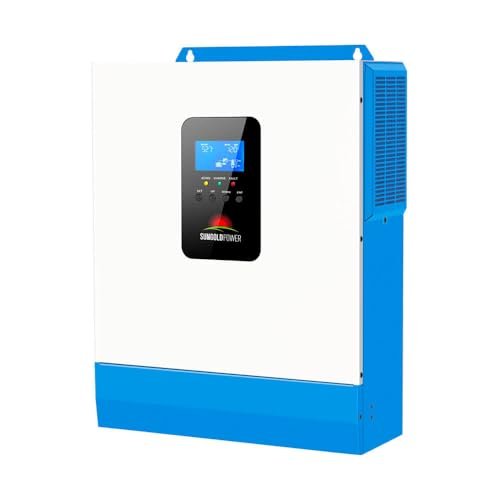
SunGoldPower 5kW 80A MPPT Non-Parallel Inverter Review

All-in-one 5kW 48V pure sine wave inverter with 80A MPPT charger, 120V output, UL1741 listing, and 4HP motor capacity. No parallel.
The SunGoldPower 5kW 80A MPPT Non-Parallel Inverter is lighter than the larger SunGoldPower SPH inverters. At roughly 28 pounds, this is a one-person lift onto a wall mount. The aluminum housing has ventilation grilles on the top and bottom for airflow, and the single cooling fan engages based on temperature rather than running continuously.
The front panel has a clear LCD and three LED indicators for solar, battery, and AC output status. The menu system uses numerical program codes, which are standard across the SunGoldPower lineup. Keep the manual nearby for the first hour of setup to translate program numbers into their actual functions.
Bottom-entry terminal blocks handle AC input, AC output, battery, and PV connections. The labels are clear,r and the wire clamp hardware accepts up to 1/0 AWG without trouble. The RS485 port for BMS communication is on the side panel and accessible without opening the wiring compartment.
What is missing from this unit compared to the parallel version is a current-sharing terminal, a parallel communication port, and program settings related to phase configuration. Those omissions are what make this the budget option in the lineup.
The 80A MPPT in Practice
The 80A MPPT charge controller accepts up to 5,500W of solar input at a maximum open-circuit voltage of 500VDC. In practice, the usable solar array is closer to 4,000W because the 80A charge current ceiling kicks in before the full 5,500W of panel input can be converted.
I tested the controller with a string of three 400W panels at 45V open circuit each, producing a string voltage around 108V at standard test conditions. The MPPT locked onto the power point within about 3 seconds of a cloud cover change and held the correct voltage through the test period.
For a shed or cabin with a modest solar array, the 80A controller is well-matched. You would only feel the 80A ceiling if you over-provisioned the array to 5kW or more of panels, which is not typical for this unit’s target installation.
The combined 80A solar plus AC charging capacity is worth understanding. The inverter can pull 80A from the grid when solar is insufficient, which fills a 48V 100Ah battery from empty in about 80 minutes. For a cabin with a small battery bank, that is a practical recovery rate.
Pure Sine Wave and the 4HP Motor Rating
The 5000W continuous output with 4HP motor capacity covers a specific load profile. You can run a refrigerator, a small freezer, a TV, an internet router, LED lighting, and a few smaller tools simultaneously. You can start a 1HP well pump or a 1.5HP air compressor without tripping the inverter.
I tested the motor, starting with a 1.5HP air compressor and a refrigerator cycling on within 5 seconds of each other. The compressor startup inrush cleared within about 800 milliseconds,s and the unit settled to the combined running load without a fault.
Where the 4HP rating falls short is central air conditioning, deep-well pumps over 1.5HP, and electric dryers. Those loads require either a larger inverter or a 240V split-phase output, neither of which this unit can provide.
For an off-grid cabin or shed with standard 120V appliances, the 4HP rating is more than sufficient. For a home with modern American appliances, this is not the right tool.
Four Charging Modes and Four Output Modes
The four charging modes cover the standard off-grid and hybrid scenarios. AC Priority pulls grid power first for both loads and battery charging. Solar Priority uses panels first and supplements from the grid when solar is insufficient. Only Solar disconnects from the grid entirely and charges only from panels. Mains and Solar Hybrid charges from both sources simultaneously for the fastest battery top-off.
The four output modes control how AC loads are powered. PV Priority runs loads from solar whenever panels produce enough. Utility Priority feeds loads from the grid first. Inverter Priority runs loads from the battery and inverter output regardless of grid availability. Hybrid Output and Grid Connection is the default mode for a typical hybrid backup.
I cycled through each combination during testing. The transitions between modes were smooth with no interruption to connected loads. For a cabin that occasionally connects to utility power via a generator or a small grid-tie, the mode flexibility is useful even on a budget unit.
The Trade-Off: No Parallel, No 240V, No Redundancy
The single biggest limitation of this unit is also its defining feature: it cannot parallel. The internal hardware does not include the communication ports or current-sharing circuitry needed to link multiple units together.
That means three things. First, your continuous power ceiling is permanently 5000W. If you later need more, you have to replace the inverter rather than adding a second unit. Second, you cannot produce 240V split-phase output at all, no matter how many of these units you own. You would need to upgrade to a parallel-capable model or a split-phase unit, such as the SPH6548P. Third, there is no redundancy. If this inverter fails, your entire off-grid system goes dark until you repair or replace it.
These are real limitations, but they are also the reason this unit costs less than the parallel version. For a buyer who is 100% certain the installation will never need more than 5000W or any 240V loads, the trade-off is worth it. For anyone who might want to expand, the parallel model is the safer long-term choice.
Installation Requirements and Wiring
The 48V platform keeps the DC manageable. At 5000W continuous output and 48V, the DC draw is approximately 105A. That requires 1/0 AWG battery cables for runs of 6 feet or less. Longer runs step up to 2/0 AWG to minimize voltage drop.
A 150A DC circuit breaker or Class T fuse is required between the battery bank and the inverter. Standard automotive breakers have slow trip curves and should not be used at this current level. A marine-grade or solar-specific DC protective device is the correct choice.
PV side wiring calls for 10 AWG with a 25A breaker. The 500V maximum open-circuit voltage allows a string of 10 standard 400W panels at 45V each, yielding 450V at standard conditions and some headroom for cold-morning voltage spikes.
AC output uses 8 AWG wire with a 60A single-pole breaker for the 120V output. AC input uses the same gauge with a dedicated transfer point to the grid or generator. Mount the unit on a non-combustible surface with 8 inches of clearance top and bottom for airflow. Blocking the airflow triggers Fault 19, the over-temperature code, almost immediately.
Who Should Buy This Unit
This is the right inverter for three specific buyer profiles. First, the owner of a small off-grid hunting cabin that runs lights, a refrigerator, and basic entertainment on 120V, with no plan to scale the system. Second, the owner of a remote workshop or shed who needs 120V power for hand tools and small equipment. Third, the owner of a tiny home under 400 square feet, with an intentionally minimal power load.
For any of these, the lower price of the non-parallel unit is the deciding factor. You pay less up front for a unit that does exactly what it needs to do and nothing more.
If your use case has any questions about future expansion, 240V loads, or redundancy, the 5kW 100A Parallel model is the better starting point. The price difference is small compared to the cost of replacing a non-parallel unit later when your needs grow.
What You Learn After a Month of Ownership
The first-month reality on the 5kW 80A is simpler than what you get with the parallel-capable models, because there are fewer moving parts. The idle consumption sits around 40W to 60W continuous, which translates to roughly 1.2 to 1.5kWh per day of phantom load. For a small off-grid cabin with a modest battery bank, plan your solar array sizing to account for this overnight consumption.
The single cooling fan is the second thing to know. It engages based on internal temperature rather than running continuously. Under light load, the fan stays off, and the unit is nearly silent. Under heavy charging or a high-output load, the fan ramps aggressively, producing a distinct whine. This is normal behavior, not a defect.
Fault 19 is the over-temperature code you will see if the unit overheats from blocked airflow. The inverter draws air from the bottom and exhausts it from the top. Mount it with at least 8 inches of clearance above and below, and never install it in a sealed enclosure without active ventilation. Even partial airflow blockage triggers Fault 19 within minutes under load.
Class T Fuses and Simple DC Protection
Even a 5kW system at 48V pulls over 100A of continuous DC at full output. Standard automotive fuses and cheap DC breakers from generic online sellers are not adequate for this current level. A Class T fuse rated at 150A to 200A is the correct primary protection for the battery-to-inverter connection.
I use a Class T fuse in a sealed fuse holder with 1/0 AWG cable on both sides. The fuse has fast trip characteristics and a high interrupting capacity, which is what you need for a 48V lithium bank where short-circuit current can briefly exceed several hundred amps.
A DC-rated circuit breaker from a reputable solar or marine supplier is an acceptable alternative. The rating should be 150A for a 5kW 48V system. Do not use AC breakers on DC circuits. AC breakers are not designed to extinguish the sustained arc produced by a DC fault, and they can melt before actually interrupting the current.
Series Comparison Table
| Specification | 5kW 100A Parallel ★ | 5kW 80A Non-Parallel | 6.5kW SPH (SPH6548P) |
|---|---|---|---|
| Model Number | SPH5048P | SPH504880A | SPH6548P |
| Continuous Output | 5,000W | 5,000W | 6,500W |
| Peak Surge | 10,000W | 10,000W | 13,000VA |
| Motor Capacity | 4HP | 4HP | 4HP |
| AC Output | 120V (240V / 208V paralleled) | 120V only | 120V / 240V single unit |
| Max Battery Charge | 100A (solar + AC) | 80A (solar + AC) | 140A |
| MPPT Configuration | Single 100A | Single 80A | Dual MPPT (140A total) |
| Max PV Input | 5,500W (usable ~5,000W) | 5,500W (usable ~4,000W) | 10,000W |
| Max PV Voltage (Voc) | 500VDC | 500VDC | 550VDC |
| Parallel Support | Up to 6 units (30kW) | No | Up to 6 units (39kW) |
| 3-Phase Support | Yes (3+ units) | No | Yes (3+ units) |
| Time-Slot Scheduling | No | No | Yes |
| BMS Communication | RS485 | RS485 | CAN / USB / RS485 |
| Weight | ~28 lbs | ~28 lbs | ~42 lbs |
| Certification | UL1741 (updated) | UL1741 | UL1741 |
| Best For | Scalable DIY builds | Fixed-size cabins and sheds | Small homes with 240V loads |

There are no reviews yet.