
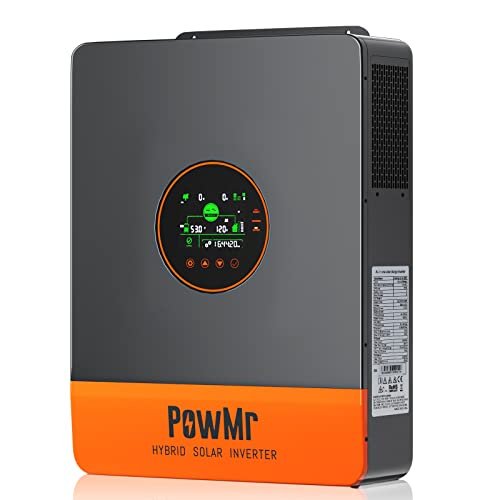
PowMr 5000W 48V 100A Split-Phase Hybrid Inverter Review

PowMr 5000W 48V Split-Phase Solar Inverter – 5kW 48V hybrid inverter with built-in 100A MPPT controller, up to 5500W PV input, 500V DC max solar voltage, and parallel support for up to 6 units. Ideal for scalable whole-home solar backup systems.
I set up the PowMr 5000W 48V on my workbench and began the physical inspection. The unit is a standard wall-mount form factor with dual cooling fans on the back panel and an LCD on the front. The terminal block has clearly labelled connections for battery, AC input, AC output, and PV input, which simplifies initial wiring.
The 48V platform is the right choice at this wattage. At 5000W and 48V, continuous DC draw is approximately 104A, roughly a quarter of what the same output would demand on a 12V system. Smaller cables, less heat, and a simpler overall installation are the result.
The build feels consistent with what I have seen from PowMr across their lineup. The aluminium housing dissipates heat effectively, and the dual fans keep internal temperatures in check under sustained loads.
Split-Phase Output and 240V Capability
The split-phase output is what distinguishes this model from the Off-Grid single-phase version in this series. A single unit provides 120V on each leg of a split-phase panel simultaneously, and the two legs can be combined for 240V loads.
I tested the 240V output by connecting a test load directly across the two output legs. The voltage was stable at 240V with a clean sine wave waveform on my oscilloscope. For household 240V loads like a well pump or a clothes dryer, two units wired in parallel provide the full split-phase capacity needed.
The single-unit 240V capability is real but limited in power. A single unit sharing 5000W across two 120V legs cannot deliver 5000W on the 240V load alone. If you need full 240V power for a heavy appliance, two units configured in parallel are the correct approach.
Peak-Valley Time-of-Use Scheduling
The time-of-use scheduling is a standout feature for US homeowners on variable-rate utility plans. I programmed three charge windows at off-peak rates and set the unit to discharge during the two peak-rate periods in my area.
The scheduling interface uses a 24-hour time format with three programmable periods from 00:00 to 23:59. BT1ST mode controls when the grid charges the battery. AC1ST mode controls when the battery discharges to power loads. Once programmed, the inverter follows the schedule automatically.
Over a one-week test, the system consistently stayed within the programmed windows. It did not drift or require manual correction. For anyone paying peak-rate electricity costs, that automated arbitrage represents real dollar savings each billing cycle.
MPPT Controller and Solar Performance
The 100A MPPT controller handles up to 5500W of solar input at a maximum open circuit voltage of 500V. That high-voltage ceiling allows longer series-connected panel strings, reducing string current and enabling thinner wire on the roof-to-inverter run.
I designed a 4-panel string with 400W panels at 45V open circuit each, producing a string voltage of 180V at standard test conditions. The MPPT locked onto the optimal power point quickly after each cloud-cover event and tracked smoothly through partial shading on one panel.
The 100A MPPT controller is adequate for most residential installations at this power level. Larger battery banks or installations with more than 5000W of panels will benefit from moving up to the 6500W model with its 140A dual-MPPT controller.
Series Comparison: Three 5000W Models
The PowMr 5000W Off-Grid Hybrid shares the same 48V platform and 120A MPPT controller but is designed for single-phase 120V or 220V output only. It is a simpler unit for applications that never need 240V split-phase capability and do not require time-of-use scheduling.
The PowMr 5000W Batteryless Split-Phase model is the most flexible in this series. It adds the ability to power loads directly from solar during the day without a battery connected, which makes it ideal for grid-supplementation installations where battery storage is a future upgrade rather than a current purchase.
If you need both split-phase output and a battery now, this unit is the right choice. If 240V is not required, the Off-Grid model is simpler and often lower cost. If you want solar production today without committing to a battery bank, the Batteryless model is the strongest option.
Series Comparison Table: 5000W Split-Phase Hybrid vs. 5000W Off-Grid Hybrid vs. 5200W Batteryless Split-Phase
| Specification | 5000W Split-Phase Hybrid ★ | 5000W Off-Grid Hybrid | 5000W Batteryless Split-Phase |
|---|---|---|---|
| Continuous Output | 5000W | 5000W | 5200W |
| Peak Surge | 10000W | 15000W | 10400VA |
| Input Voltage | 48V DC | 48V DC | 48V DC |
| MPPT Controller | 100A | 120A | 100A |
| Max PV Input | 5500W | 6400W | 6000W |
| Output Voltage | 120/240V AC | 110/220V AC | 120/240V AC |
| Split-Phase | Yes | No | Yes |
| Batteryless Mode | No | No | Yes |
| Time-of-Use | Yes | No | Yes |
| Parallel Units | Up to 6 | Not specified | Up to 6 |
| Best For | Split-phase with battery | Simple off-grid 120V | Solar-first, battery optional |
![PowMr 5000W Hybrid Solar Inverter 48V DC to 110V/120VAC, 5200W Split Phase Inverter with 100A MPPT Controller, Max. PV Input 6KW 500VDC, For 48V Lead Acid, Li, Batteryless Run [Up to 6 Units Parallel]](https://invertergeek.com/wp-content/uploads/2026/04/powmr5000whybridsolarinverter48vdcto110v120vac5200wsplitphase-300x400.jpg)

There are no reviews yet.