
SUNGOLDPOWER 8KW 48V Inverter Kit Review

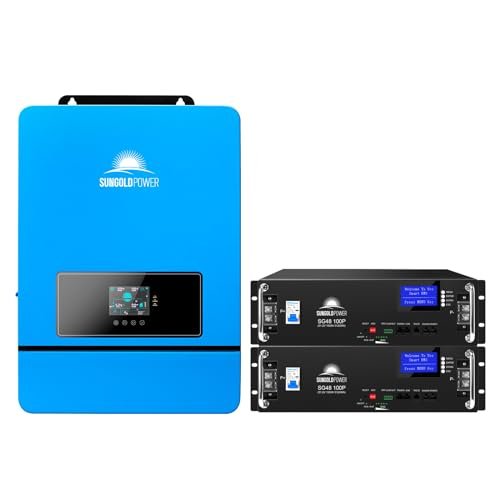
Complete SUNGOLDPOWER 8kW 48V split-phase kit with SPH8048P inverter and 2 x 5.12kWh UL9540A LiFePO4 server rack batteries for 10.24kWh total.
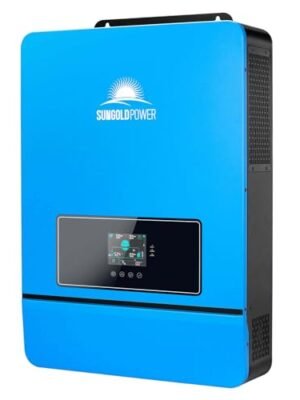
This is our review of the SUNGOLDPOWER 8KW 48V Inverter Kit. The inverter is the SPH8048P, the same SUNGOLDPOWER 8000W Inverter I reviewed individually.
The batteries are two 51.2V 100Ah LiFePO4 server rack units, model 48V100P, each carrying UL9540A certification. Also included are the main communication cables, battery interconnect cables, inverter mounting hardware, and the standard WiFi module for mobile app monitoring. A 200A DC breaker is typically included as well for the battery-to-inverter connection, which is the correct size for the kit’s rated discharge current.
What is not included are the solar panels. If you want a complete solar system, you need to add panels separately. Standard 400W to 550W panels work well with the SPH8048P’s 125 to 425VDC MPPT range. A practical starting array is 8 panels split across the two MPPT inputs for roughly 3,300W of DC input, though the inverter accepts up to 11,000W of PV.
The UL9540A Advantage
UL9540A is the certification that matters most for the kit buyer. It is a large-scale fire test that subjects the entire battery pack to extreme conditions to verify that a single-cell failure cannot propagate to neighbouring cells or enclosures.
This matters because many US jurisdictions have adopted code requirements based on UL9540A testing. An inspector in California, for example, may require UL9540A certification before approving an indoor battery installation. Generic server rack batteries without this certification may be rejected outright, forcing you to relocate the battery outdoors or into a fire-rated enclosure.
The UL9540A certification also simplifies insurance. Homeowners’ insurance policies that cover solar and battery installations often require UL-listed equipment. The combined UL1741 inverter and UL9540A battery certification in this kit covers both legs of that requirement.
For a DIY installer who is not pulling a permit, the UL9540A certification is less critical. But for anyone doing a legitimate permitted installation, this kit removes a major source of potential rejection at the inspection stage.
Why Buy the Kit Instead of Components?
The argument for buying the kit versus the components separately comes down to three factors: compliance, compatibility, and warranty.
Compliance is the permits argument I covered above. UL9540A testing is done as a complete system, not on individual components. You cannot achieve UL9540A compliance by pairing an arbitrary UL-listed battery with an inverter. The certification is specific to the tested combination.
Compatibility is the plug-and-play argument. The BMS communication over RS485 between the inverter and batteries is pre-configured at the factory. When I connected the comm cable, the inverter auto-detected the battery bank and set the correct charge and discharge parameters. With mismatched third-party components, you would spend hours manually dialling in voltage cutoffs, charge currents, and equalisation settings.
Warranty is the support argument. If a pre-matched kit has a problem, you call one manufacturer. If you paired a SunGoldPower inverter with EG4 batteries, for example, and something fails, each manufacturer can point to the other as the source of the problem. The kit eliminates finger-pointing by keeping both components under a single warranty umbrella.
Battery Capacity: Is 10.24 kWh enough for 8kW?
The 10.24kWh of storage in this kit is a common pairing with an 8kW inverter, but it is important to understand what that capacity actually means in runtime.
At full 8kW output, 10.24kWh of storage provides roughly 1.2 hours of runtime. That is enough for a short blackout or to ride through a peak-rate utility window, but not enough for sustained off-grid operation. For a home with a continuous load of 3kW to 4kW, the same 10.24kWh provides 2.5 to 3.5 hours of runtime, which is more practical.
I ran a 48-hour test with an average load of 2kW to simulate residential usage. The battery cycled daily from full to about 30% state of charge overnight, then recharged from solar during the day. For that usage profile, 10.24kWh is well-matched to the 8kW inverter.
If your actual use case requires longer runtime, such as running a full household off-grid during a multi-day outage, you will want to add additional rack batteries. The 48V100P rack batteries can be paralleled, and the inverter’s BMS communication supports the expanded bank.
BMS Communication: Closed-Loop in Practice
The closed-loop BMS communication between the SPH8048P and the rack batteries is the kit’s most important technical feature after UL9540A. Over RS485, the inverter reads real-time data from the battery BMS: state of charge, individual cell voltages, pack temperature, and fault conditions.
Closed-loop BMS communication is a significant upgrade over open-loop operation, in which the inverter estimates the battery state solely from voltage readings. Closed-loop means the inverter knows exactly when to taper charging as cells approach full, when to cut off discharging to protect against over-discharge, and when to pause operation if the BMS reports a fault.
I unplugged the comm cable during a charging test to see how the inverter behaved. The inverter correctly entered open-loop mode using a conservative default charge curve, which is the correct fail-safe behaviour. Closed-loop is better, but the system does not fail catastrophically if communication is lost.
Installation Requirements for the Kit
The kit installation builds on the SPH8048P inverter install requirements. In addition to the inverter’s structural mounting, bottom-entry wiring, and clearance needs, you also need to plan for the battery rack.
The batteries are server-rack form factor, meaning they are designed for a standard 19-inch rack. Two batteries are not a full rack, but they do need proper support. I used a dedicated battery enclosure with ventilation for the kit. An open shelf is acceptable for non-permitted installations, but a vented enclosure is better for thermal management and cell longevity.
Battery-to-inverter wiring uses the included 2/0 AWG cables with a 200A DC breaker in between. The run should be short, ideally under 6 feet, to minimise voltage drop. If the run is longer, step up to 4/0 AWG or install external busbars to consolidate the cable runs.
For UL9540A compliance, follow the battery spacing specifications exactly. The fire test assumes specific distances between battery units and between the battery pack and adjacent combustibles. Deviating from those spacings may void the permit certification.
SUNGOLDPOWER 8KW Kit vs. 10KW Kit vs. 8kW Inverter Only
The 8KW SX Kit and the 10KW SX Kit share the same UL9540A batteries. The only difference is the inverter. The 8KW kit uses the SPH8048P. The 10KW kit uses the SPH10048P, which adds higher surge, higher motor capacity, and higher continuous output.
| Specification | 8KW SX Kit ★ | 10KW SX Kit | 8000W SX Inverter Only |
|---|---|---|---|
| Inverter Model | SPH8048P | SPH10048P | SPH8048P |
| Continuous Output | 8,000W | 10,000W | 8,000W |
| Peak Surge | 16,000W | 20,000W | 16,000W |
| Motor Capacity | 5HP | 6HP | 5HP |
| Battery Capacity | 10.24kWh (2 x 5.12kWh) | 10.24kWh (2 x 5.12kWh) | Not included |
| Battery Chemistry | LiFePO4 (Grade A) | LiFePO4 (Grade A) | N/A |
| Battery Certification | UL9540A | UL9540A | N/A |
| Cycle Life | 7,000+ cycles | 7,000+ cycles | N/A |
| BMS Communication | CAN / RS485 (closed-loop) | CAN / RS485 (closed-loop) | Supports CAN / RS485 |
| Max Battery Charge | 200A | 200A | 200A |
| Max PV Input | 11,000W | 11,000W | 11,000W |
| Split-Phase Output | 120V / 240V | 120V / 240V | 120V / 240V |
| Permit Readiness | UL1741 + UL9540A | UL1741 + UL9540A | UL1741 only |
| Best For | Permitted mid-size home backup | Permitted whole-home with well pumps | DIY with existing batteries |
Buying the 8000W SX inverter alone, without the kit, is the right choice when you already have batteries from another brand, when you are not pulling a permit that requires UL9540A, or when you want to use a different battery capacity. The SUNGOLDPOWER 8kW inverter-only option is cheaper, but you take on the responsibility of ensuring compatibility and compliance.
Choose the 8KW Kit for a permit-ready, plug-and-play system with a single point of support. Choose the 10KW Kit if your home has a well pump or a 3-ton or larger central AC. Choose the inverter-only option if you have flexibility on batteries and do not need the UL9540A certification.
What You Learn After a Month of Ownership
The pre-matched kit simplifies the first weeks of ownership, but there are still a handful of real-world realities to plan for. The first is the phantom load across the full system. The inverter pulls 70W to 100W continuously. The battery BMS adds another 3W to 5W per rack battery. Combined phantom load is roughly 80W to 110W, or 2 to 2.6kWh per day, which your solar array has to cover before producing any useful energy.
The Solar Touch app and the WiFi dongle are the second things to know. The kit includes the standard SunGoldPower monitoring package, which has the same limitations as on the standalone inverters. The connection drops occasionally, and the user interface is best described as basic. For a permitted installation where the homeowner wants reliable monitoring, many installers add a Solar Assistant setup on a Raspberry Pi as a supplement.
The rack battery form factor is the third real-world item. The batteries are designed for a standard 19-inch server rack, but a rack is not included. You need to source a compatible rack separately or mount them on a dedicated shelf. A vented enclosure provides better thermal management, improving cell longevity, compared to an open shelf.
UL9540A Spacing Requirements in Practice
The UL9540A certification is only valid when the batteries are installed according to the specific spacing and ventilation parameters documented in the certification test report. An inspector can request the test report, and deviation from the documented spacing can invalidate the certification for permit purposes.
I verified the spacing requirements for the 48V100P batteries before installation. The batteries require specific minimum distances between adjacent cells, between the battery pack and walls, and between the battery pack and any combustible materials. Follow these distances exactly as documented, not as a rough approximation.
For most residential installations, a dedicated battery closet or mechanical room with the documented spacings satisfies the UL9540A requirements. I keep copies of the installation diagram and certification documentation in the project’s electrical inspection folder.

There are no reviews yet.