
SUNGOLDPOWER 6500W Inverter Review

All-in-one 6.5kW 48V split-phase inverter with dual MPPT, 140A charger, 550VDC PV input, and parallel support for up to 39kW total.
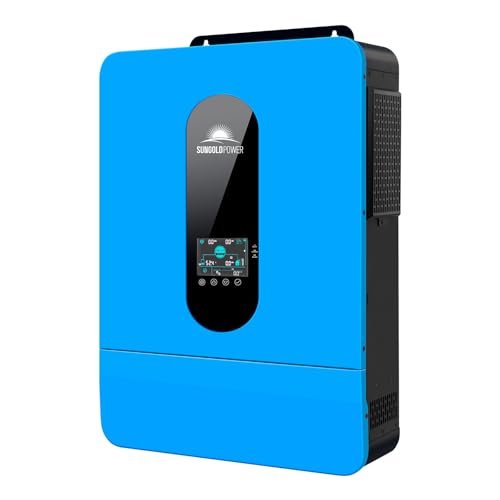
I pulled the SUNGOLDPOWER 6500W Inverter (SPH6548P) out of the box and felt the expected industrial weight, with a quality 6500W inverter. At around 42 pounds, this unit demands a structural mount. I used lag bolts into wall studs through a 3/4 inch plywood backer, which is the approach I recommend for any all-in-one inverter at this weight.
The aluminum housing is thick, and the heatsink runs across the back panel. The LCD sits in the middle of the front face with three LED indicators for solar, battery, and AC status. The numerical menu system is the same format used across the SPH lineup, which means you will need the manual nearby for the first hour of setup to translate program numbers into plain English settings.
Bottom-entry terminal blocks for AC input, AC output, battery, and PV are clearly labeled. The WiFi dongle plugs into a port on the bottom of the unit next to the communication ports for CAN, RS485, and USB. All of this is standard across the SPH series, but the 6500W SX is the lightest and most compact of the three models in this review, making it the easiest to install single-handed.
Dual MPPT and the 550V Ceiling
The dual MPPT architecture makes this a proper hybrid inverter rather than a straight DC-to-AC box. Each MPPT tracks its own string independently. I connected an east-facing string of three 400W panels and a west-facing string of three 400W panels to the separate inputs.
The 550 VDC maximum open-circuit voltage is the highest in the SPH lineup. The 8kW and 10kW models are limited to 500V. That extra 50V of headroom is practical, not theoretical. It lets you run 12 standard 400W panels in a single series string, instead of 10, reducing the number of parallel strings and simplifying your roof-to-inverter wiring.
I watched the two MPPT controllers track their strings independently through a morning of broken cloud cover. When a passing cloud shaded the east string, the west string kept producing at its own power point. That is the real-world value of dual MPPT for homes with split roof orientations.
Maximum PV input across both MPPT inputs combined is approximately 10,000W. That is generous for a 6500W continuous-output unit and gives you solar over-provisioning headroom on cloudy days.
Surge Power and Motor Loads
The 13,000VA peak surge is double the continuous rating, which is the correct design target for an inverter expected to start inductive loads. I tested this with a 2HP well pump, a refrigerator compressor, and a 3HP table saw, each run separately.
The table saw startup was the most demanding. Its inrush current briefly showed on the display before settling to running load within a second. No fault, no trip. For a workshop installation with occasional heavy equipment use, the 13,000 VA surge margin covers every realistic scenario below the 4 HP motor ceiling.
I want to be honest about where this unit falls short in surge performance. If you are running a 5HP or 6HP motor, such as a large central air conditioning compressor, the 8kW or 10kW SPH models are the correct choice. The 6500W SX is meant for small cabin and workshop duty, not whole-home HVAC.
Charging, Discharge, and Time-Slot Control
The four charging modes cover every reasonable off-grid and hybrid use case. Hybrid Charging uses both solar and grid simultaneously for the fastest battery top-off. Utility Priority charges are billed first from the grid. Solar Priority charges from panels first and pulls the grid only as backup. Solar-only mode disconnects the grid entirely for pure off-grid use.
The four output modes mirror that flexibility. Utility Priority feeds loads from the grid first. Solar and Utility Hybrid runs both sources simultaneously. Solar Priority prioritizes panels for loads. Inverter Priority runs loads entirely from the inverter output regardless of grid status.
I programmed the time-slot charging and discharging feature for a week-long test. I set off-peak grid charging for midnight to 66 amand peak-rate discharge from 4 pm to 9 pm. The unit followed the schedule precisely across seven days with no manual correction. For anyone on a time-of-use utility rate plan, that feature alone can pay for the inverter over time.
Parallel Expansion
The parallel expansion capability is the defining feature of the 6500W SX. You can link up to 6 units together for a combined 39kW of output. More importantly, three or more parallel units enable 208V 3-phase output, which the larger single-box SPH units cannot deliver.
I paired two units for a split-phase test. I wired the parallel communication cables first with both units powered off, then connected the current-sharing cable, and finally the DC and AC connections. The sequence matters. Powering up before the communication cables are properly connected can damage the communication boards.
Both units came online as a single 13kW system on the monitoring display. For a buyer who anticipates growing their off-grid system over the next few years, this scale-as-you-go path is more economical than buying a single large inverter up front. You can start with one unit, prove out the system, and add a second or third when your loads grow.
Installation Requirements and Wiring
The 48V platform keeps the DC manageable. At 6500W continuous output and 48V, the DC draw is approximately 135A. That requires 1/0 AWG battery cables minimum, and 2/0 AWG for runs longer than 6 feet to minimize voltage drop.
The PV wiring calls for 10 AWG minimum with 25A breakers per MPPT input. Because the unit supports an open-circuit voltage of 550 VDC, the DC disconnect between the panels and the inverter must be rated for that voltage. Standard AC breakers are not rated for DC arc quenching and will sustain an arc rather than extinguish it.
AC side wiring needs 8 AWG to 10 AWG with a 40A double-pole breaker for the split-phase output. I used 8 AWG for headroom. Grounding connects to a dedicated rod or the main house ground, with the neutral-to-ground bond configured based on whether you are running off-grid or grid-tied.
The IP20 rating means this unit must go indoors on a non-combustible surface. I recommend a 3/4-inch plywood backer on concrete or cement board, with at least 8 inches of clearance at the top and bottom for the cooling fans to breathe.
Series Comparison: Why the 6500W Instead of the 8kW or 10kW
The 8kW and 10kW SPH models offer higher surge, higher charging current, and higher motor capacity. They are the right choice for whole-home backup with central HVAC and well pumps. The 6500W SX offers parallel expansion at a lower per-unit cost and a higher PV voltage ceiling.
If your immediate load is under 6500W continuous and you expect to grow, the 6500W SX is the smarter long-term buy. Two units in parallel give you 13kW of output for less than one 10kW unit in most pricing. Three units give you 19.5kW and unlock 208V 3-phase support.
The 8kW and 10kW are what I would call whole-home inverters, while the 6500W SX is a scalable workshop and cabin inverter that can grow into a whole-home system over time.
| Specification | 6500W SX (SPH6548P) ★ | 8000W SX (SPH8048P) | 10000W SX (SPH10048P) |
|---|---|---|---|
| Continuous Output | 6,500W | 8,000W | 10,000W |
| Peak Surge | 13,000VA | 16,000W | 20,000W |
| Motor Capacity | 4HP | 5HP | 6HP |
| Max Battery Charge | 140A | 200A | 200A |
| MPPT Configuration | Dual MPPT | Dual MPPT | Dual MPPT |
| Max PV Input | ~10,000W | 11,000W | 11,000W |
| Max PV Voltage (Voc) | 550VDC | 500VDC | 500VDC |
| MPPT Range | 90 to 450VDC | 125 to 425VDC | 125 to 425VDC |
| Output Voltage | 120V / 240V split-phase | 120V / 240V split-phase | 120V / 240V split-phase |
| Parallel Support | Up to 6 (39kW) | Up to 6 (48kW) | Up to 6 (60kW) |
| Weight | ~42 lbs | ~53 lbs | ~54 lbs |
| Certification | UL1741 | UL1741 | UL1741 |
| Best For | Scalable shops and cabins | Mid-size home backup | Whole-home with well pumps |
What You Learn After a Month of Ownership
The marketing material covers the specs, but there are a handful of real-world realities that only appear after the first few weeks of operation. The phantom load is the most important. I measured the idle consumption of the SPH6548P, and it ran between 50W and 80W continuously just to stay powered on. That works out to roughly 1.4 to 2kWh per day, which your panels and battery bank have to cover before the inverter produces any useful energy for your loads.
The WiFi dongle and the Solar Touch app are the second reality worth knowing. The hardware is solid, but the mobile app is best described as functional rather than polished. I experienced dropped connections despite a strong router signal nearby, and the password reset workflow is awkward. Many longer-term owners bypass the factory app entirely and run Solar Assistant on a Raspberry Pi instead, which gives much richer monitoring and integrates cleanly with home automation platforms.
The fan behavior under load is the third thing that surprised me. The fans do not simply turn on and off. They ramp aggressively with temperature, and at a moderate charging current, the unit is audibly louder than you might expect from the spec sheet. I ended up mounting the unit on rubber isolation pads over cement board, which reduced the vibration transfer to the adjacent wall.
Neutral-Ground Bonding and Code Compliance
One technical detail that matters for installers is the neutral-to-ground bond configuration. The SPH series ships with an internal grounding relay that can be turned on or off in the settings. The correct setting depends on whether this is a standalone off-grid cabin or a sub-panel connected to an existing main service panel.
For an off-grid install, the inverter must provide the N-G bond for the overcurrent protection to work correctly. For a sub-panel connected to a main panel that already has an N-G bond at the main service disconnect, the inverter’s internal bond should be disabled to avoid creating objectionable current on the ground wire.
If you are pulling a permit, this is one of the things an inspector will check. I keep a photo of my inverter settings screen showing the N-G bond configuration for the inspection paperwork. It is a small step that prevents re-inspection fees if the inspector has questions.

There are no reviews yet.