
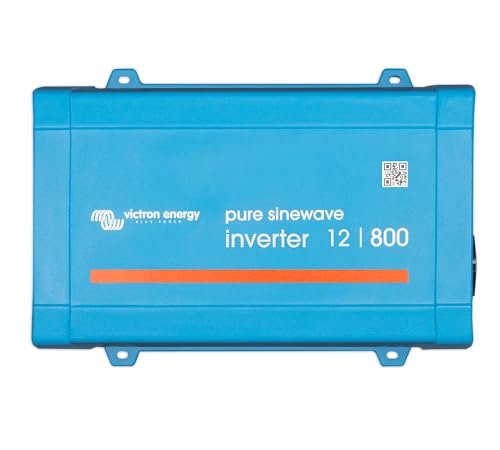
Victron Energy 12V 800VA Inverter Review

The Victron Energy 12V 800VA Inverter is the sweet spot for the average van-lifer who does not run a microwave. It handles a laptop, a 12V compressor fridge, a blender, and phone charging without the heavier cabling demands of the 1200VA model. The 1500W peak surge gives it enough punch to start most small motor loads, and the compact chassis fits under a seat or in a cabinet where the 1200VA would be too large.
This is my review of the Victron Energy Phoenix 800VA 12V 120V AC Pure Sine Wave Inverter (NEMA 5-15R), a compact, efficient solution for 12V battery systems in mobile and off-grid applications. It delivers 700W continuous output (800VA) with a peak surge of 1500W, making it well-suited for running small appliances, laptops, fridges, blenders, and entertainment systems. Its ECO mode idle draw of just 1W makes it ideal for RVs, vans, boats, and camping setups where conserving battery power is important.
For my installation, I paired the inverter with essential Victron accessories to ensure a safe, fully functional setup. For communication and monitoring, I used the VE.Direct Bluetooth Smart Dongle for mobile access, with the option of the VE.Direct-to-USB Interface for PC-based configuration. On the protection side, I installed a 125A Victron MIDI fuse with a proper MIDI fuse holder (32V rated), which is critical for system safety. I also integrated the Phoenix VE.Direct remote on/off panel for convenient control.
From an installation perspective, I sized cables according to run length: 16 mm² (approx. 6 AWG) for runs up to 1.5 meters, and 25 mm² (approx. 4 AWG) for runs up to 3 meters. Grounding was done with a minimum of 10 mm² to maintain stability and safety. This setup reflects my approach to real-world installs: proper protection, correct cabling, and reliable control integration to get the most out of the inverter.
First Look and Build Quality
I pulled the Victron Energy 12V 800VA out of the box and set it next to the 1200VA model for a side-by-side comparison. The 800VA is noticeably more compact. The housing is the same powder-coated aluminum construction, but the form factor is smaller and lighter because the toroidal transformer inside is sized for 800VA rather than 1200VA.
I inspected the terminal block and found the same-quality screw terminals as in the larger unit. At 800 VA and 12V, the continuous current draw is roughly 83 A at full load. The terminals accept the 6 AWG cable required for short runs without any issues. The VE. Direct port is in the same position on the front panel. I connected the Bluetooth dongle and had the unit visible in VictronConnect within seconds.
The temperature-controlled fan on this model operates similarly to the 1200VA version. It stays off at idle and low loads, making the unit silent in ECO mode. Under sustained loads above roughly 400W, the fan engages at a moderate speed. The overall noise profile is quieter than that of the 1200VA because the power stage generates less heat at lower wattage.
What Is in the Box
The package includes the inverter and a manual. No battery cables are included. For a 12V 800VA unit, I sourced 6 AWG cable for my test installation, which is the correct gauge for runs under 1.5 meters at this current level. The 125A MIDI Fuse and holder must be purchased separately. I installed the fuse within 300mm of the battery positive terminal, which is standard practice for any inverter installation.
The Phoenix Inverter Control VE. The direct panel is the same remote switch available for the entire Phoenix line. I wired it to a panel in the front of the van for convenient daily on/off control without reaching into the cabinet.
Outputs and Features
The 12V 800VA delivers 700W of continuous output through a single NEMA 5-15R AC outlet. The 1500W peak surge is sufficient for a blender, a small power tool, or a compressor fridge startup. The unit will not start a microwave, which typically requires over 1100W, including its startup spike. If a microwave is anywhere on your load list, the 12V 1200VA is the correct choice.
ECO mode drops the idle draw to 1W, the same as the 1200VA. In practice, the 800VA is the better choice for a van or camper where the inverter runs throughout the day at light loads. The lower-rated wattage means less heat generation and less fan noise during typical use. The VictronConnect app, via the Bluetooth dongle, provides real-time wattage, battery voltage, and programmable protection thresholds.
Efficiency on this model is approximately 90 to 91 per cent, similar to the 1200VA. The toroidal transformer maintains high efficiency across a wide load range, which is one of the reasons Victron units generate significantly less heat than budget high-frequency inverters at the same continuous wattage.
Protection Features
The 12V 800VA includes the same protection suite as the rest of the Phoenix line: low-voltage, high-voltage, overload, over-temperature, and short-circuit protection. The SinusMax surge handling delivers 1500W peak from a 700W continuous unit, for a 2.1:1 surge ratio. That covers most small motor starts without tripping the overload protection.
The Dynamic Cut-off feature, programmable through VictronConnect, prevents false shutdowns when battery voltage sags momentarily under a heavy surge. For a van running a lithium-iron-phosphate bank, setting the Dynamic Cut-off correctly is one of the most important commissioning steps. A fixed cut-off threshold tuned for lead-acid will cause unnecessary shutdowns on a lithium bank that is still well within its usable range.
Potential Point of Failure
The mounting surface matters more than most buyers expect. The toroidal transformer in this unit produces a low-frequency hum at around 25 to 30 dB when powered on. I tested the 800 VA unit mounted directly to a thin plywood panel and found the panel resonated audibly. I switched to rubber vibration mounts, and the perceived noise dropped significantly. For a sleeping area in a van, those mounts are worth buying.
The 700W continuous rating is also worth planning around,d honestly. Running this unit continuously at 700W for extended periods in a hot ambient environment will engage the fan and eventually trigger thermal derating. Install it in a ventilated space with at least two inches of clearance on all sides. A sealed cabinet with no airflow will trigger thermal protection within 20 to 30 minutes at full load.
Victron Energy 12V Inverter Lineup Comparison
| Spec | 800VA ★ | 250VA | 375VA | 1200VA |
|---|---|---|---|---|
| Continuous | 700W | 200W | 300W | 1000W |
| Peak Surge | 1500W | 400W | 700W | 2400W |
| Input | 12V | 12V | 12V | 12V |
| ECO Idle | 1W | 0.8W | 0.9W | 1W |
| Fuse | 125A | 60A | 80A | 200A |
| Cable (0-1.5m) | 6 AWG | 12 AWG | 10 AWG | 4 AWG |
| Chassis | Large | Small | Small | Large |
Use Case Recommendation
Choose the 12V 800VA for a van or camper build where your loads are a laptop, a small fridge, a blender, and device charging. It handles all of those comfortably and saves roughly 100 dollars compared to the 1200VA. Step up to the 1200VA only if a microwave or a high-draw power tool is on the load list. If you are building a new system and can choose battery voltage, the 24V 800VA runs the same loads with lower current, thinner cables, and slightly less heat in the wiring.
Summary
The Victron Energy 12V 800VA is the most practical unit in the 12V Phoenix range for everyday van-life and camper use. The 1500W surge, quiet ECO mode, V E.Direct programmability, and durable toroidal construction make it a reliable long-term install. Size your cables and fuses correctly, mount them with airflow clearance, and they will deliver clean power for well over a decade.

There are no reviews yet.