Victron Energy 24V 375VA Inverter Review

The Victron Energy 24V 375VA Inverter sits between the 250VA and 500VA in the 24V range and is the just-right choice for small 24V solar setups powering lighting circuits or small entertainment centers in off-grid sheds. The fully programmable Dynamic Cut-off is the feature buyers should know about. It protects expensive battery banks by adjusting the shutdown voltage based on the exact load being drawn at that moment, which prevents nuisance shutdowns under high-draw conditions while still protecting the battery from genuine deep discharge.
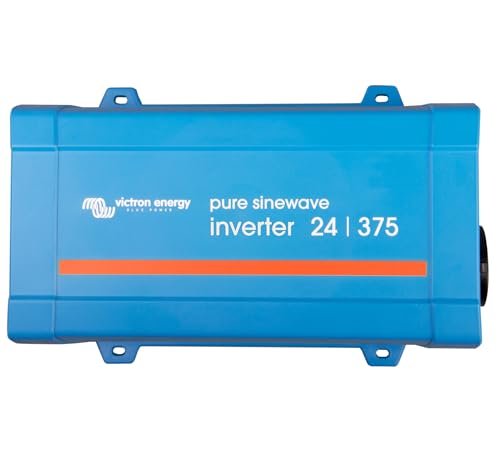
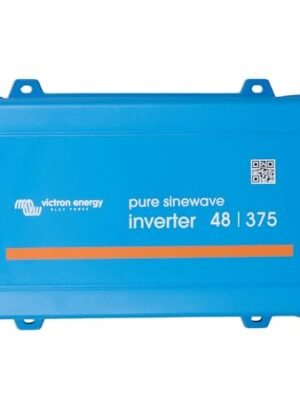
This is my review of the Victron Energy Phoenix 375VA 24V 120V AC Pure Sine Wave Inverter (NEMA 5-15R). It is a compact inverter designed for smaller 24V systems where efficiency and reliability matter more than raw power. It delivers 300W of continuous output (375VA) and can handle surge loads up to 700W. The ECO mode is very efficient, with a low idle draw of 1.4W, which helps preserve battery life during light or standby use.
I recommend this model for RVs, boats, cars, workshops, off-grid sheds, lighting circuits, and entertainment setups. It is a good fit for small loads that require stable, clean power without oversizing the system.
For a complete and safe setup, I paired it with essential Victron accessories. For communication and monitoring, I used either the VE.Direct Bluetooth Smart Dongle for mobile access or the VE.Direct-to-USB interface for PC configuration.
For system protection, I installed a Victron MIDI fuse with a proper fuse holder. This model requires a 40A, 32V-rated MIDI fuse to protect the inverter and wiring from faults or overloads.
For control, I added the Phoenix Inverter VE.Direct remote on/off switch panel, making operation simple without accessing the inverter.
For cabling, I followed proper sizing based on distance. For cable runs from 0 to 1.5 meters, I used 4 mm² (about 12 AWG). For 1.5 to 3 meters, I used 6 mm² (about 10 AWG). For grounding, I used a minimum of 2.5 mm² to ensure safe and stable system performance.
First Look and Build Quality
I unboxed the Victron Energy 24V 375VA and set it on my workbench alongside the Victron Energy 24V 250VA for comparison. The two units share the same compact aluminum chassis. The 375VA is indistinguishable from the 250VA by appearance alone – the VE.Direct port, screw terminals, and NEMA 5-15R outlet are in identical positions. The difference is in the internal power stage, which is rated for 300W continuous and 700W surge compared to 200W and 400W in the 250VA.
I connected the unit to a 24V lithium-iron-phosphate bank in my test setup and paired the Bluetooth dongle with VictronConnect. I ran a small LED entertainment center through the unit, including a 32-inch LED television at 45W, a streaming device at 15W, and a sound bar at 30W. The total draw of 90W barely registers on the 300W continuous rating, and the unit ran silently in convective cooling mode throughout the evening test.
The Dynamic Cut-off feature is what I spent the most time configuring during this review. I set four points on the Dynamic Cut-off curve corresponding to different load levels. At 50W load, the cut-off is set to 22.8V. At 300W load, the cut-off drops to 21V to account for the voltage sag the battery experiences under heavier draw. That programmable curve prevents the inverter from shutting down the television mid-movie when the battery voltage sags during a brief power draw spike.
What Is in the Box
The package includes the inverter and a manual. No battery cables are included. For this unit, I used 12 AWG cable for runs under 1.5 meters. The 40A MIDI Fuse and holder must be purchased and installed separately – the Phoenix Inverter Control VE.Direct remote panel is a practical addition for a shed installation where the inverter is mounted in an inconvenient location.
Outputs and Features
The Victron Energy 24V 375VA delivers 300W continuously and a 700W peak surge through a single NEMA 5-15R outlet. That covers an LED television, a streaming box, a sound bar, LED lighting, and device charging simultaneously without approaching the continuous limit. The 700W surge handles the startup spikes of LED power drivers and small electronics cleanly.
ECO mode draws 1.4W at idle, slightly higher than the Victron Energy 24V 250VA at 1.3W. In ECO mode, the unit pulses every 2.5 seconds to detect a connected load. For a shed where the lights and entertainment center are on for several hours in the evening and then off overnight, ECO mode keeps overnight battery drain from the inverter itself very low.
Pure sine wave output at 300W is compatible with all electronics, including televisions, audio equipment, and sensitive chargers. The VictronConnect app displays real-time wattage, input voltage, and any active protection events. I monitored the unit during an extended weekend test in an off-grid shed and found no protection events during normal use.
Protection Features
Protection includes low-voltage, high-voltage, overload, overtemperature, and short-circuit protection. The Dynamic Cut-off is the most practically useful protection feature for battery preservation. I tested it by running the inverter on a partially discharged lithium bank and confirmed that the cut-off adjusted correctly as I varied the load between 50W and 280W. The unit stayed on through load variations that would have triggered a fixed-threshold inverter to shut down unnecessarily.
The convective cooling keeps the unit silent under normal loads. I ran a sustained 280W load for one hour and checked the housing temperature. It was warm but well within safe handling range. No fan engaged during the test. For a shed or cabin where evening silence matters, convective cooling offers a significant comfort advantage.
Potential Point of Failure
The 1.4W idle draw in non-ECO mode is worth addressing for systems where the inverter is left continuously powered on. For a seasonal shed, turning the inverter off at the main DC switch during periods of inactivity prevents unnecessary battery drain. The physical remote switch makes it a one-step operation from the shed door.
The compact chassis screw terminals accept up to 10 mm2 wire. For this 24V unit, 12 AWG cable is appropriate for the current levels involved. The risk is inadvertently using a heavier cable from a previous 12V installation. Check the terminal specification before sourcing the cable for this unit.
Victron Energy 24V Lineup Comparison
| Spec | 375VA ★ | 250VA | 500VA | 800VA | 1200VA |
|---|---|---|---|---|---|
| Continuous | 300W | 200W | 400W | 700W | 1000W |
| Peak Surge | 700W | 400W | 900W | 1500W | 2200W |
| Input | 24V | 24V | 24V | 24V | 24V |
| ECO Idle | 1.4W | 1.3W | 1.5W | 1.5W | 1W |
| Fuse | 40A | 30A | 60A | 80A | 100A |
| Cable (0-1.5m) | 12 AWG | 14 AWG | 10 AWG | 10 AWG | 8 AWG |
| Chassis | Small | Small | Small | Large | Large |
Use Case Recommendation
Choose the Victron Energy 24V 375VA for a small 24V off-grid shed, a tiny home, or a boat with primary loads of LED lighting, a small television, and device charging. The Dynamic Cut-off programmability makes it particularly well-suited for setups where battery protection is a priority. If your loads include a blender or a small appliance with a motor, step up to the Victron Energy 24V 500VA. If your load list is a single device and compact size is the primary concern, the Victron Energy 24V 250VA is slightly lighter and draws marginally less at idle.
Summary
The Victron Energy 24V 375VA is the practical choice for small off-grid lighting and entertainment applications on a 24V system: the Dynamic Cut-off programmability, convective cooling, and VE.Direct monitoring and Victron’s build quality make it a reliable long-term install. Plan your load list against the 300W continuous limit and, during commissioning, configure the Dynamic Cut-off in VictronConnect to provide the best protection for your battery bank.

There are no reviews yet.