
![PowMr 5000W Hybrid Solar Inverter 48V DC to 110V/120VAC, 5200W Split Phase Inverter with 100A MPPT Controller, Max. PV Input 6KW 500VDC, For 48V Lead Acid, Li, Batteryless Run [Up to 6 Units Parallel]](https://invertergeek.com/wp-content/uploads/2026/04/powmr5000whybridsolarinverter48vdcto110v120vac5200wsplitphase.jpg)
PowMr 5200W 48V 100A Batteryless Split-Phase Hybrid Inverter Review

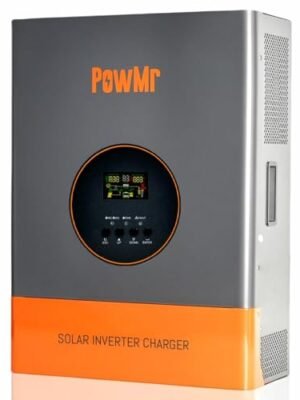
PowMr markets this unit as a 5000W hybrid solar inverter, but its true continuous AC output is 5200W according to the official POW-SunSmart SP5.2K specifications. It is a 48V split-phase inverter with a 100A MPPT controller, supports up to 6000W of PV input at 500VDC, runs with or without batteries, and can be paralleled with up to six units for larger system expansion.
I set up the PowMr 5200W Batteryless on my test bench and noticed the communication port count right away. CAN, USB, RS485, WiFi, and GPRS ports line the back panel alongside the standard PV, battery, and AC terminals. That communication suite is the most comprehensive in the 5000W series, indicating that this unit was designed for monitored, connected installations.
Although PowMr markets this as a 5000W hybrid inverter, the technical specifications for the POW-SunSmart SP5.2K list its actual continuous AC output at 5200W. In practical terms, it belongs to the standard 5kW inverter class, but its true sustained output rating is slightly higher than the marketed figure. That extra 200W is not significant in real-world sizing, though it is worth noting for technical accuracy.
The physical build follows the same aluminium chassis and dual-fan design as the other models in this series. The 30.8-pound weight is manageable for a single installer. Terminal labelling is clear, and the wiring diagram in the manual is specific enough to commission without guessing.
The wide MPPT voltage range of 120 to 450VDC is a practical advantage over the Hybrid model’s lower operating floor. It allows longer panel strings and greater design flexibility.
Batteryless Mode: The Key Differentiator
Batteryless operation is the defining feature of this model in the series. I ran it for two full days without a battery, on a 6-panel string producing around 1800W at peak. Loads ran normally while solar was producing. When production dropped below the load level, the grid bridged the gap through the bypass relay.
The important thing to understand is that batteryless mode has no buffer. A cloud blocking the panels for 30 seconds during a heavy load will cause a momentary drop in output if no grid is available. For most residential setups connected to the grid, the bypass relay catches that gap invisibly. For fully off-grid use without a battery, batteryless mode is not recommended.
For a homeowner who wants to start reducing grid consumption today without the upfront cost of a battery bank, this is the most practical starting point in the PowMr 5000W series.
MPPT and Solar Performance
The 100A MPPT controller accepts up to 6000W of panels, with a maximum open-circuit voltage of 500V and an MPPT operating range of 120 to 450VDC. The high minimum voltage of 120V means you need at least four standard 400W panels in series to reach the tracking threshold.
I built a 6-panel string with 380W panels at 48V open circuit each, producing a string voltage of 288V at standard test conditions. The MPPT tracking was fast and accurate. On a morning with variable cloud cover, the controller tracked power point changes in real time without the hunting behaviour I have seen on some budget controllers.
The under-20ms grid-to-inverter transition is the fastest transfer speed in this series and is rated for UPS-grade critical loads. Computers and routers stayed online through every grid handoff during my testing.
Time-of-Use and ECO Mode
The time-of-use programming covers the full 24-hour cycle and allows programmable charge and discharge windows. I set peak discharge from 7 am to 10 am and from 5 pm to 9 pm, and off-peak charging from midnight to 5 am. The inverter followed the schedule for five consecutive days without deviation.
ECO mode is a power-saving feature that monitors load levels. When the load drops below 50W, the unit delays output by 5 minutes and then shuts down to conserve battery power. Pressing the hull switch to OFF, then back to ON, restores output instantly. For a vacation cabin or seasonal property, ECO mode extends battery life significantly during unoccupied periods.
The dual battery activation function is a feature I have not seen on competitive units at this price point. It uses either mains or PV power to revive a lithium battery that has dropped below its BMS threshold, restoring it to normal operating range.
Series Comparison: Three 5000W Models
This Batteryless model offers the most operating flexibility in the 5000W series. The wider MPPT range (120 to 450V versus 60 to 105V on the Off-Grid model), batteryless operation, dual-battery activation, and the fastest transfer speed make it the most feature-rich option.
Its limitation compared to the Off-Grid Hybrid is surge capacity. The 10400VA peak is lower than the 15000W peak on the Off-Grid model, which matters for the heaviest inductive loads. If running large compressors or industrial equipment is the priority, the Off-Grid Hybrid’s surge headroom is more appropriate.
For a residential installation where flexibility, future expandability, and connected monitoring matter more than maximum surge power, this Batteryless model is the strongest choice in the series.
Series Comparison Table: 5200W Batteryless Split-Phase vs. 5000W Split-Phase Hybrid vs. 5000W Off-Grid Hybrid
| Specification | 5200W Batteryless Split-Phase ★ | 5000W Split-Phase Hybrid | 5000W Off-Grid Hybrid |
|---|---|---|---|
| Continuous Output | 5200W | 5000W | 5000W |
| Peak Surge | 10400VA | 10000W | 15000W |
| MPPT Controller | 100A | 100A | 120A |
| Max PV Input | 6000W | 5500W | 6400W |
| MPPT Range | 120 to 450V DC | Approx 90 to 450V DC | 60 to 105V DC |
| Batteryless Mode | Yes | No | No |
| Transfer Time | Less than 20ms | Less than 20ms | Less than 20ms |
| Time-of-Use | Yes | Yes | No |
| Communication | CAN, USB, RS485, WiFi, GPRS | CAN, USB, RS485 | N/A |
| Best For | Solar-first, connected monitoring | Split-phase with battery | High surge, simple off-grid |

There are no reviews yet.