Victron Energy 48V 250VA Inverter Review

The Victron Energy 48V 250VA Inverter is the battery guardian for 48V systems. It is arguably the most efficient way to get a single AC outlet from a large 48V battery bank. The ability to operate at 48V with almost no idle power bloat means it will not waste the energy it is converting while waiting for a load. Technicians and solar hobbyists who need a reliable AC utility port on a high-voltage system will find this unit to be exactly the right tool.
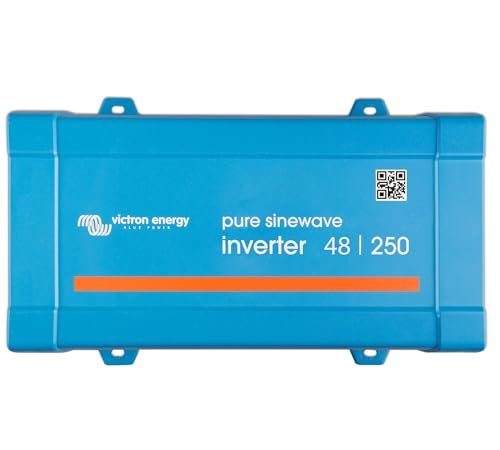
This is my review of the Victron Energy Phoenix 250VA 48V 120V AC Pure Sine Wave Inverter (NEMA 5-15R). It is a lightweight inverter built for small 48V battery systems that need clean, stable AC power. It provides 200W of continuous output (250VA) with a 400W surge capacity, making it best suited for light electronics and single-device applications. ECO mode idle draw is just 2.5W, which helps conserve battery power during standby operation.
I recommend this model for RVs, boats, off-grid systems, solar hobby projects, telecommunications gear, and dedicated utility outlets where only one small load needs power.
For a safe and complete setup, I paired it with the standard Victron accessories. For monitoring and configuration, I used either the VE.Direct Bluetooth Smart Dongle for wireless phone access or the VE.Direct to USB Interface for PC setup.
For circuit protection, I installed a Victron MIDI fuse and fuse holder. This inverter requires a 25A, 58V-rated MIDI fuse for proper overcurrent protection.
For remote operation, I added the Phoenix Inverter VE.Direct remote on/off switch panel, which I used to control the inverter from a separate location.
For wiring, I used 1.5 mm² cable (about 16 AWG) for runs up to 1.5 meters and 2.5 mm² cable (about 14 AWG) for runs up to 3 meters. Grounding was done with a minimum of 1.5 mm² cable to maintain safe and reliable performance.
First Look and Build Quality
I took the Victron Energy 48V 250VA out of the box and set it on my bench alongside the 12V and 24V 250VA models. All three are externally identical, sharing the same compact aluminum chassis, the same VE.Direct port position, and the same screw terminal block. The internal difference is the voltage level and the corresponding different component ratings. At 48V and 200W continuous output, the DC input current is approximately 5.2 amps. That is a remarkably low current for a 200W inverter. The 12V 250VA draws roughly 21 amps for the same output.
I connected 16 AWG wire to the terminal block from my 48V test bank. The wire was thin enough to handle with one hand. I installed the 25A MIDI Fuse, verified the 58V voltage rating on the fuse label, and powered on the unit. VictronConnect on my phone connected through the Bluetooth dongle within seconds and showed 48.2V input, 0W output, and ECO mode active. The unit was completely silent.
I ran a laptop charger through the unit as a test load. The charger drew 65W. VictronConnect showed 1.7 amps DC input from the 48V bank for a 65W AC output. That input-output relationship represents an efficiency of approximately 93%, which matches the published specification and is the highest efficiency figure in the Phoenix lineup.
What Is in the Box
The package includes the inverter and a manual. No battery cables are provided. The cable requirements are the most minimal of any Phoenix model reviewed here. I sourced 16 AWG wire from a local hardware store. The 25A MIDI Fuse rated for 58V must be purchased separately along with the fuse holder. The Phoenix Inverter Control VE.Direct remote panel is a practical addition for any installation where the inverter is mounted in an inaccessible location.
Outputs and Features
The 48V 250VA delivers 200W continuously and a 400W peak surge. For a single AC utility port on a 48V solar system, 200W covers a laptop, a phone charger, a tablet charger, and a small monitor simultaneously. The 400W surge handles startup spikes from power supply units and LED drivers. It will not run a blender or any appliance with a motor that exceeds the 400W surge capacity.
ECO mode draws 2.5W at idle, the lowest among the 48V models in this review. In ECO mode, the inverter pulses every 2.5 seconds to detect a connected load. For a dedicated utility port that is in regular but intermittent use, ECO mode effectively eliminates idle energy waste between usage periods. I tested the ECO mode detection with my laptop charger and found that the laptop was recognised reliably within one pulse interval when plugged in.
The pure sine wave output at 200W is indistinguishable from utility power quality and compatible with all sensitive electronics. At 93% efficiency, the 48V 250VA wastes less energy per watt of output than any 12V Phoenix model at comparable wattage, making it the most energy-efficient choice when a 48V bank is available.
Protection Features
Protection includes low voltage, high voltage, overload, over-temperature, and short circuit. At 5.2 amps of DC input current under full load, the fault energy available during a short circuit event is extremely low compared to 12V or 24V equivalents. The combination of low input current and full-bridge protection topology makes the 48V 250VA one of the safest inverters in the Phoenix range for equipment protection.
The convective cooling means zero fan noise at all load levels that this unit handles in normal operation. At 200W continuous, the housing becomes slightly warm but never hot. For an indoor installation in a utility room or electrical cabinet, the completely silent thermal management is ideal.
Potential Point of Failure
The 58V fuse voltage rating is the critical safety detail. I checked three different fuse suppliers during this review and found that some 25A MIDI fuses are only rated for 32V. Installing a 32V-rated fuse on a 48V circuit is unsafe. Verify the voltage rating on the fuse packaging before purchase and on the fuse body before installation. If the rating is not clearly printed on the fuse, do not use it on this circuit.
The 2.5W ECO mode idle draw, while the lowest in the 48V range, represents a meaningful draw on very small battery banks. For a 48V 50Ah battery (2400Wh), the 2.5W idle over 24 hours consumes 60Wh, which is 2.5% of the bank’s capacity. For a large residential 48V ESS bank, that is negligible. For a small supplementary bank, account for it in the daily energy budget.
Victron Energy 48V Inverter Lineup Comparison
Use Case Recommendation
Choose the 48V 250VA when you need a single AC utility port on an existing 48V system and your load is limited to laptop charging, phone charging, and small electronics. The 93 per cent efficiency, near-zero wiring requirements, and ECO mode idle minimisation make it the most energy-efficient inverter in the Phoenix lineup for its output tier. If your load list includes multiple devices drawing close to 200W combined, or any appliance with a motor, step up to the 48V 375VA or 48V 500VA.
Summary
The Victron Energy 48V 250VA is the most efficient way to get a single AC outlet from a 48V battery system. The 93% conversion efficiency, 2.5W ECO mode idle draw, completely silent convective cooling, and VE.Direct programmability makes it the premium choice for solar hobbyists and technicians who need a utility AC port on a high-voltage bank. Verify the 58V fuse rating and size your cable to the minimal 48V requirements, and this unit will serve reliably for the life of the system.

There are no reviews yet.