Victron Energy 24V 500VA Inverter Review

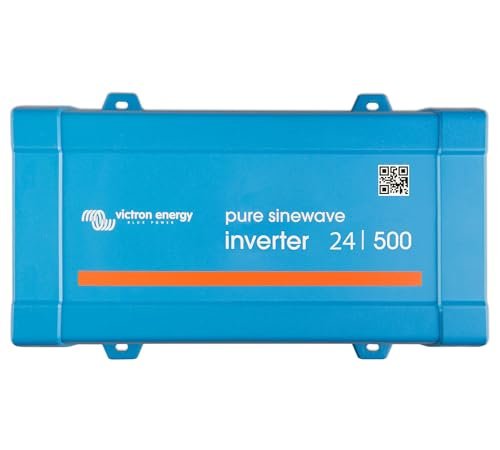
The Victron Energy 24V 500VA Inverter is designed for small 24V systems common in trucking, specialised marine setups, and small off-grid cabins. By running at 24V, it reduces cable thickness and heat loss compared to 12V models at the same output. The unit is uniquely stable in industrial environments, offering high-efficiency power conversion for communication equipment, small 24V refrigerators, and dedicated electronic loads that need clean, reliable power around the clock.
This is my review of the Victron Energy Phoenix 500VA 24V 120V AC Pure Sine Wave Inverter (NEMA 5-15R). It is a small but reliable inverter built for 24V battery systems. It provides 400W of continuous power (500VA) and can handle surge loads up to 900W. It also has an ECO mode with a very low idle draw of 1.5W, which helps reduce battery drain during light use or standby.
I recommend this inverter for trucking, marine use, off-grid cabins, communication systems, and small backup setups. It is also suitable for running light loads like small refrigerators and basic electronics where stable power is needed.
For a complete and safe installation, I paired it with key Victron accessories. For monitoring and configuration, I used either the VE.Direct Bluetooth Smart Dongle for phone and tablet access or the VE.Direct to USB Interface for PC setup.
For protection, I installed a Victron MIDI fuse and a proper MIDI fuse holder. This model requires a 60A, 32V-rated MIDI fuse to protect the system properly.
For control, I added the Phoenix Inverter VE.Direct remote on/off switch panel, which allows easy operation without directly accessing the unit.
For cabling, I followed the correct sizing based on distance. For runs between 0 and 1.5 meters, I used 6 mm² (about 10 AWG). For 1.5 to 3 meters, I used 10 mm² (about 8 AWG). For grounding, I used a minimum of 4 mm² to ensure safe and stable performance.
First Look and Build Quality
I unboxed the Victron Energy 24V 500VA and set it next to the 12V 500VA model for direct comparison. The housing is the compact chassis used across the 250VA to 500VA range, identical externally to the 12V counterpart. The internal design is where the 24V advantage lives. At 400W output and 24V input, the unit draws approximately 23 amps DC, compared to roughly 46 amps for the 12V version at the same output. That difference in current is the reason the 24V model runs cooler, requires thinner cable, and is more stable in industrial and commercial environments with longer wiring runs.
I inspected the compact screw terminals and connected a 10 AWG cable from my test 24V battery bank. The terminal accepted the cable cleanly, the VE.Direct port sits on the front panel. I connected the Bluetooth dongle and opened VictronConnect. The unit was recognised immediately and showed input voltage, output wattage, and operating status in real time.
Cooling on this model is a hybrid approach. The aluminium housing serves as the primary heat sink. A fan assists at higher loads. During my testing at 400W continuous, the fan engaged briefly at moderate speed and then reduced back to off once the housing temperature stabilised. At typical loads of 200 to 300W, the unit runs silently.
What Is in the Box
The package includes the inverter and a manual. No battery cables are included. For this unit, I used 10 AWG cable for the test installation. The 60A MIDI Fuse and holder must be purchased separately. That fuse rating is significantly lower than what the 12V 500VA would require, reflecting the lower current draw at 24V. The lighter fuse and cable requirements are a practical advantage for installations in commercial vehicles or remote cabins where cable routing is constrained.
Outputs and Features
The 24V 500VA delivers 400W continuously and a 900W peak surge. That covers a small refrigerator compressor startup, a laptop under heavy load, a small LED monitor, and device charging simultaneously without reaching the continuous limit. Communication equipment, routers, Starlink dishes, and security cameras are particularly well-suited to this unit because they draw modest continuous power and benefit from the clean, pure sine wave output.
ECO mode draws 1.5W at idle. The 900W surge is handled well by the SinusMax design. I tested the unit, starting a 12V refrigerator compressor through a 24V to 12V converter during my evaluation. The startup surge was approximately 650W, well within the 900W peak capacity. The unit did not trip and resumed normal operation within two seconds of the compressor reaching running speed.
VictronConnect programmability is fully available through the VE.Direct port and Bluetooth dongle. I set the Dynamic Cut-off for the lithium bank in my test setup and confirmed that the unit ignored the brief startup sag without triggering a low-voltage shutdown. The output voltage adjustment and ECO mode sensitivity settings are the same as the rest of the Phoenix line.
Protection Features
The 24V 500VA includes low voltage, high voltage, overload, over-temperature, and short circuit protection. The hybrid cooling keeps the unit within thermal limits during a sustained 400W load without generating the fan noise levels of the larger chassis models. The SinusMax surge design handles the 900W peak reliably for the motor and converter loads this unit is designed to power.
The pure sine wave output is compatible with all sensitive electronics, including medical devices, communications equipment, and precision instruments. Modified sine wave inverters in this wattage class are available at a fraction of the price. Still, the harmonic distortion they introduce causes measurable long-term degradation in power supply capacitors and transformer cores in sensitive equipment. For industrial and communications applications, that distinction justifies the Victron price premium.
Potential Point of Failure
The 1.5W idle draw is worth planning for in a system where the inverter runs continuously, powering always-on equipment. For a Starlink dish drawing 60W and running 24 hours a day, the additional 1.5W from the inverter idle represents about 2.5 per cent overhead. That is acceptable in most installations. For a system with very tight energy budgets, putting the inverter on a timer or using the remote switch to power it down during known idle periods is the right approach.
The compact chassis screw terminals are rated for a maximum cable size of 10 mm2. For the current levels of this 24V unit, that is rarely a constraint. The risk comes when users try to use the 24V 500VA with an oversized cable left over from a previous 12V installation. Forcing a cable larger than 10 mm2 into the screw terminal damages the terminal face. Use the correct gauge for this model.
Victron Energy 24V Lineup Comparison
| Spec | 500VA ★ | 250VA | 375VA | 800VA | 1200VA |
|---|---|---|---|---|---|
| Continuous | 400W | 200W | 300W | 700W | 1000W |
| Peak Surge | 900W | 400W | 700W | 1500W | 2200W |
| Input | 24V | 24V | 24V | 24V | 24V |
| ECO Idle | 1.5W | 1.3W | 1.4W | 1.5W | 1W |
| Efficiency | ~92% | ~92% | ~92% | ~92% | ~92% |
| Fuse | 60A | 30A | 40A | 80A | 100A |
| Cable (0-1.5m) | 10 AWG | 14 AWG | 12 AWG | 10 AWG | 8 AWG |
| Chassis | Small | Small | Small | Large | Large |
Use Case Recommendation
Choose the 24V 500VA for a 24V system that runs communication equipment, a small refrigerator, security cameras, or a Starlink dish as a primary load. The lower current at 24V makes it a more practical and more stable choice than a 12V inverter at the same wattage for any installation with cable runs over 1.5 meters. If your loads include a blender or kitchen appliance with a motor, step up to the 24V 800VA. If your loads are very small and defined, the 24V 375VA or 24V 250VA saves money and reduces idle draw.
Summary
The Victron Energy 24V 500VA is a reliable, efficient inverter for small industrial and commercial 24V applications: the hybrid cooling, 900W surge, VE.Direct programmability and 24V efficiency advantages over 12V equivalents make it a sound long-term choice for trucking, marine, and off-grid cabin use. Plan cable sizing based on the 24V current levels, not 12V, and this unit will run quietly and reliably for years.

There are no reviews yet.