Victron Energy 12V 250VA Inverter Review

The Victron Energy 12V 250VA Inverter is the stealth minimalist of the 12V world. It is sized for the weekend camper who needs to charge a camera battery, run a small LED light string, or power a single low-draw device. The nearly invisible ECO mode idle draw of 0.8W and the completely silent convective cooling make it the right choice for anyone who wants to tuck an inverter away and forget it is there.
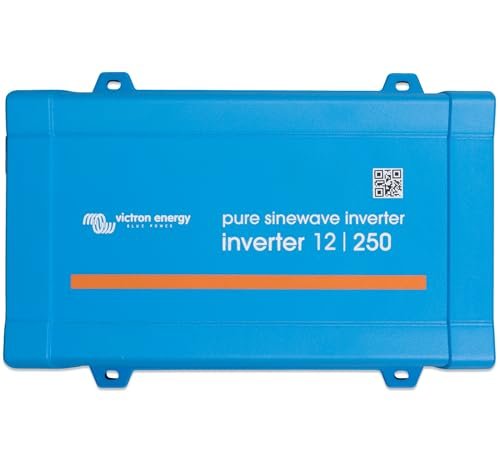
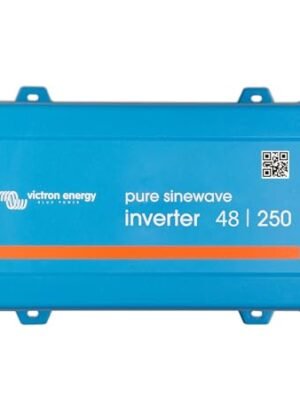
This is my review of the Victron Energy Phoenix 250VA 12V 120V AC Pure Sine Wave Inverter (NEMA 5-15R), a small but highly efficient unit for 12V battery systems in mobile and off-grid setups. It delivers 200W continuous output (250VA) with a peak surge of 400W, making it ideal for charging cameras, powering LED lights, small electronics, and other light loads during RV trips, boating, or travel. Its ECO mode idle draw of just 0.8W ensures minimal battery drain when the inverter is on standby.
For my installation, I paired the inverter with the recommended Victron accessories to ensure a safe and fully functional setup. For monitoring and configuration, I used the VE.Direct Bluetooth Smart Dongle for mobile access, with the option of the VE.Direct-to-USB Interface for PC-based tuning. On the protection side, I installed a 60A Victron MIDI fuse with a proper MIDI fuse holder (32V rated), which is essential for safeguarding the system. I also added the Phoenix VE.Direct remote on/off panel for convenient control.
From a cabling perspective, I sized the wires based on run length: 4 mm² (approx. 12 AWG) for runs up to 1.5 meters, and 6 mm² (approx. 10 AWG) for runs up to 3 meters. Grounding was done with a minimum of 2.5 mm² to maintain stability and safety. This setup reflects my real-world approach: prioritizing proper protection, correct cabling, and reliable control to maximize inverter performance and safety.
First Look and Build Quality
I took the Victron Energy 12V 250VA out of the box and held it in one hand. It is the smallest inverter in the Phoenix 12V range. The aluminum chassis is the compact design used across the 250VA to 500VA tier. Every surface is clean and well-finished. The VE.Direct port is present, which is remarkable for a unit at this wattage. No budget inverter in this wattage class offers programmable monitoring through a phone app.
I mounted the 250VA inside a small storage cupboard using the bracket holes. It fit in a space roughly the size of a paperback book. There is no fan. The unit cools entirely through the aluminum housing. After 30 minutes of continuous 200W load, the housing was warm to the touch but not hot. For an enclosed-cupboard installation, passive thermal behavior is ideal.
I connected the VE.Direct Bluetooth Dongle and paired it with VictronConnect on my phone. I could see the 200W load from my test camera charger in real time on the app display. I set the low-battery shutdown to 11.8V to protect the lead-acid battery in my test setup. That kind of precise, programmable protection is the reason Victron commands a price premium over standard inverters at this wattage.
What Is in the Box
The package includes the inverter and a manual. No battery cables are included. For this unit, I used 12 AWG wire, which is the correct gauge for runs under 1.5 meters at 200W continuous on a 12V system. The 60A MIDI Fuse and holder must be purchased separately. I installed the fuse as close to the battery positive terminal as possible, within 300mm.
The Phoenix Inverter Control VE.Direct remote panel is an optional add-on. For a tucked-away cupboard install, it is worth the purchase. Having a physical on/off switch on an accessible panel means you do not need to reach into the cupboard to power the inverter down when it is not in use.
Outputs and Features
The 12V 250VA delivers 200W of continuous output through a single NEMA 5-15R outlet and a 400W peak surge. That covers a camera charger, a small LED light string, a phone charger, a tablet charger, or a low-power radio. It will not run a laptop under heavy load, a blender, or any appliance with a motor. The load list must be defined and modest for this unit to be the right choice.
ECO mode draws 0.8W at idle, the lowest figure in the entire 12V Phoenix lineup. In ECO mode, the inverter pulses every 2.5 seconds to check for a connected load. Between pulses, the unit is completely silent. For overnight use in a small van or a sleeping area, the ECO mode behavior is ideal. The battery drain from the inverter itself over eight hours at 0.8W is approximately 0.5 amp-hours, which is negligible on any reasonably sized battery bank.
Pure sine wave output is standard across the Phoenix line. Even at 200W, the output is clean and compatible with sensitive electronics, including cameras, tablets, medical devices, and audio equipment. Modified sine wave inverters at this wattage are cheaper, but the harmonic distortion they produce can shorten the life of battery chargers and sensitive power supplies over extended use.
Protection Features
The 12V 250VA includes low-voltage, high-voltage, overload, over-temperature, and short-circuit protection. The 400W surge capacity is double the continuous rating, appropriate for the small LED driver and power converter loads this unit is designed to handle. Convective cooling means no fan failures. At 200W continuous, the internal components operate well within their thermal limits in any reasonably ventilated space.
The VictronConnect programmability extends to the low-battery shutdown threshold, the output voltage, and the Dynamic Cut-off. For a 12V lead-acid battery bank in a weekend camper, properly setting the low-battery shutdown prevents deep discharge, which shortens battery life. For a lithium iron phosphate bank, the Dynamic Cut-off prevents false shutdowns during the momentary voltage sag that occurs when a load first connects.
Potential Point of Failure
The 200W continuous ceiling is the constraint to plan around carefully. A DSLR camera charger typically draws 40-60W. A tablet charger draws 20-45W. Adding two of those plus a phone charger still leaves headroom. But a standard laptop charger drawing 90W, a camera charger drawing 60W, and an LED light drawing 40W bring the total to 190W, which is close to the limit under sustained load. Know exactly what you are powering before choosing this unit.
The screw terminals on the compact chassis accept up to 10 mm2 wire. For the short cable runs this unit typically requires, 12 AWG is the correct choice. I tested a longer 3-meter run using 10 AWG cable and confirmed that the voltage drop remained within acceptable limits. Anything lighter than 12 AWG on a run over 1 meter is not appropriate for this unit, even at its modest current levels.
Victron 12V Inverter Lineup Comparison
| Spec | 250VA ★ | 375VA | 800VA | 1200VA |
|---|---|---|---|---|
| Continuous | 200W | 300W | 700W | 1000W |
| Peak Surge | 400W | 700W | 1500W | 2400W |
| Input | 12V | 12V | 12V | 12V |
| ECO Idle | 0.8W | 0.9W | 1W | 1W |
| Fuse | 60A | 80A | 125A | 200A |
| Cable (0-1.5m) | 12 AWG | 10 AWG | 6 AWG | 4 AWG |
| Chassis | Small | Small | Large | Large |
Use Case Recommendation
Choose the 12V 250VA for a weekend camper, a boat, or a vehicle where your load list is limited to camera charging, LED lighting, phone and tablet charging, or a single low-draw electronic device. The near-zero ECO mode idle draw, completely silent operation, and compact form factor make it the easiest Victron inverter to install and forget. If your load list includes a laptop or anything with a motor, step up to the 12V 375VA or 12V 800VA.
Summary
The Victron Energy 12V 250VA is the right choice for minimal, defined AC loads in compact spaces. The VE.Direct programmability, 0.8W ECO mode idle draw, silent convective cooling, and Victron build quality make it the best small inverter for campers and weekenders who prioritize reliability over raw wattage. Define your load list carefully before choosing this unit, and it will serve reliably for many years.

There are no reviews yet.