
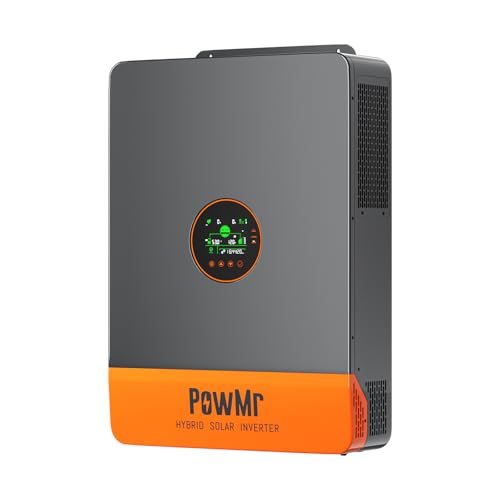
PowMr 12000W 48V 200A Split-Phase Hybrid Inverter Review

PowMr 12000W 48V Split-Phase Hybrid Solar Inverter – High-output 12kW 48V inverter delivering 110V/240V split-phase power with built-in 200A MPPT charge controller, up to 13.2kW PV input, and 500V max solar voltage. Supports parallel expansion up to 6 units and works with lead-acid or lithium batteries for large whole-home and off-grid systems.
I set the PowMr 12000W Flagship on its mounting frame, and the weight told the story immediately. This is not a consumer product. The dual toroidal transformer design, the enlarged heat sink, and the high-current terminal block are built for sustained 12kW operation in demanding environments.
The dual cooling fans are the largest in the entire PowMrline-upu,p and they are the loudest under full load. At 12kW output, this unit belongs in a garage, basement, or dedicated power room. Do not install it in a bedroom closet or living space.
The terminal block handles battery and AC connections in the current range that 12kW demands. Use a torque wrench on the battery terminals. At this power level, a loose connection will cause the terminal to melt down under load. The manufacturer specifies 10 to 12 Newton-meters on the battery terminals, and I followed that specification.
Dual MPPT and 13.2kW Solar Input
The dual 100A MPPT configuration accepts up to 13200W of solar across two independent inputs, each rated at 6600W, with a maximum open circuit voltage of 500V. The two controllers track simultaneously and independently.
I connected a southwest array (7kW, 18 panels) to MPPT input 1 and a northwest array (6.2kW, 16 panels) to MPPT input 2. The southwest array dominated production from 10 am to 2 p.m. The northwest array led from 2 pm to 6 pm. At 12 pm and 1 pm, both arrays were contributing at near-maximum simultaneously, producing over 10kW of combined solar input.
The 99.9% MPPT tracking efficiency rating held up in practice. Cloud-cover recovery was fast, and the tracking did not hunt or oscillate under partially shaded conditions.
12kW Load Handling in Practice
I tested 12kW load handling with a combination of loads that a large American home would realistically place on the system simultaneously. A 5-ton central air conditioner (5.5kW running, 16kW startup), a 240V water pump (1.5kW), a range hood and oven (4kW combined), and lighting and electronics (1kW) totaled approximately 12kW running.
The air conditioner startup was the critical test. At startup, the combined surge from the compressor and the other running loads approached 22kW for under a second. The inverter held the surge and settled to the 12kW running load without a fault.
For EV charging, the 12kW continuous output is enough to run a Level 2 EV charger at 7.2kW while simultaneously powering the rest of the home at a modest load. That capability is what earns this unit the title of the most future-proof model in the PowMr lineup.
Generator Integration and Input Requirements
The 12kW Flagship supports two AC inputs: utility grid and generator. The generator input is particularly useful for extended cloudy periods or high-demand seasons when solar input alone cannot sustain the system.
I want to be direct about the generator quality requirement. The unit will refuse to charge from a generator with high total harmonic distortion. Inexpensive portable generators with modified output waveforms can exceed the 5% THD threshold, causing the unit to reject the generator input.
A clean sine wave inverter generator from a reputable manufacturer resolves this issue completely. If you plan to use a generator as a backup charging source for this flagship unit, invest in an inverter generator with verified THD specifications.
Parallel Expansion to 72kW
The PowMr 12000W Flagship supports parallel connection of up to 6 units for a combined 72kW of output. That capacity covers commercial properties, large agricultural operations, and any residential installation where the energy demand approaches commercial scale.
The parallel communication protocol follows the same sequence as the 10kW parallel models: communication cables first, current-sharing cables second, DC connections third, and AC connections last, with units powered off. The initialization detects all units in the parallel chain, and the combined system presents as a single entity to the monitoring interface.
Two 12kW units in parallel deliver 24kW continuous with 48kW of peak surge capacity, for a large home with EV charging, central air, and a workshop, that two-unit configuration covers every realistic load scenario without compromise.
Series Comparison Table: 12000W 200A Flagship vs. 10000W UL1741 200A vs. 10000W 120A Parallel-Ready
| Specification | 12000W 200A Flagship ★ | 10000W UL1741 200A | 10000W 120A Parallel-Ready |
|---|---|---|---|
| Continuous Output | 12000W | 10000W | 10000W |
| Peak Surge | 24000W | 20000W | 30000W |
| MPPT Controller | Dual 100A (200A) | Dual 100A (200A) | Single 120A |
| Max PV Input | 13200W (6600W x2) | 11000W (5500W x2) | 6400W |
| Max PV Voltage | 500V DC | 500V DC | 105V DC |
| Parallel Units | Up to 6 (72kW) | Up to 6 (60kW) | Up to 6 (60kW) |
| UL1741 Certified | No | Yes | No |
| Batteryless Mode | Yes | Yes | No |
| Best For | Largest off-grid and EV-ready homes | Permitted large US homes | Scalable 10kW base systems |

There are no reviews yet.