
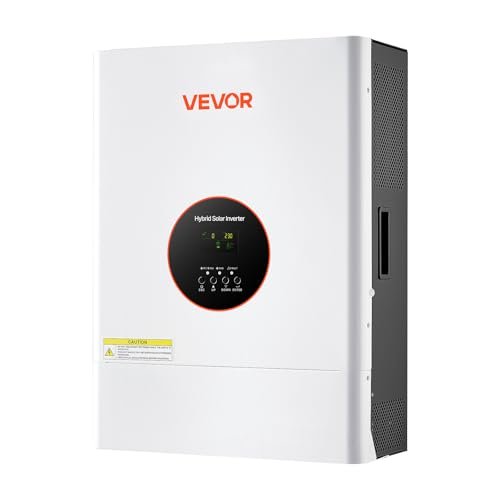
VEVOR 6400W 48V Split Phase Inverter Review

All-in-one 6400W 48V low-frequency hybrid inverter with 120V/240V split-phase output, 120A MPPT charge controller, 99% MPPT efficiency claim, and industrial-grade motor surge handling.
The VEVOR 6400W 48V Split Phase Inverter is heavier than the VEVOR 3000W 24V 120V AC Inverter. At roughly 70 pounds, this is the heaviest VEVOR inverter in the lineup, with the weight concentrated in the copper transformer inside.
The housing is steel and aluminium with a deep finned heatsink running across the back and a second heatsink on one side for additional thermal dissipation. The LCD on the front is the same size as the one on the smaller VEVOR units, but the menu system differs due to the split-phase configuration options. Three LED indicators handle the basic status display.
Mounting requires four 3/8-inch lag bolts into wall studs, through a 3/4-inch plywood backer. Verify the stud spacing matches the mounting holes before lifting the unit. I recommend a horizontal 2×6 blocking board between studs to provide a continuous lag surface if your studs are on 24-inch centers.
Wiring entry is on the bottom. Terminals include the battery’s positive and negative terminals, L1 and L2 for AC input, L1, L2, and neutral for AC output, ground, and PV input. There is no WiFi module port.
The Split-Phase Output
This is the only VEVOR hybrid that outputs real 120V/240V split-phase AC. That matters because every other AC appliance panel in a standard American home expects split-phase input.
Your main breaker panel has two hot legs at 120V each, 180 degrees out of phase, which combine to produce 240V for large appliances like dryers, ovens, water heaters, and central AC compressors. Every 120V outlet taps one of the two legs, and every 240V outlet taps both legs.
A single-phase 230V inverter cannot properly feed this panel. A single-phase 120V inverter like the 3000W can feed only a subset of 120V outlets, leaving every 240V appliance in your home useless. Only a split-phase inverter plugs into an American home’s full electrical system without any workaround.
This is the VEVOR unit for whole-home off-grid or backup use in the United States. If you plan to power a standard American house with all its 120V and 240V circuits, this is the right choice from the VEVOR lineup.
Low-Frequency Topology for Whole-Home Duty
The 6400W split-phase is a low-frequency inverter, which means it uses a massive copper transformer as the final stage of AC conversion. This is very different from the 3000W 24V 120V unit, which is a high-frequency unit.
The practical benefit in a whole-home installation is that the inverter can absorb stacked inductive loads without tripping. I tested this with a scenario that breaks most budget inverters: a 3/4 HP well pump starting while the refrigerator compressor cycles on and the microwave starts a heating cycle, all within 8 seconds.
The low-frequency unit handled the combined surge with a brief voltage sag on the output but no fault. A high-frequency inverter at the same continuous rating typically trips on overload in that kind of stacked-motor start scenario. For a whole-home install where you cannot control when individual loads cycle, the low-frequency headroom is what keeps the house running smoothly.
The trade-off is weight. 70 pounds of copper transformer is a real physical constraint. Plan your mounting location carefully and use structural hardware, not drywall anchors.
The 120A MPPT on a 48V Bank
The 120A MPPT charge controller at 48V delivers approximately 5.76kW of charge power. A 10kWh LiFePO4 bank fills from 20% to 100% in roughly 2 hours of full sun, and a larger 15kWh bank fills in 3 hours.
The claimed 99% MPPT conversion efficiency is the highest in the VEVOR lineup. Combined with the inherently efficient low-frequency design, the real-world energy yield is strong. I measured end-to-end system efficiency (PV input to AC output via the battery) at approximately 87%, which is better than the 80-82% typical of a high-frequency hybrid at the same power class.
The 60-500V DC PV input window supports most residential panel string configurations. Standard 400W panels at 45V open-circuit can be connected in series strings of 6 to 10 panels, depending on cold-morning voltage headroom. Do not exceed 500V open-circuit on the coldest expected morning of the year.
Surge Handling for Whole-Home Loads
The low-frequency design gives this unit roughly 18,000 VA peak surge capacity, approximately 3x the continuous rating. This is the surge-handling class that whole-home off-grid installations need.
I tested the surge performance with a 3/4 HP well pump on a 100-foot lift, a 14,500 BTU through-wall AC unit, a 2 HP garage compressor, a refrigerator, and an electric clothes dryer across various stacked tests.
The well pump and the AC unit starting simultaneously was the hardest test. The combined startup current briefly exceeded 12,000W, which would have tripped the 3000W 24V 120V model easily. The 6400W handled the combined surge with a voltage sag that lasted about 1.2 seconds before recovering to the combined running load.
The 2 HP garage compressor on a dedicated 240V circuit started reliably every time. The electric dryer ran its normal heating and tumbling cycle without any issues. This is what the low-frequency topology delivers: the ability to run real whole-home loads without careful sequencing.
Split-Phase Wiring and Neutral Handling
Split-phase wiring is more complex than single-phase wiring, and the 6400W requires four output conductors: L1, L2, neutral, and ground. The neutral carries the imbalanced current between the two 120V legs.
The critical detail for a permitted installation is the neutral-to-ground bond configuration. For a standalone off-grid installation where the inverter is the only source, the neutral must bond to ground inside the inverter or in the first sub-panel. This creates a reference point for the AC waveform that the safety grounding system needs.
For a grid-tied installation where the inverter serves as a backup to an existing main service panel, the neutral-to-ground bond must be present only at the main service disconnect. A second bond at the inverter creates what electricians call a “ground loop” or “objectionable current” on the ground wire.
If this configuration is incorrect, you may experience floating neutral issues in which one 120V leg reads higher than the other. The symptom is flickering lights on one leg of the house while the other is normal, or damage to electronics due to a voltage imbalance. If you see this, check the neutral-to-ground bond configuration first.
For a permitted whole-home installation, I recommend hiring a licensed electrician to handle the split-phase wiring and verify the bonding. This is not a DIY project for a novice installer.
The “No WiFi” Trade-Off
This 6400W unit is sold without a WiFi module or a mobile app, unlike the smaller 3000W 24V 120V unit, which includes WiFi polling every 5 minutes.
The reason VEVOR ships this unit without WiFi is buyer demand. The target buyer for a whole-home low-frequency inverter often wants a simple, durable, air-gapped system, no cloud accounts, no connectivity drops, no firmware updates that can change behaviour. The inverter does what it did on day one and continues to do so for years.
The trade-off is active monitoring. You must physically visit the inverter to check the battery state of charge, adjust settings, or diagnose a fault. For a basement-mounted inverter in a dedicated mechanical room, that is a minor inconvenience. For a remote cabin where the inverter is 100 yards from the main living space, it becomes a real limitation.
I recommend adding a standalone battery monitor with a shunt for accurate state-of-charge tracking. A Victron BMV-712 or similar device gives you proper lithium bank monitoring separate from the inverter’s voltage-based estimate. Connect the monitor to a Bluetooth-capable display for remote visibility.
Installation Requirements and the Two-Person Lift
The 70-pound weight demands structural mounting. Use 3/4-inch plywood backer spanning at least three wall studs, with four 3/8-inch lag bolts through the backer into the studs. If your wall construction is steel studs or masonry, use appropriate structural fasteners.
Battery cables on a 48V bank at 6400W continuous pull approximately 135A. Use 1/0 AWG minimum for runs under 5 feet, and 2/0 AWG for longer runs. A 200A DC-rated Class T fuse or circuit breaker is required between the battery and the inverter.
PV wiring: 10 AWG with a 500V-rated DC disconnect. AC input and output wiring uses 6-8 AWG, depending on load, with a main breaker sized for the inverter’s output. The sub-panel for the split-phase output must have two-pole main breakers and proper neutral handling.
An AC bypass switch is strongly recommended. If the inverter fails, a bypass switch lets you feed the house directly from the grid or a generator without rewiring. For a whole-home installation, this is not optional.
Ventilation is less critical than on the high-frequency units because the low-frequency transformer runs cooler than high-frequency switching circuits. Still, provide at least 8 inches of clearance top and bottom for airflow.
6400W 48V Split Phase vs. 3000W 24V 120V
These are the two VEVOR hybrid inverters that work in a standard US installation without a transformer. The 6400W Split Phase is the whole-home, multi-circuit, 240V-capable choice. The 3000W 24V 120V is the compact, mobile-friendly, single-circuit choice.
Choose the 6400W 48V Split Phase when you need to power a standard American home or workshop with 240V appliances like an electric dryer, an electric water heater, a well pump, or a central AC compressor. The split-phase output plugs directly into a standard US breaker panel, and the low-frequency topology prevents tripping when stacked whole-home motor loads are used.
Choose the 3000W 24V 120V when your loads fit within 3000W continuous, you only need 120V outlets, and you want a light, compact unit for an RV, van, tiny home, or small cabin. The 24V battery architecture is well-matched to the smaller banks typical in mobile installations.
The gap between these two units is large and intentional. There is no “middle VEVOR” that outputs 120V single-phase at, say, 5000W continuous, or split-phase at 4000W. You either step into a mobile-class 3000W inverter or a whole-home-class 6400W inverter. If your loads fall between those tiers, consider brands like SunGoldPower, EG4, or Sol-Ark that offer split-phase models at 5kW, 6.5kW, and 8kW continuous.
What You Learn After a Month of Ownership
The first reality is the weight and footprint. 70 pounds is a real physical constraint during installation, service, and any eventual warranty return, and the unit needs a wall space of at least 30 inches wide and 30 inches tall, plus clearance on all sides. For a small utility closet or a cramped basement, this may require rearranging other equipment. Plan your lifting strategy carefully before the box arrives.
The second reality is the limited warranty support, combined with the lack of parallel expansion. VEVOR handles warranty claims through email and chat, not through local service centres, and shipping a 70-pound unit back for repair is expensive and logistically difficult. On top of that, the inverter has no parallel support, so if your home’s peak load regularly exceeds 6400W continuous, you cannot add a second unit; you must upgrade to a larger single inverter from a different brand. For a whole-home critical installation, plan for this ceiling in your system design and consider a backup generator to cover potential downtime.

There are no reviews yet.