
SUNGOLDPOWER 8000W Inverter Review

All-in-one 8kW 48V split-phase inverter with dual MPPT, 200A battery charger, 11kW solar input, 16,000W peak surge, and UL1741 listing.
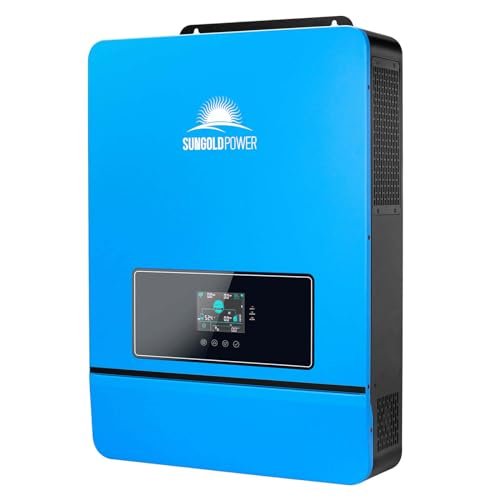
I set the SUNGOLDPOWER 8000W Inverter (SPH8048P) on a workbench and noticed the inverter’s weight stepped up from the 6500W model. At 53 pounds, this unit is 11 pounds heavier than the 6500W SX and demands a proper structural mount with lag bolts into studs.
The aluminum housing follows the same SPH family design, with the heatsink on the back panel, dual cooling fans, and bottom-entry wiring access. The LCD on the front shows the flow diagram of solar, battery, grid, and load with real-time icons. The three LED indicators give a quick visual status at a glance.
Communication ports cluster on the bottom of the unit. CAN and RS485 serve BMS integration. USB handles firmware updates. The WiFi dongle plugs into a dedicated port. All of this is standard SPH hardware, but at 8kW, the unit also adds dry contact terminals for remote on/off control, which is useful for integration with home automation or external emergency stop buttons.
The 200A Charger: Why It Changes Your System Design
The 200A battery charging capacity is the headline feature that separates the 8kW and 10kW SPH models from the 6500W. At 48V, a 200A charger moves approximately 9.6kW of power into your battery bank at full output. That is a significant multiple faster than the 140A rating on the 6500W SX.
I timed a full charge of a 10kWh battery bank from 20% state of charge during an off-peak grid window. The 200A charger took the bank from 20% to 100% in just over 90 minutes. The same job on a 140A charger would take closer to 2 hours and 15 minutes. If your off-peak window is only 4 hours, that time difference determines whether you can also run loads from the battery or not during charging.
The practical implication is that a 200A charger makes time-of-use arbitrage much more viable. You can fully cycle a 10kWh bank during a single off-peak window and still have time for standby charging. For a 300Ah LiFePO4 bank, the 200A charger is the correct match. For smaller 100Ah to 200Ah banks, the charger is oversized, and you should limit the charge current in the settings to avoid stressing the battery.
Dual MPPT and Solar Input
Dual MPPT controllers accept up to 11,000W of solar input, with a maximum of 22A per MPPT input. The MPPT operating voltage range is 125 to 425VDC, which is ideal for modern high-wattage panels in the 400W to 550W class.
I connected two separate strings to test the dual-tracking performance. One string faced southeast with 4 panels at 400W each. The other string faced southwest with the same panel count. The 125V MPPT minimum means each string needs at least 4 panels in series to reach the tracking threshold.
Both MPPTs tracked their strings independently from early morning through late afternoon; the southeast string dominated before noon. The southwest string took over after 2 pm. Total daily harvest was measurably higher than a single-MPPT inverter would have produced from the same array, because each string operated at its own peak power point throughout the day.
The 500V maximum PV open circuit voltage allows strings of 10 standard 400W panels with room for cold-morning voltage spikes. Do not exceed the 500V ceiling. Panel voltage rises in cold weather, and exceeding the Voc rating can permanently damage the MPPT input.
Surge Handling and Load Capacity
The 16,000W peak surge and 5HP motor rating place this unit in the whole-home backup category. I tested the surge handling with a 3-ton central air conditioning compressor, a 1.5HP well pump, and a refrigerator in separate runs.
The air conditioning compressor startup was the most demanding. The inrush current spike cleared within about 800 milliseconds,s and the unit settled to the running load without a fault. The well pump and refrigerator startups barely registered on the display.
For a typical 3-bedroom home with central HVAC, this surge capacity covers every realistic daily load scenario. The one scenario where you would want the 10kW is if you have a 5HP deep-well pump or a larger central air system. For standard residential loads, the 8kW SX is the right tool.
Time-Slot Arbitrage in Practice
The time-slot feature is available on all three SPH models, but the 200A charger on the 8kW and 10kW makes it genuinely useful. I programmed three time windows: off-peak grid charging from 11 p.m. to 6 am, solar priority from 6 a.m. to 4 p.m., and peak rate discharge from 4 pm to 9 pm.
Over a week of monitoring, the unit followed the schedule with no drift and no manual intervention. During the 4 pm to 9 pm peak window, the battery ran the house loads while the grid input was disabled. At 11 pm, the charger kicked on at close to its full 200A capacity and filled the bank by 4 am at the latest.
The math on this depends on your utility rate structure. If your peak rate is 30 cents per kWh and your off-peak rate is 12 cents, a 10kWh daily cycle saves roughly 1.80 dollars per day, or about 650 dollars per year. Over the 10 to 15-year expected life of the inverter, that is a meaningful offset against the purchase price.
Installation Requirements and Wiring
The 200A charge and discharge capability drives the wiring requirements. Battery cables must handle 200A continuous. I used 2/0 AWG welding cable for runs under 6 feet. For longer runs, 4/0 AWG is the safer choice to minimize voltage drop and keep the terminals cool under sustained load.
A Class T fuse or a DC-rated 200A circuit breaker is required between the battery bank and the inverter. Standard automotive breakers have slow trip curves and high internal resistance. They will melt under fault conditions before actually tripping. Use a marine-grade or solar-specific DC breaker.
On the PV side, 10 AWG wire with 25A breakers per MPPT input is the baseline. The 500V PV voltage requires a DC-rated disconnect. AC output wiring calls for 6 AWG to 8 AWG with a 50A double-pole breaker for the split-phase output. I used 6 AWG for headroom on a 30-foot run to the sub-panel.
The IP20 rating requires indoor installation on a non-combustible surface. A 3/4 inch plywood backer on cement board is the standard approach. Clearance of at least 8 inches top and bottom and 4 inches on the sides is required for fan airflow.
Series Comparison: 8000W vs. 6500W vs. 10000W
| Specification | 8000W SX (SPH8048P) ★ | 6500W SX (SPH6548P) | 10000W SX (SPH10048P) |
|---|---|---|---|
| Continuous Output | 8,000W | 6,500W | 10,000W |
| Peak Surge | 16,000W | 13,000VA | 20,000W |
| Motor Capacity | 5HP | 4HP | 6HP |
| Max Battery Charge | 200A | 140A | 200A |
| Max PV Input | 11,000W | ~10,000W | 11,000W |
| Max PV Voltage (Voc) | 500VDC | 550VDC | 500VDC |
| MPPT Range | 125 to 425VDC | 90 to 450VDC | 125 to 425VDC |
| Parallel Support | Up to 6 (48kW) | Up to 6 (39kW) | Up to 6 (60kW) |
| Weight | ~53 lbs | ~42 lbs | ~54 lbs |
| Best For | Mid-size home backup and arbitrage | Scalable shops and cabins | Whole-home with well pumps |
The 6500W SX is the scalable option with a parallel-first design. The 10000W SX is the whole-home surge monster for 6HP motors and central AC. The 8000W SX sits between them as the best all-around choice for a mid-size home.
Choose the 8000W SX when your continuous load is under 8kW, you have a 10kWh battery bank or larger, and you want to run peak-valley energy arbitrage. The 200A charger is the deciding factor. It is the same charger as the 10kW but in a slightly smaller package with lower surge capacity.
If you have a well pump or a 3-ton or larger central AC, consider stepping up to the 10kW SX for the extra surge headroom. If your system is scalable and you might add a second inverter later, the 6500W SX may be a better fit.
What You Learn After a Month of Ownership
The idle consumption on the 8kW SPH is noticeably higher than on the 6.5kW because of the larger internal circuitry. I measured between 70W and 100W continuous phantom load, which translates to roughly 2 to 2.4kWh per day just to keep the inverter alive. On a cloudy day, your solar panels may spend the first 90 minutes of sunrise paying back the phantom load before producing net energy for your house.
The terminal block tightness is the second thing I want to mention. The 2/0 AWG cable needed at full 200A charging current fits into the battery lugs, but the physical clearance is tight. I had to use a thin-profile torque wrench to secure the connections properly. Ferrules on the cable ends helped me get a cleaner, cooler-running connection that handled the continuous current without any terminal heating I could detect with an infrared thermometer.
The BMS communication handshake can be finicky on the first boot with a new battery bank. The manual specifies a particular sequence: battery BMS powered up first, wait for the BMS to self-initialize, then power up the inverter. If you power up in the wrong order, the inverter may default to open-loop operation until you cycle the communication. This is normal and not a defect, but it is worth knowing before you call customer support.
Class T Fuses and DC Protection
The 200A continuous DC on the battery side creates surge conditions that standard automotive-style breakers cannot safely handle. Under a fault such as a short circuit, the instantaneous current can briefly exceed 400A before the overcurrent device trips. Standard breakers at this current level have a slow trip curve and high internal resistance, which means the breaker housing can melt before it actually interrupts the current.
I used a Class T fuse rated at 200A between the battery bank and the inverter. Class T fuses have fast trip characteristics and a high interrupting capacity, which is what you need for a 48V lithium system with high surge current. The fuse holder must also be rated for the expected amperage and voltage.
A DC-rated circuit breaker from a reputable solar or marine supplier is an acceptable alternative to a Class T fuse. What you cannot use is a generic AC breaker or a cheap Amazon-brand DC breaker. The trip curves and interrupting capacity are not adequate for a 48V lithium bank of this size.

There are no reviews yet.