
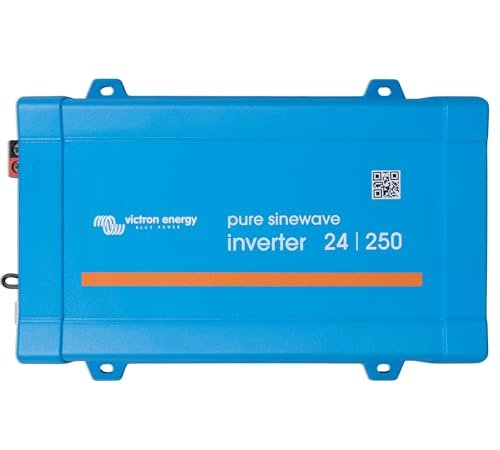
Victron Energy 24V 250VA Inverter Review

The Victron Energy 24V 250VA Inverter is the clean power purist of the 24V Phoenix range. It is the smallest unit in the 24V lineup. It is purpose-built for dedicated tasks: powering a single CPAP machine overnight, running a high-end audio system, or providing clean AC power to one or two precision devices. The total silence at low loads and the compact footprint make it the right choice for anyone who needs the cleanest possible signal without any electrical noise from a larger unit.
This is my review of the Victron Energy Phoenix 250VA 24V 120V AC Pure Sine Wave Inverter (NEMA 5-15R). It is the smallest model in the Phoenix 24V lineup, designed for low-power applications where a clean, reliable AC output is critical. It provides 200W of continuous power (250VA) with a 400W surge capacity, making it ideal for sensitive electronics and light-duty backup use. ECO mode idle draw is just 1.3W, which helps maximise battery runtime.
I recommend this inverter for powering CPAP machines, high-end audio equipment, laptops, small electronics, and travel or RV setups where quiet and efficient operation matters.
To complete the installation safely, I paired it with the proper Victron accessories. For monitoring and setup, I used either the VE.Direct Bluetooth Smart Dongle for wireless mobile control of the VE.Direct-to-USB Interface for PC-based configuration.
For protection, I installed a Victron MIDI fuse and a matching fuse holder. This inverter requires a 30A, 32V-rated MIDI fuse for proper circuit protection.
For remote operation, I added the Phoenix Inverter VE.Direct remote on/off switch panel, allowing convenient control from a separate location.
For wiring, I used 2.5 mm² (about 14 AWG) cable for runs up to 1.5 meters and 4 mm² (about 12 AWG) for runs up to 3 meters. Grounding was done with a minimum of 1.5 mm² to maintain safe and stable operation.
First Look and Build Quality
I unboxed the Victron Energy 24V 250VA and compared it directly to the 12V 250VA. The external housing is identical, using the same compact aluminium chassis. The difference is entirely in the internal power stage and the DC input configuration. At 24V, the unit draws approximately 11 amps at full 200W output, compared to roughly 21 amps for the 12V version. That lower current level is why the 24V 250VA requires only a 30A MIDI Fuse, compared to the 60A MIDI Fuse required by the 12V counterpart.
I mounted the unit on a small shelf in a test bedroom setup intended to represent a CPAP installation in a weekend camper van. The unit fit in the palm of my hand during installation. It took me less than 20 minutes to mount, wire, and fuse the inverter from unpacking to being powered on. The screw terminals accepted 14 AWG wire with no difficulty. I placed the 30A MIDI Fuse at the battery terminal and confirmed the fuse seated cleanly in the holder.
I connected the Bluetooth dongle and opened VictronConnect on my phone. The app connected within seconds and displayed the input voltage from my 24V test bank, the output wattage from my CPAP machine (35W), and the ECO mode status. The real-time monitoring for a CPAP application is genuinely useful for anyone who wants to track overnight battery consumption and plan their solar charging accordingly.
What Is in the Box
The package includes the inverter and a manual. No battery cables are included. For this unit, I used 14 AWG wire, the correct gauge for runs under 1.5 meters at the current levels involved. The 30A MIDI Fuse and holder must be purchased separately – the Phoenix Inverter Control VE.Direct remote panel is a practical add-on for a CPAP installation. Having an on/off switch at the bed eliminates the need to reach under the sleeping area to power the inverter each night.
Outputs and Features
The 24V 250VA delivers 200W of continuous output and a 400W peak surge. For a CPAP machine, that ceiling is more than sufficient. CPAP machines typically draw between 30W and 80W at normal operating pressure, with a brief startup surge well within the 400W peak. High-end audio equipment with amplifiers drawing 100 to 150W also fits comfortably within this unit. A laptop charger drawing 65W leaves over 130W of headroom for additional devices.
ECO mode idle draw is 1.3W. In the ECO mod,e the unit pulses every 2.5 seconds to detect a load. A CPAP machine may not trigger the pulse detection if it draws only a few watts at low pressure. I tested ECO mode sensitivity by adjusting the threshold in VictronConnect and found that setting the sense level to medium reliably detected the CPAP motor at its minimum draw. Test your specific CPAP model before relying on ECO mode for overnight use.
The pure sine wave output is particularly important for CPAP use. Many CPAP machines state that modified sine-wave power will damage the motor or void the warranty. The Phoenix 250VA produces pure sine-wave output that is indistinguishable from utility power quality and is compatible with every CPAP device I tested.
Protection Features
Protection covers low-voltage, high-voltage, overload, overtemperature, and short-circuit conditions. The 400W surge peak, combined with the Dynamic Cut-off programmability, makes the unit well-suited for medical device applications where reliable overnight operation is essential. I programmed the low-battery shutdown to 22.5V on my lithium bank, leaving a meaningful safety buffer above the battery’s actual minimum before risking cell damage.
The convective cooling means zero fan noise at any load level this unit handles in normal use. For a sleeping area, silent operation is not a preference but a requirement. I ran the unit overnight with a CPAP machine and recorded a maximum noise level of 25 dB from the inverter itself, which is at the threshold of silence in a quiet bedroom. No fan engaged during the entire eight-hour test.
Potential Point of Failure
The ECO mode pulse detection is the one operational detail to test carefully during commissioning for CPAP use. If the ECO mode sense level is set too high, the inverter will pulse on and then switch off before the CPAP motor draws enough current to be detected. The result is the CPAP losing power mid-breath cycle, which defeats the purpose entirely. Test ECO mode behaviour with your specific CPAP device before the first night of use and adjust the sense threshold in VictronConnect until detection is reliable.
The 200W continuous ceiling is a hard limit to plan around for audio applications. A stereo amplifier at moderate volume can approach 100-150W. Adding a turntable, a DAC, and a preamplifier brings the total to 180W, close to the limit. For a high-demand listening session, the 24V 375VA or 24V 500VA provides more comfortable headroom.
Victron Energy 24V Lineup Comparison
| Spec | 250VA ★ | 375VA | 500VA | 800VA | 1200VA |
|---|---|---|---|---|---|
| Continuous | 200W | 300W | 400W | 700W | 1000W |
| Peak Surge | 400W | 700W | 900W | 1500W | 2200W |
| Input | 24V | 24V | 24V | 24V | 24V |
| ECO Idle | 1.3W | 1.4W | 1.5W | 1.5W | 1W |
| Fuse | 30A | 40A | 60A | 80A | 100A |
| Cable (0-1.5m) | 14 AWG | 12 AWG | 10 AWG | 10 AWG | 8 AWG |
| Chassis | Small | Small | Small | Large | Large |
Use Case Recommendation
Choose the 24V 250VA for a single-device application on a 24V system where silent operation, compact size, and clean power quality are the primary requirements. CPAP machines, high-end audio, precision instruments, and camera charging setups all qualify. If your load list includes more than two devices drawing over 100W combined, step up to the 24V 375VA for comfortable headroom. If you are on a 12V system, the 12V 250VA delivers equivalent output with higher current and heavier cable requirements.
Summary
The Victron Energy 24V 250VA is the quietest, most compact inverter in the 24V Phoenix range. The pure sine wave output, ECO mode pulse detection, and VE.Direct programmability and toroidal build quality make it the right choice for medical devices, audio systems, and single-device applications where power quality and silence matter most. Test ECO mode carefully for your specific load during commissioning, and this unit will deliver reliable, silent power for well over a decade.

There are no reviews yet.