
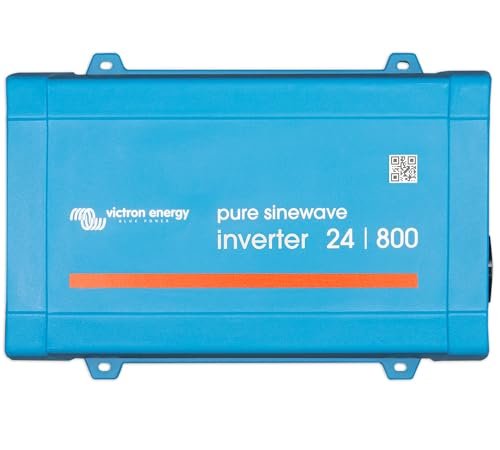
Victron Energy 24V 800VA Inverter Review

The Victron Energy 24V 800VA Inverter is the bridge model for 24V users who need more than the basics but are not ready for a full 1200VA unit. It handles most household kitchen gadgets, a blender, a hand mixer, and a small power tool that the 500VA model would struggle with. The compact form factor combined with the 1500W surge makes it the choice for off-grid dwellers who need an occasional power punch without the heavier wiring demands of the 1200VA.
This is my review of the Victron Energy Phoenix 800VA 24V 120V AC Pure Sine Wave Inverter (NEMA 5-15R). It is a compact and reliable inverter designed for 24V battery systems. It delivers 700W of continuous power (800VA) and can handle surge loads up to 1500W. The ECO mode is very efficient, with a low idle draw of just 1.5W, which helps save battery power during light or standby use.
I recommend this inverter for RVs, boats, camping setups, small workshops, and light home backup. It works well with small appliances like blenders and hand mixers, as well as laptops and other everyday electronics that need clean, stable power.
For a complete and safe installation, I used a few key Victron accessories. For monitoring and setup, I added either the VE.Direct Bluetooth Smart Dongle for phone and tablet control, or the VE.Direct-to-USB Interface for PC configuration.
For protection, I installed a Victron MIDI fuse and a proper MIDI fuse holder. This model uses an 80A, 32V-rated fuse to protect the system from overloads and faults.
For control, I added the Phoenix Inverter VE.Direct remote on/off switch panel makes it easy to turn the inverter on and off without direct access.
For cabling, I followed proper sizing based on distance. For runs from 0 to 1.5 meters, I used 6 mm² (about 10 AWG). For 1.5 to 3 meters, I used 10 mm² (about 8 AWG). For grounding, I used a minimum of 4 mm² to ensure safety and stable performance.
First Look and Build Quality
I set the Victron Energy 24V 800VA on the bench and compared it against the 24V 500VA. The form factor steps up to the large chassis at 800VA, which is the same size as the 12V 800VA and 12V 1200VA. That larger chassis provides more internal space for the toroidal transformer and the active cooling fan that engages under sustained loads. The housing is the same powder-coated aluminium as the rest of the Phoenix line.
I inspected the terminal block and found M8 bolt-style terminals suitable for the cable gauges required by this unit. At 24V and 700W continuous, peak current draw is approximately 42 amps, which is significantly lower than the 12V version at the same wattage. The 80A MIDI Fuse reflects that lower current level. The cabling is proportionally lighter, making the installation easier to manage than an equivalent 12V setup.
I paired the Bluetooth dongle with VictronConnect and ran a blender test. The app showed a startup surge of approximately 1100W for less than a second, followed by a running draw of 350W. The 1500W surge peak handled the blender startup cleanly without any protection event. That is the practical value of the SinusMax surge design.
What Is in the Box
The package includes the inverter and a manual. No battery cables are included. I used 10 AWG cable for my test installation at a run length under 1.5 meters. I bought the 80A MIDI Fuse and holder, purchased separately, and installed them at the Phoenix Inverter Control VE battery terminal.Direct remote panel completed the setup, giving me a convenient on/off switch at the counter level of my test off-grid kitchen installation.
Outputs and Features
The 24V 800VA delivers 700W continuously and a 1500W peak surge. That combination covers a blender at 300 to 400W, a hand mixer at 200 to 300W, an LED monitor, a laptop, and a phone charger simultaneously without approaching the continuous limit. A toaster at 800 to 1000W is above the continuous rating but manageable in short bursts. The microwave exceeds both the continuous and surge ratings for this model.
ECO mode idle draw is 1.5W, slightly higher than the smaller 24V models at 1.3W to 1.4W. That reflects the larger power stage in the big chassis design. VictronConnect programmability includes the Dynamic Cut-off, low-battery shutdown, and output voltage adjustment. I set the Dynamic Cut-off to handle the blender startup sag on my lithium bank and confirmed that the unit stayed on cleanly through repeated blender cycles during testing.
Efficiency is rated at approximately 92%. That is the same figure as the 24V 500VA and slightly above the 12V models at the same wattage. The 24V advantage in efficiency comes from lower DC input current at the same output power, which reduces resistive losses in the wiring and terminals.
Protection Features
Protection covers low-voltage, high-voltage, overload, overtemperature, and short-circuit conditions. The toroidal transformer handles the 1500W surge without stressing the main power stage. The temperature-controlled fan in the large chassis engages earlier and more aggressively than in the smaller convection-cooled chassis, which keeps the operating temperature stable during sustained loads.
The active fan design in the 800VA chassis introduces noise under heavy loads. I measured the fan at approximately 45 dB under a sustained 700W load, comparable to a quiet kitchen appliance. For a sleeping area, that is worth noting. For a workshop or kitchen application, it is unremarkable background noise.
Potential Point of Failure
The 1.5W ECO mode idle draw is the highest among the 24V Phoenix models. For a system that runs the inverter continuously, including during overnight periods when no load is present, that idle draw adds up. On a 24V 100Ah lithium bank, continuous 1.5W idle draw consumes roughly 0.75 amp-hours per hour at 24V. Over 8 hours with no load, the inverter alone consumes 6 amp-hours. A simple remote switch or the physical on/off control addresses this completely.
The motor load capability of the 24V 800VA is substantial, but it has a ceiling. I tested a 1/4 horsepower pump motor during the review. The startup surge approached 1500W. The inverter handled it, but there was no headroom for a second load starting at the same time. For applications where multiple motor loads might start at the same time, plan the sequence to avoid simultaneous startups.
Victron Energy 24V Lineup Comparison
| Spec | 800VA ★ | 250VA | 375VA | 500VA | 1200VA |
|---|---|---|---|---|---|
| Continuous | 700W | 200W | 300W | 400W | 1000W |
| Peak Surge | 1500W | 400W | 700W | 900W | 2200W |
| Input | 24V | 24V | 24V | 24V | 24V |
| ECO Idle | 1.5W | 1.3W | 1.4W | 1.5W | 1W |
| Fuse | 80A | 30A | 40A | 60A | 100A |
| Cable (0-1.5m) | 10 AWG | 14 AWG | 12 AWG | 10 AWG | 8 AWG |
| Chassis | Large | Small | Small | Small | Large |
Use Case Recommendation
Choose the 24V 800VA for a 24V off-grid kitchen or workshop setup with loads including a blender, a hand mixer, or a small power tool, along with regular electronics. It handles those occasional high-draw tasks while maintaining efficiency at moderate continuous loads. If your kitchen or workshop loads stay consistently under 500W, the 24V 500VA is the more efficient and less expensive choice. If a microwave is on the load list, step up to the 24V 1200VA.
Summary
The Victron Energy 24V 800VA fills the gap between the light-duty 500VA and the more capable 1200VA in the 24V Phoenix range: the 1500W surge, compact-for-its-class large chassis, VE.Direct programmability and 24V efficiency advantages make it a well-rounded choice for off-grid kitchens and workshop installations. Size your cables and fuse correctly, install it with airflow clearance, and plan your motor load sequencing, and this inverter will deliver reliable service for years.

There are no reviews yet.