
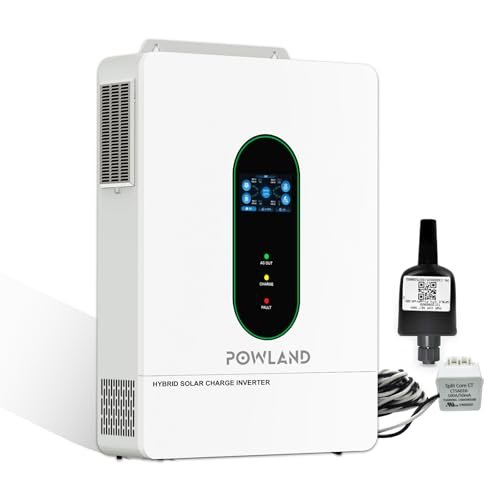
POWLAND 12000W Grid-Tied Hybrid Inverter Review

The POWLAND 12000W Grid-Tied Hybrid Inverter is a 48V unit delivering 12,000W of pure sine wave split-phase power with a built-in 200A MPPT controller, battery-free operation, built-in WiFi, and UL1741 certification. It targets large homes, RV parks, and commercial properties that need maximum solar output and grid integration in a single inverter. With the ability to stack up to six units for a combined 72kW output, it is also the foundation for large-scale off-grid and grid-interactive systems.
I mounted the POWLAND 12000W in a clients garage setup and ran through the full startup procedure. The IP65 casing and sealed front panel hold up to the kind of environment a garage or utility room delivers, including dust, temperature swings, and occasional splashes. The LCD is bright and legible under direct light.
The WiFi setup process was the same as the 10kW model: scan the QR code, enter network credentials, and the unit appears in the POWLAND app within minutes. The app dashboard on the 12kW shows the same real-time metrics of solar input, battery level, AC load, and grid status.
The 45dB fan noise specification puts this unit in the same acoustic category as a quiet dishwasher or a background HVAC blower. I ran a sustained 9000W test load, and the fans remained at a level I describe as noticeable but not intrusive in a utility room setting.
Solar Input and MPPT Performance
The 200A MPPT controller accepts solar input from 90V to 500V DC, which is a wider voltage window than almost any residential inverter at this price point. The 500V ceiling allows you to string more panels in series, which reduces the current on the PV wire run and allows thinner and less expensive wire gauge for long-distance runs from the roof to the inverter.
The 99.9% tracking efficiency and wide voltage window combine to extend the effective harvest window at both ends of the day. I tested the inverter starting just after sunrise on a partially overcast morning. The MPPT controller began producing useful output earlier than a 150V-class controller connected to the same array.
For a large roof installation with 20 or more panels, the 500V input ceiling is a meaningful design advantage. It gives your installer more flexibility in string configuration and reduces the number of parallel strings needed to stay within the controller’s rated input current.
Battery-Free Mode and Grid Integration
Battery-free mode on the 12kW works the same way as on the 10kW: the inverter powers home loads directly from solar during daylight hours. It pushes excess generation toward the grid or limits output to zero-export based on your configuration. The result is a meaningful reduction in daily utility consumption without the upfront cost of a large battery bank.
The AC input protection range of 90V to 280V AC means the inverter accepts a wide range of grid voltages, which is useful for installations in areas with variable grid quality or for generator backup. Most US grid supplies fall well within this range.
As with the 10kW unit, UL1741 anti-islanding means the inverter stops output when the grid drops in battery-free mode. A battery bank is required for blackout backup capability. This is not a limitation unique to POWLAND; it is a code requirement for all grid-tied inverters in the US.
Scale and Parallel Expansion
The POWLAND 12000W can be stacked with up to five additional units for a combined 72kW output. That capacity covers large agricultural properties, small commercial buildings, and off-grid facilities with substantial power demands. Each unit in the stack operates in phase synchronization with the others and shares the same battery bank.
For a single-home buyer, the 72kW expansion ceiling is more relevant as a long-term planning tool than an immediate need. Buying a single 12kW unit today with knowledge that expansion is possible provides flexibility that lower-end inverters do not.
A single 12kW unit is the correct size for a large 4-bedroom home running central air conditioning, a kitchen, a home office, and an EV charger simultaneously. Plan your load list at peak demand before deciding between the 10kW and 12kW models.
Potential Point of Failure
Battery bank sizing for 12kW output on a 48V system requires serious planning. At full output, DC draw exceeds 250 amps continuous. A minimum of 400Ah of lithium is required to support sustained full-load operation without the BMS tripping. For a system that regularly runs at 8 to 10kW, 600Ah or more is a practical target for meaningful runtime between solar recharges.
The 200A MPPT rating, while substantial, is the slightly lower spec of the 10kW model 250A controller. For arrays above 10kW DC, check your string configuration against the 200A current limit to ensure you are not exceeding the controller’s rated input current.
POWLAND Lineup Comparison
| Spec | 12000W Hybrid WiFi ★ | 3600W 48V | 4000W Hybrid 24V | 4000W Std 24V | 6500W 48V | 10000W 48V | 12000W Split Phase |
|---|---|---|---|---|---|---|---|
| Continuous Output | 12,000W | 3600W | 4000W | 4000W | 6500W | 10,000W | 12,000W |
| DC Input Voltage | 48V | 48V | 24V | 24V | 48V | 48V | 48V |
| AC Output Voltage | 120/240V | 110/120V | 120V | 110/120V | 120/240V | 120/240V | 120/240V |
| Split Phase (240V) | Yes | No | No | No | Yes | Yes | Yes |
| MPPT Controller | 200A | 80A | 140A | 60A | 120A | 250A | 200A |
| Max PV Input (Solar) | 4500W | 5600W | 1600W | ||||
| Max PV Voltage (OCV) | 500V DC | 300V DC | 350V DC | 108V DC | 300V DC | 485V DC | 500V DC |
| MPPT Voltage Range | 90–500V DC | 90–260V DC | 30–90V DC | 90–260V DC | 90–485V DC | 90–500V DC | |
| MPPT Efficiency | 99.9% | 99% | 98% | 99.9% | 99.9% | 99.9% | |
| Peak Surge | 8000W | ||||||
| Battery Voltage | 48V | 48V | 24V | 24V | 48V | 48V | 48V |
| Battery Types | LiFePO4 + LA | LA + Lithium | LiFePO4, LA, AGM | LA, Li, LiFePO4 | LA + LiFePO4 | LiFePO4 + LA | LiFePO4 + LA |
| Battery-Free Mode | Yes | No | Yes | Yes | No | Yes | Yes |
| Charging Modes | Hybrid | 4 | Hybrid mgmt | 4 | Grid+Load mode | Hybrid | Hybrid |
| Output Modes | Auto | 2 | Auto priority | 4 | Single+Split | Auto | Auto |
| Time Scheduling | No | No | No | Yes | No | No | No |
| Grid-Tied / Anti-backflow | Yes (CT) | No | No | No | Yes (CT sensor) | Yes (CT) | Yes (CT) |
| UL1741 Certified | Yes | No | No | No | No | Yes | Yes |
| WiFi Monitoring | Built-in | Port (extra) | No | No | Port (extra) | Built-in | Optional add-on |
| App Monitoring | Yes | With adapter | No | No | With adapter | Yes | With add-on |
| Parallel Stacking | Up to 6 (72kW) | No | No | No | Up to 6 (39kW) | Up to 6 (60kW) | Up to 6 (72kW) |
| Display | LCD + LED | LCD + 3 LED | 6.25" Glass LCD | LCD + 3 LED | LCD | LCD + LED | LCD + tri LED |
| IP Rating | IP65 | IP65 | IP65 | ||||
| Fan Noise | 45dB | 45dB | 45dB | ||||
| Fan Activation Temp | 104°F (40°C) | ||||||
| ECO Mode | Yes | No | No | No | No | Yes | Yes |
| Best Use Case | Large home+WiFi | Small cabin/RV | Van/tiny home | Home/RV budget | Growing home | Large home | Off-grid home |
Use Case Recommendation
Choose the POWLAND 12000W Hybrid WiFi for a large home, a multi-unit property, or an RV park where peak loads exceed 10kW and grid interaction with remote monitoring is a priority. The UL1741 certification, battery-free mode, 500V MPPT input, and 72kW parallel expansion capability make it the most complete grid-tied hybrid platform in the POWLAND lineup. Budget a minimum of 400Ah of lithium battery capacity if blackout protection is in your requirements. If your peak load stays below 10kW, the 10kW model with its 250A MPPT controller is the more precisely matched choice at a lower price point.

There are no reviews yet.