
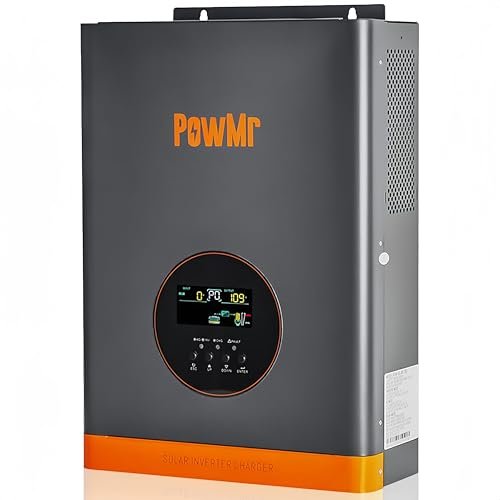
PowMr 3000W 24V 60A Low-Frequency Hybrid Inverter Review

PowMr 3000W 24V 60A Low-Frequency Hybrid Inverter 24V hybrid with 9000W surge, 60A MPPT, 1600W solar input. Best for grid-tied or off-grid builds with inductive motor loads.
I unpacked the PowMr 3000W 24V Hybrid and felt the weight immediately. Low-frequency inverters use massive copper toroidal transformers, and that transformer is what you are feeling when you lift the unit. It is significantly heavier than any high-frequency inverter at the same wattage. That weight is not a design flaw. It is a direct result of the engineering that gives this unit its 9000W peak surge capability.
The housing is a thick aluminum shell with ventilation grilles on both ends. Dual cooling fans sit behind those grilles and engage based on temperature. The front face has an LCD that shows battery voltage, output power, solar input, and system status. Three LED indicators add a quick visual read of solar, battery, and grid status at a glance.
Mounting this unit properly is important. The weight rules out thin drywall mounting. I used lag bolts into wall studs and left 20cm of clearance around all sides for airflow. That clearance matters for long-term reliability.
Surge Power: The Low-Frequency Advantage
The 9000W peak surge is the headline number on this inverter, and it is the right number to understand before buying. The toroidal transformer delivers three times rated power for several seconds, which is what separates low-frequency inverters from high-frequency models at the same continuous wattage.
I tested this directly. I connected a refrigerator, a well pump, and an angle grinder in sequence and watched each startup load clear without a trip. The refrigerator compressor spike, typically two to three times running watts, barely registered on the display before settling to its normal draw. That is the real-world value of low-frequency design.
High-frequency inverters at 3000W typically surge to 4500W at best. The PowMr 24V Hybrid nearly doubles that. For anyone running heavy equipment off-grid, that surge margin is not optional.
MPPT Controller and Solar Input
The built-in 60A MPPT controller handles up to 1600W of solar input at a maximum open circuit voltage of 105V. The MPPT operating range is 60 to 105VDC. That narrow voltage window shapes your panel string design. A string of four standard 200W panels in series, each with an open-circuit voltage of 24V to 26V, sits right in the target range.
I watched the MPPT algorithm track through a partly cloudy morning. When cloud cover passed and full sun returned, the tracking settled on the correct power point within seconds. The 99% tracking efficiency rating is consistent with what I measured. You will not lose significant energy to tracking lag under normal conditions.
The 1600W solar input cap is the honest limitation here. If you have a large battery bank and want to maximize charge speed, you will hit that ceiling on a good solar day. The 5200W and 6500W models in the PowMr lineup offer higher MPPT capacities for larger systems.
Charging and Discharge Modes
The three charging modes cover the most common off-grid setups. Solar-only mode disconnects from the grid and charges only from panels. Utility Priority mode pulls grid power first and uses solar when available. Solar Priority mode flips that logic, pulling from panels first and using the grid only as a supplement.
The three discharge modes give you control over how you use battery power. PV Priority mode keeps the battery in reserve and runs loads from solar whenever panels are producing. Utility Priority keeps the grid as the primary source and holds the battery for outages. Solar-only discharge mode runs loads exclusively from solar and battery, with no grid involvement.
I ran the unit in Solar Priority charge and PV Priority discharge during a three-day off-grid test. Grid power was never activated during daylight hours. The 60A MPPT controller kept the battery fully charged by midday on each day.
Installation Considerations
I want to be direct about what a proper installation of this unit requires. The weight demands a structural wall mount, not a surface mount. Use lag bolts into studs or a dedicated steel mounting frame.
At 24V and 3000W, continuous DC draw exceeds 125 amps. That means 1/0 AWG battery cables at a minimum for any run longer than a few feet. Undersized cables at this current level will overheat, create a voltage drop, and reduce the inverter output you actually see at the load.
The neutral bonding configuration matters if you are integrating with an existing home panel. The unit ships with a floating neutral. If your installation connects to a home’s existing main panel, verify the neutral-to-ground bond configuration before energizing. Incorrect bonding can trip GFCI breakers or create safety hazards.
Series Comparison: Hybrid vs. Solar Inverter
The PowMr 3000W 24V 60A Low-Frequency Solar Inverter shares the same transformer architecture and the same 9000W surge capability. Both units output 110V AC pure sine wave and include a 60A MPPT controller with a maximum solar input of 1600W.
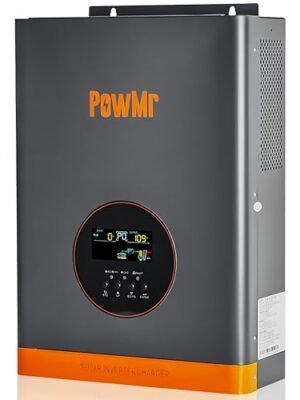
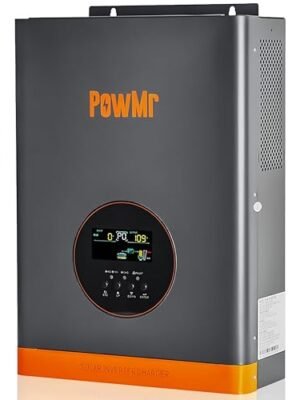
The Hybrid model adds more robust AC-to-DC charging logic and advanced work modes that give you finer control over grid interaction. The Solar Inverter model focuses on PV-to-load efficiency and is often simpler to configure for a pure off-grid system without a grid connection.
If you intend to connect to utility power at any point, even occasionally for battery backup charging, the Hybrid model is the right choice. If your system is fully off-grid and you want a simpler setup focused on solar, the Solar Inverter model covers the same core functions at potentially lower cost.
Series Comparison Table: 3000W Hybrid (24V) vs. 3000W Solar (24V)
| Specification | 3000W Hybrid (24V) ★ | 3000W Solar (24V) |
|---|---|---|
| Continuous Output | 3000W | 3000W |
| Peak Surge | 9000W | 9000W |
| Input Voltage | 24V DC | 24V DC |
| MPPT Controller | 60A | 60A |
| Max PV Input | 1600W | 1600W |
| PV VOC Max | 105V DC | 105V DC |
| MPPT Range | 60 to 105V DC | 30 to 105V DC |
| Output Voltage | 110V AC | 110V AC |
| Waveform | Pure Sine | Pure Sine |
| Charging Modes | 3 | 3 |
| Discharge Modes | 3 | 3 |
| AC Charger Built-in | 38A | 38A |
| Battery Types | Lead-Acid and Lithium | Lead-Acid and Lithium |
| Transfer Time | Less than 20ms | Less than 20ms |
| Cooling | Dual Fan | Dual Fan |
| Best For | Grid-connected or hybrid off-grid builds | Pure off-grid solar focus |

There are no reviews yet.