
POWLAND 12000W Split Phase Inverter Review

The POWLAND 12000W Split Phase Solar Hybrid Inverter is a 48V unit built for homeowners and off-grid installers who need maximum continuous power, native 120V/240V split-phase output, and UL1741 certification in a single enclosure. With a built-in 200A MPPT controller, battery-free PV-to-AC conversion, and parallel stacking for up to 72kW, it is designed as a permanent whole-home power solution rather than a backup or supplemental device. This is the heavy lifter in the POWLAND lineup.
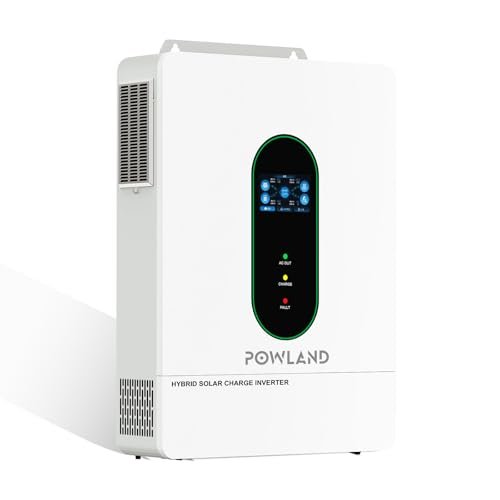
I installed the POWLAND 12000W Split Phase on a wall bracket in a utility room. The IP65 casing is the same sealed aluminum enclosure as the WiFi model. The front panel carries the LCD and the tri-color LED indicator array: green for normal operation, yellow for advisory conditions, and red for faults. The LED visibility from across a room means you can check system status at a glance without walking to the unit.
The pre-wired connections for 550W to 700W solar panels are a useful installation convenience. Most modern high-efficiency residential panels fall in that wattage range, so the factory configuration supports typical installations without modification.
Build quality is consistent with the rest of the high-wattage POWLAND lineup. The DC terminal block is clearly labeled and accepts large-gauge cable appropriate for 200A charge currents. I used a calibrated torque wrench on every terminal connection before testing, because at this current level, terminal resistance is a safety issue, not a nuisance.
UL1741 certification means this inverter meets the anti-islanding standard required for permitted grid-tied installation in most US jurisdictions. When the utility grid goes down, the inverter stops producing AC output to the home circuits automatically. This protects utility workers who may be working on the grid during the outage.
Split-Phase 240V Output
The 12kW split-phase output is the core reason to choose this model over a 120V-only inverter. In the United States, the standard residential electrical service is split-phase: two 120V legs that combine to deliver 240V for heavy appliances. Well pumps, electric dryers, and central air conditioning systems all require 240V. Running those loads from an inverter that delivers only 120V requires either stacking two units or using an external autotransformer, both of which add cost and complexity.
I measured both output legs during testing. Each leg held 120V to neutral under asymmetric loading without a significant voltage imbalance. The 240V between L1 and L2 was within specification across the load range I tested, from 2kW to 10kW total output.
For a complete home installation, native split-phase output means the inverter connects directly to a standard residential sub-panel without additional conversion hardware. That simplicity reduces installation cost and eliminates an additional failure point.
MPPT Performance and Low-Light Harvesting
The 200A MPPT controller handles input from 90V to 500V DC. The 500V ceiling allows longer panel strings in series, which lowers current on the PV wire runs and permits thinner wire gauge over long distances. For a ground-mounted array located 100 feet or more from the inverter, this is a meaningful wiring cost reduction.
The 99.9% efficiency and wide voltage window extend the productive hours of a solar day. I monitored PV output from shortly after sunrise on a clear day. The controller was producing useful power at a panel voltage that would have been below the activation threshold of a lower-voltage MPPT controller. Those additional morning and evening production minutes add up over the course of a year.
Anti-reverse loss protection prevents current from flowing backward through the MPPT input at night, protecting the panels and controller without requiring external blocking diodes.
Battery-Free Mode
Battery-free operation lets you connect this inverter directly to a solar array and power home loads without a battery bank. During daylight hours with sufficient panel output, the inverter converts PV power directly to AC. This mode can reduce battery bank costs by up to 40% for buyers who start with solar-only daytime bill reduction and add storage later.
The consequence of anti-islanding in battery-free mode is that grid outages leave you without power, even if the sun is shining. A battery bank, properly sized, resolves this: the inverter switches to battery backup mode and continues powering home loads through the outage. Without a battery, this unit is a bill-reduction tool, not a blackout protection device.
Parallel Expansion and Scale
Six units in a parallel stack produce 72kW of continuous output, a capacity that covers large agricultural properties, small commercial buildings, and multi-family residential systems. Each unit shares the same battery bank and operates in phase synchronization using POWLAND’s proprietary sync technology.
For a single-home buyer, the 72kW ceiling is primarily a future-planning consideration. Starting with one unit today and expanding later avoids the need to replace the base inverter as loads grow. Each additional unit adds 12kW of capacity to the stack.
Professional installation is strongly recommended for any multi-unit parallel configuration. The AC distribution, phase synchronization wiring, and battery bank balancing at 72kW require qualified electrical work and, in most jurisdictions, a permit.
Potential Point of Failure
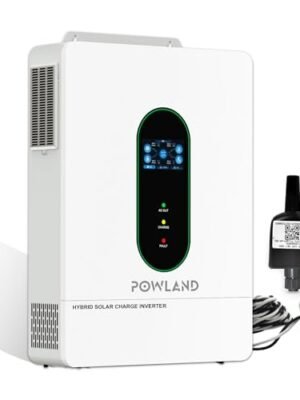
The absence of built-in WiFi means that monitoring this unit requires physical presence or the addition of a separate WiFi module. For installations in accessible locations like a garage or a utility room, the LCD and LED indicators are sufficient for routine status checks. For installations in a remote equipment room or a locked utility shed, the optional WiFi module is worth the additional cost.
Sustained 12kW output at 48V requires a battery bank capable of delivering over 250 amps continuously without tripping the BMS. A 400Ah lithium bank is a practical minimum for full-load operation with any meaningful runtime. For extended high-load scenarios, 600Ah or more provides comfortable headroom. Undersizing the battery bank will produce BMS trips under heavy load, which is not a product failure but an installation planning failure.
POWLAND Lineup Comparison
| Spec | 12000W Split Phase ★ | 3600W 48V | 4000W Hybrid 24V | 4000W Std 24V | 6500W 48V | 10000W 48V | 12000W Hybrid WiFi |
|---|---|---|---|---|---|---|---|
| Continuous Output | 12,000W | 3600W | 4000W | 4000W | 6500W | 10,000W | 12,000W |
| DC Input Voltage | 48V | 48V | 24V | 24V | 48V | 48V | 48V |
| AC Output Voltage | 120/240V | 110/120V | 120V | 110/120V | 120/240V | 120/240V | 120/240V |
| Split Phase (240V) | Yes | No | No | No | Yes | Yes | Yes |
| MPPT Controller | 200A | 80A | 140A | 60A | 120A | 250A | 200A |
| Max PV Input (Solar) | 4500W | 5600W | 1600W | ||||
| Max PV Voltage (OCV) | 500V DC | 300V DC | 350V DC | 108V DC | 300V DC | 485V DC | 500V DC |
| MPPT Voltage Range | 90–500V DC | 90–260V DC | 30–90V DC | 90–260V DC | 90–485V DC | 90–500V DC | |
| MPPT Efficiency | 99.9% | 99% | 98% | 99.9% | 99.9% | 99.9% | |
| Peak Surge | 8000W | ||||||
| Battery Voltage | 48V | 48V | 24V | 24V | 48V | 48V | 48V |
| Battery Types | LiFePO4 + LA | LA + Lithium | LiFePO4, LA, AGM | LA, Li, LiFePO4 | LA + LiFePO4 | LiFePO4 + LA | LiFePO4 + LA |
| Battery-Free Mode | Yes | No | Yes | Yes | No | Yes | Yes |
| Charging Modes | Hybrid | 4 | Hybrid mgmt | 4 | Grid+Load mode | Hybrid | Hybrid |
| Output Modes | Auto | 2 | Auto priority | 4 | Single+Split | Auto | Auto |
| Time Scheduling | No | No | No | Yes | No | No | No |
| Grid-Tied / Anti-backflow | Yes (CT) | No | No | No | Yes (CT sensor) | Yes (CT) | Yes (CT) |
| UL1741 Certified | Yes | No | No | No | No | Yes | Yes |
| WiFi Monitoring | Optional add-on | Port (extra) | No | No | Port (extra) | Built-in | Built-in |
| App Monitoring | With add-on | With adapter | No | No | With adapter | Yes | Yes |
| Parallel Stacking | Up to 6 (72kW) | No | No | No | Up to 6 (39kW) | Up to 6 (60kW) | Up to 6 (72kW) |
| Display | LCD + tri LED | LCD + 3 LED | 6.25" Glass LCD | LCD + 3 LED | LCD | LCD + LED | LCD + LED |
| IP Rating | IP65 | IP65 | IP65 | ||||
| Fan Noise | 45dB | 45dB | 45dB | ||||
| Fan Activation Temp | 104°F (40°C) | ||||||
| ECO Mode | Yes | No | No | No | No | Yes | Yes |
| Best Use Case | Off-grid home | Small cabin/RV | Van/tiny home | Home/RV budget | Growing home | Large home | Large home+WiFi |
Use Case Recommendation
Choose the POWLAND 12000W Split Phase for a complete off-grid home system with heavy 240V loads like well pumps, electric dryers, and large air conditioners, or for a large grid-tied installation where app monitoring is not a priority. The UL1741 certification, 500V MPPT input, IP65 casing, and 72kW expandability make it a serious long-term power platform. If built-in WiFi and app monitoring are important to you, choose the 12kW WiFi model instead. If your peak load stays below 10kW, the 10kW model with its 250A MPPT controller is a more precisely matched choice at a lower price point.

There are no reviews yet.