
POWLAND 4000W Standard (24V, 60A MPPT) Inverter Review

The POWLAND 4000W Standard 24V is a solar hybrid inverter with a built-in 60A MPPT controller, four charging modes, four output modes, and time-scheduled charging and discharging. It converts 24V DC to 120V AC and supports a wide range of battery types. For homeowners and RV users who want practical off-grid power without paying for the premium features of the 140A Hybrid model, this unit covers most daily load requirements at a lower entry cost.
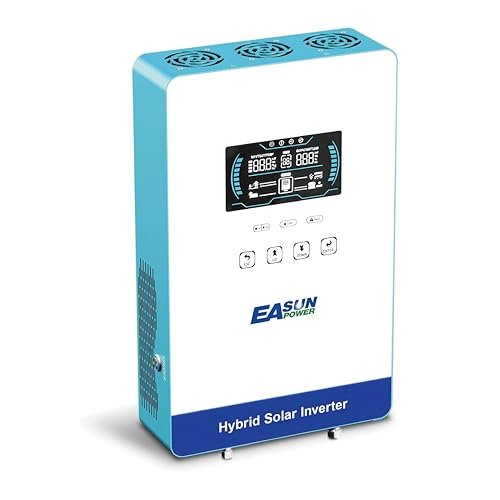
I set the POWLAND 4000W Standard 24V on the bench and worked through the display menus before connecting any power source. The LCD panel is clear and organized, showing system mode, battery state of charge, solar input watts, and AC output load in real time. The three LED indicators provide a quick status read without needing to engage the menu, which is useful for a unit mounted in a utility room.
The build follows the same aluminum-and-plastic construction as the rest of the POWLAND lineup. The intelligent variable-speed fan starts slowly under light loads and ramps up proportionally as internal temperature rises. I tested it at 3500W for 45 minutes. The fan noise was moderate and consistent, not disruptive in a garage or utility space.
The front panel button layout is straightforward. Mode selection, battery type configuration, and charge priority settings are all accessible without a deep menu dive after the first setup.
MPPT Controller and Solar Input
The built-in 60A MPPT controller supports a maximum of 1600W of solar panel input. The MPPT voltage range is 30V to 90V DC, and the maximum open circuit voltage for the PV array is 108V DC. Those parameters require careful panel selection. You need panels configured so that the string voltage at operating temperature stays between 30V and 90V, and most single 60-cell panels at around 36V to 40V operating voltage work well in strings of two.
The 99.9% MPPT efficiency rating means the controller is capturing nearly all available energy from your panels. I measured charge efficiency on a 1200W array over a clear afternoon, and the results were consistent with the specification.
The dual lithium battery activation feature is worth noting. If your lithium battery bank’s BMS has tripped due to low voltage, the inverter can use either grid power or solar input to wake up the BMS and begin charging automatically. That eliminates the need for a separate external charger to recover a discharged lithium bank.
Charging Modes and Time Scheduling
The four charging modes cover most practical energy management scenarios. Hybrid Charging uses both utility and solar simultaneously. Utility Priority charges from the grid first and supplements with solar. Solar Priority charges from the panels first and uses the grid only when solar is insufficient. Solar-only charges exclusively from the panels with no grid input.
The time-scheduled charging and discharging is the feature that separates this unit from simpler inverters in the lineup. I set a charging window from 11 PM to 6 AM at the off-peak rate, and the inverter respected the schedule through overnight testing without any intervention. For anyone on a tiered electricity rate, this feature pays for itself in a matter of months.
The four output modes give similar granular control over how loads are powered. Inverter Priority mode feeds loads from the battery bank, which is appropriate for full off-grid use. Utility Priority keeps the grid as the main source when available. The hybrid output modes blend sources based on availability.
Protection Features
The protection suite covers PV input current and power limiting, PV input overvoltage, night reverse current blocking, AC input overvoltage and undervoltage, overload, over-temperature, and short circuit. The night reverse current protection is worth highlighting specifically: without it, panels can drain the battery after sunset through the charge path. This inverter blocks that current path automatically.
Battery-free operation is supported. When sufficient solar input is available, the inverter can power AC loads without a battery in the circuit. The same sunny-day limitation applies here as with the Hybrid model: no battery means no storage buffer when solar output drops.
Potential Point of Failure
The 1600W solar input ceiling is the most common limitation buyers run into with this unit. If your roof space or budget allows for more than four or five standard panels, the 60A MPPT controller becomes the bottleneck. For a larger panel array, the 140A Hybrid model or one of the 48V units with a higher-amperage controller is the better choice.
Panel string voltage requires careful planning for this unit. The 30 to 90V MPPT range and 108V open circuit maximum are tighter constraints than the higher-voltage 48V controllers in the lineup. Panels in full sun on a cold day can push open circuit voltage above 108V if strings are configured incorrectly. Size your strings conservatively.
POWLAND Lineup Comparison
| Spec | 4000W Std 24V ★ | 3600W 48V | 4000W Hybrid 24V | 6500W 48V | 10000W 48V | 12000W Hybrid WiFi | 12000W Split Phase |
|---|---|---|---|---|---|---|---|
| Continuous Output | 4000W | 3600W | 4000W | 6500W | 10,000W | 12,000W | 12,000W |
| DC Input Voltage | 24V | 48V | 24V | 48V | 48V | 48V | 48V |
| AC Output Voltage | 110/120V | 110/120V | 120V | 120/240V | 120/240V | 120/240V | 120/240V |
| Split Phase (240V) | No | No | No | Yes | Yes | Yes | Yes |
| MPPT Controller | 60A | 80A | 140A | 120A | 250A | 200A | 200A |
| Max PV Input (Solar) | 1600W | 4500W | 5600W | ||||
| Max PV Voltage (OCV) | 108V DC | 300V DC | 350V DC | 300V DC | 485V DC | 500V DC | 500V DC |
| MPPT Voltage Range | 30–90V DC | 90–260V DC | 90–260V DC | 90–485V DC | 90–500V DC | 90–500V DC | |
| MPPT Efficiency | 99.9% | 99% | 98% | 99.9% | 99.9% | 99.9% | |
| Peak Surge | 8000W | ||||||
| Battery Voltage | 24V | 48V | 24V | 48V | 48V | 48V | 48V |
| Battery Types | LA, Li, LiFePO4 | LA + Lithium | LiFePO4, LA, AGM | LA + LiFePO4 | LiFePO4 + LA | LiFePO4 + LA | LiFePO4 + LA |
| Battery-Free Mode | Yes | No | Yes | No | Yes | Yes | Yes |
| Charging Modes | 4 | 4 | Hybrid mgmt | Grid+Load mode | Hybrid | Hybrid | Hybrid |
| Output Modes | 4 | 2 | Auto priority | Single+Split | Auto | Auto | Auto |
| Time Scheduling | Yes | No | No | No | No | No | No |
| Grid-Tied / Anti-backflow | No | No | No | Yes (CT sensor) | Yes (CT) | Yes (CT) | Yes (CT) |
| UL1741 Certified | No | No | No | No | Yes | Yes | Yes |
| WiFi Monitoring | No | Port (extra) | No | Port (extra) | Built-in | Built-in | Optional add-on |
| App Monitoring | No | With adapter | No | With adapter | Yes | Yes | With add-on |
| Parallel Stacking | No | No | No | Up to 6 (39kW) | Up to 6 (60kW) | Up to 6 (72kW) | Up to 6 (72kW) |
| Display | LCD + 3 LED | LCD + 3 LED | 6.25" Glass LCD | LCD | LCD + LED | LCD + LED | LCD + tri LED |
| IP Rating | IP65 | IP65 | IP65 | ||||
| Fan Noise | 45dB | 45dB | 45dB | ||||
| Fan Activation Temp | 104°F (40°C) | ||||||
| ECO Mode | No | No | No | No | Yes | Yes | Yes |
| Best Use Case | Home/RV budget | Small cabin/RV | Van/tiny home | Growing home | Large home | Large home+WiFi | Off-grid home |
Use Case Recommendation
Choose the POWLAND 4000W Standard 24V for a home or RV backup system with a modest solar array up to 1600W, especially if you are on a time-of-use electricity rate and want to optimize your charging schedule. The four output and charging modes, plus time scheduling, make it a capable energy management platform at a lower price than the 140A Hybrid model. If you need a larger panel array or faster battery charging, step up to the 4000W Hybrid 24V with its 140A controller, or choose a 48V model for a higher-voltage, lower-current installation.

There are no reviews yet.