
POWLAND 4000W (24V, 140A MPPT) Inverter Review

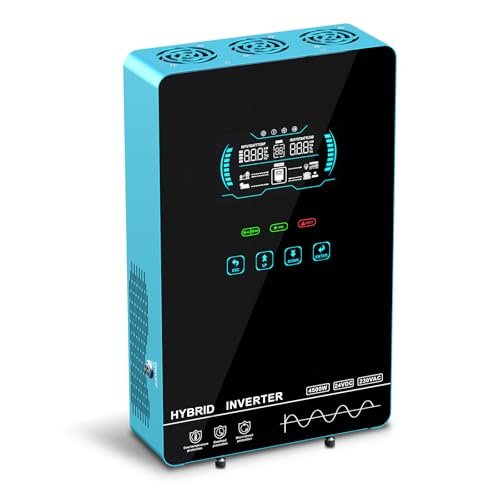
The POWLAND 4000W Hybrid 24V is a solar hybrid inverter that pairs a 4000W pure sine wave output with a 140A MPPT charge controller and a 6.25-inch tempered glass touchscreen display. It runs on a 24V DC input and supports battery-less operation in direct sunlight, making it a flexible platform for van builds, small homes, and off-grid setups where both aesthetics and charging speed matter.
I unboxed the POWLAND 4000W Hybrid 24V and immediately noticed the glass top display. On most inverters at this price point, the LCD panel is protected by a plastic lens that collects scratches over a season of use. The 6.25-inch tempered glass lens on this unit is a durability upgrade that matters in an RV or garage install where the panel may be at eye level and exposed to regular handling.
The touch buttons respond cleanly through the glass. I navigated through the menu system to set charging priorities, adjust battery voltage parameters, and verify the MPPT configuration without referring to the manual after the first pass. The display shows power output, battery status, solar input, and system mode in real time.
Three cooling fans sit behind recessed grilles. The fans run at variable speed based on load and internal temperature. Under light loads in testing, the unit ran quietly. Under sustained 3000W draw, the fans ramped up to a moderate level, nothing unusual for this wattage.
MPPT Controller and Solar Input
The 140A MPPT controller is the standout spec on this unit. At 24V and 140 amps, the controller can handle up to 5600W of solar panel input at 98% efficiency. That is a large controller for a 4000W inverter, and it means you can wire a substantial panel array without needing a separate charge controller.
The 98% MPPT efficiency rating means that in real-world conditions, very little energy is lost between your panels and your battery. I ran a 3600W panel array through this controller on a clear afternoon, and the charge rate matched expectations closely. The algorithm settled at the maximum power point within seconds of a change in cloud cover.
The maximum PV open circuit voltage supports up to 350V DC. That allows for longer panel strings in series, which is useful when panels are mounted at a distance from the inverter. Longer strings at higher voltage carry less current, which means a smaller wire gauge on the PV run.
Battery-Less Solar Operation
The battery-less mode is one of the more practical features on this unit for buyers who are starting their solar journey without a full battery bank. When sufficient sunlight is available, the inverter can power AC loads directly from the solar panels without a battery in the circuit. I tested this on a clear afternoon with three 370W panels and was able to run a 1200W load cleanly.
Battery-less operation has one important limitation: the moment cloud cover reduces panel output below your load demand, the inverter cannot buffer the difference. Loads will drop or shut off. For stable battery-less operation, you need a sunny day and a load that stays well below your panel’s output capacity.
For most buyers, battery-less mode is a starting point, not a permanent solution. It lets you power daytime loads while you save for a battery bank.
Hybrid Energy Management
The hybrid energy management system prioritizes solar first, then battery, then grid, depending on availability and your configured mode. I found the logic straightforward to configure through the display menus. The system handled transitions between power sources smoothly during testing, with the AC output staying stable when I switched between solar and battery power.
The automatic battery voltage recognition simplifies installation for users who are new to battery banks. The inverter reads the battery voltage at startup and configures its charging parameters accordingly, reducing the risk of charging errors on a new system.
The one-touch reset feature is a small but practical addition. After a fault event, recovery requires pressing a single button rather than cycling power through the DC terminals.
Potential Point of Failure
The 24V platform is the primary installation constraint at 4000W. At full output, this inverter draws approximately 167 amps from the battery bank. Cable sizing for 24V at that current requires 2/0 AWG or heavier for most practical run lengths. Undersized DC cables create resistance, heat, and voltage drop that trigger undervoltage shutdowns under load. Plan your cable run and terminal hardware before installation day.
Battery-less operation carries a risk that bears repeating: the inverter has no buffer when solar output drops suddenly. Running sensitive loads that cannot tolerate a brief power interruption in battery-less mode is not advisable. Use a battery for loads that need continuous power.
POWLAND Lineup Comparison
| Spec | 4000W Hybrid 24V ★ | 3600W 48V | 4000W Std 24V | 6500W 48V | 10000W 48V | 12000W Hybrid WiFi | 12000W Split Phase |
|---|---|---|---|---|---|---|---|
| Continuous Output | 4000W | 3600W | 4000W | 6500W | 10,000W | 12,000W | 12,000W |
| DC Input Voltage | 24V | 48V | 24V | 48V | 48V | 48V | 48V |
| AC Output Voltage | 120V | 110/120V | 110/120V | 120/240V | 120/240V | 120/240V | 120/240V |
| Split Phase (240V) | No | No | No | Yes | Yes | Yes | Yes |
| MPPT Controller | 140A | 80A | 60A | 120A | 250A | 200A | 200A |
| Max PV Input (Solar) | 5600W | 4500W | 1600W | ||||
| Max PV Voltage (OCV) | 350V DC | 300V DC | 108V DC | 300V DC | 485V DC | 500V DC | 500V DC |
| MPPT Voltage Range | 90–260V DC | 30–90V DC | 90–260V DC | 90–485V DC | 90–500V DC | 90–500V DC | |
| MPPT Efficiency | 98% | 99% | 99.9% | 99.9% | 99.9% | 99.9% | |
| Peak Surge | 8000W | ||||||
| Battery Voltage | 24V | 48V | 24V | 48V | 48V | 48V | 48V |
| Battery Types | LiFePO4, LA, AGM | LA + Lithium | LA, Li, LiFePO4 | LA + LiFePO4 | LiFePO4 + LA | LiFePO4 + LA | LiFePO4 + LA |
| Battery-Free Mode | Yes | No | Yes | No | Yes | Yes | Yes |
| Charging Modes | Hybrid mgmt | 4 | 4 | Grid+Load mode | Hybrid | Hybrid | Hybrid |
| Output Modes | Auto priority | 2 | 4 | Single+Split | Auto | Auto | Auto |
| Time Scheduling | No | No | Yes | No | No | No | No |
| Grid-Tied / Anti-backflow | No | No | No | Yes (CT sensor) | Yes (CT) | Yes (CT) | Yes (CT) |
| UL1741 Certified | No | No | No | No | Yes | Yes | Yes |
| WiFi Monitoring | No | Port (extra) | No | Port (extra) | Built-in | Built-in | Optional add-on |
| App Monitoring | No | With adapter | No | With adapter | Yes | Yes | With add-on |
| Parallel Stacking | No | No | No | Up to 6 (39kW) | Up to 6 (60kW) | Up to 6 (72kW) | Up to 6 (72kW) |
| Display | 6.25" Glass LCD | LCD + 3 LED | LCD + 3 LED | LCD | LCD + LED | LCD + LED | LCD + tri LED |
| IP Rating | IP65 | IP65 | IP65 | ||||
| Fan Noise | 45dB | 45dB | 45dB | ||||
| Fan Activation Temp | 104°F (40°C) | ||||||
| ECO Mode | No | No | No | No | Yes | Yes | Yes |
| Best Use Case | Van/tiny home | Small cabin/RV | Home/RV budget | Growing home | Large home | Large home+WiFi | Off-grid home |
Use Case Recommendation
Choose the POWLAND 4000W Hybrid 24V if you are on a 24V battery system and want the fastest solar charging available at this wattage tier. The 140A MPPT controller and battery-less operation make it the most flexible entry in the 4000W range. It is especially well-suited for van builds or modern tiny homes where the inverter is in a visible location, and the glass display is a practical durability upgrade. If you are building from scratch and can choose battery voltage, the 48V models offer lower DC for the same wattage, which simplifies cable sizing.

There are no reviews yet.